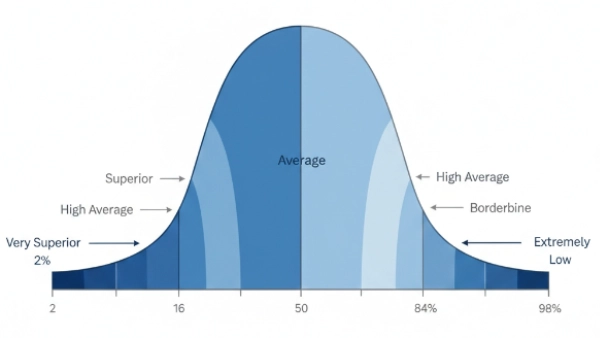
Intelligence does not remain static throughout life. Cognitive abilities develop rapidly in childhood, stabilize in adulthood, and may gradually change in later years. Because of this, IQ scores are always interpreted relative to age, not across the entire population at once.
This article explains how average IQ works by age, why age-based norms exist, and how to correctly interpret intelligence scores across different life stages. Before diving in, you may want to review how IQ scores are calculated to understand the statistical foundation behind these numbers.
Understanding Age-Normed IQ Scores
IQ tests are age-normed, meaning each person’s performance is compared only to others within the same age group. A 10-year-old is not compared to a 30-year-old, and a 70-year-old is not compared to a teenager.
This approach exists because:
- Cognitive abilities develop unevenly across the lifespan
- Certain skills peak earlier than others
- Processing speed and memory change with age
As a result, the average IQ score for every age group is set at 100.
This does not mean that intelligence stops developing or declines sharply at certain ages. Instead, it means that IQ reflects relative standing among peers, not absolute brain power.
Why the Average IQ Is Always 100
Modern IQ tests are norm-referenced. Test developers collect data from large, representative samples within each age bracket and adjust scores so that:
- The mean (average) score is 100
- The standard deviation is typically 15
- Scores follow a bell-shaped distribution
This ensures fairness and comparability across age groups. If raw scores were compared directly, adults would always outperform children simply due to experience and brain development.
By age-normalizing results, IQ scores answer a specific question. To see the full picture of how these standardized scores are built, read how IQ tests are designed and standardized.
How does this person perform compared to others of the same age?
Average IQ by Age Group
| Age Group | Avg. Raw Score Trend | IQ Score (Age-Normed) | Key Cognitive Trait |
| 4 – 6 | Low, high variability | ~100 (peer-relative) | Foundational skills |
| 7 – 12 | Steadily increasing | ~100 (peer-relative) | Logical reasoning emerges |
| 13 – 18 | Rapid growth | ~100 (peer-relative) | Abstract thinking develops |
| 18 – 29 | Peak fluid performance | ~100 (peer-relative) | Processing speed peaks |
| 30 – 59 | Stable overall | ~100 (peer-relative) | Crystallized knowledge grows |
| 60+ | Gradual slowing | ~100 (peer-relative) | Wisdom and experience |
ℹ️ All IQ scores are age-normed — the average is always 100 within each group. See our IQ Score Chart for absolute range interpretations.
Although the average IQ score is set at 100 for every age group, the abilities being measured change significantly across the lifespan. This is because intelligence develops, adapts, and expresses itself differently at each stage of life. IQ testing accounts for these changes by comparing individuals only to others of the same age, rather than across generations.
Understanding how cognitive abilities evolve over time helps clarify why an IQ score must always be interpreted within an age-based context.
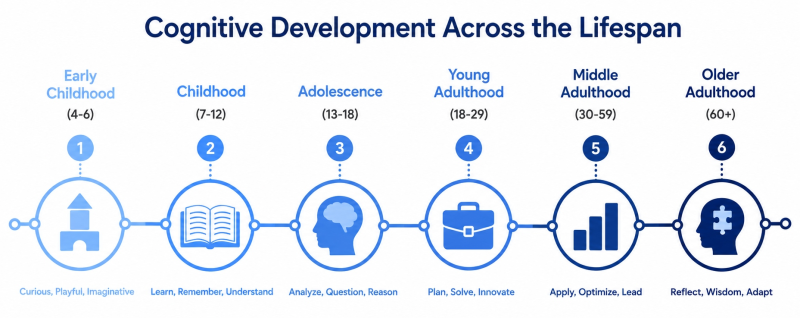
Early Childhood (Ages 4–6)
In early childhood, cognitive development is rapid but uneven. IQ tests at this stage focus on foundational mental skills rather than advanced reasoning.
Commonly assessed abilities include:
- Basic cause-and-effect reasoning
- Early vocabulary acquisition and word comprehension
- Recognition of visual and spatial patterns
- Simple memory and attention tasks
At this age, IQ scores tend to be highly variable. Small differences in environment, language exposure, and early education can lead to noticeable score fluctuations. Because of this, early childhood IQ is less predictive of long-term intellectual outcomes.
With supportive learning environments, cognitive abilities can accelerate quickly, often leading to significant changes in measured intelligence within just a few years.
Childhood (Ages 7–12)
During middle childhood, cognitive skills become more organized and consistent. Children begin applying reasoning skills more deliberately, and learning becomes increasingly structured.
IQ tests in this age range place greater emphasis on:
- Logical reasoning and problem-solving
- Reading comprehension and language usage
- Working memory and attention control
- Visual-spatial processing
While IQ scores start to stabilize, they remain strongly influenced by educational quality, home environment, and learning opportunities. Children with access to supportive instruction and consistent practice often show steady gains in performance.
At this stage, IQ reflects both innate reasoning ability and the effectiveness of early learning experiences.
Adolescence (Ages 13–18)
Adolescence marks a major shift toward higher-order thinking. The brain develops increased capacity for abstraction, planning, and complex reasoning.
Key cognitive abilities that mature during this period include:
- Hypothetical and abstract thinking
- Multi-step problem-solving
- Faster information processing
- Advanced verbal reasoning and comprehension
IQ scores during adolescence tend to become more stable and more predictive of adult cognitive patterns. However, emotional development, motivation, and stress can still influence test performance.
This stage often reveals emerging strengths in specific domains such as verbal reasoning, mathematical logic, or spatial thinking. For a broader view of how intelligence develops from childhood through adulthood, see our guide on how intelligence develops across the lifespan.
Young Adulthood (Ages 18–29)
Young adulthood is commonly associated with peak performance in many cognitive domains, particularly those involving speed and mental flexibility.
Typical strengths in this age range include:
- Rapid processing speed
- Strong working memory capacity
- Efficient learning of unfamiliar material
- High adaptability to new problem types
IQ scores measured during this period are considered highly reliable and are often used as a reference point for adult intelligence norms. Many standardized assessments are calibrated using performance data from this age group.
This stage represents a balance between cognitive efficiency and accumulated knowledge. For more on when cognitive performance typically reaches its highest point, read at what age does intelligence peak.
Middle Adulthood (Ages 30–59)
In middle adulthood, intelligence becomes more specialized and experience-driven. While certain speed-based abilities may gradually slow, knowledge-based skills often strengthen.
Common cognitive patterns include:
- Stable or increasing verbal knowledge
- Strong comprehension and reasoning in familiar domains
- Extensive accumulated experience and expertise
- Gradual slowing in processing speed or short-term recall
Despite these changes, overall IQ scores typically remain stable. Gains in experience and conceptual understanding often compensate for slower processing, maintaining relative performance compared to peers.
This stage highlights the role of applied intelligence and strategic thinking. Research on whether cognitive skills can improve with age shows that deliberate mental engagement plays a major role in maintaining performance during this period.
Older Adulthood (Ages 60+)
In later adulthood, cognitive changes tend to occur gradually rather than abruptly. Aging affects different mental abilities in different ways.
Typical trends include:
- Slower processing speed
- Reduced efficiency in short-term memory
- Strong preservation of verbal knowledge
- Well-developed crystallized intelligence
Because IQ tests are age-normed, a healthy older adult can still score around 100, indicating average performance relative to others in the same age group. Declines in speed do not equate to loss of intelligence.
Experience, judgment, and knowledge often remain strong well into older age.
Fluid vs. Crystallized Intelligence Across Age
A key framework for understanding age-related cognitive change is the distinction between fluid and crystallized intelligence.
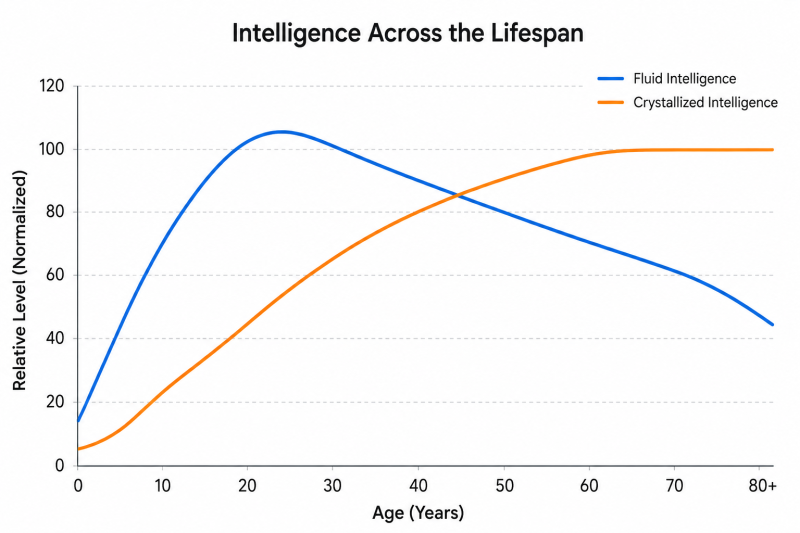
Fluid Intelligence
Fluid intelligence refers to the ability to solve novel problems without relying on prior knowledge.
It includes:
- Reasoning speed
- Pattern recognition
- Logical problem-solving in unfamiliar situations
Fluid intelligence typically peaks in early adulthood and gradually declines over time, largely due to changes in processing speed and working memory. For a deeper explanation of this distinction, see our dedicated guide on fluid intelligence vs crystallized intelligence.
Crystallized Intelligence
Crystallized intelligence represents knowledge accumulated through learning and experience.
It includes:
- Vocabulary and language mastery
- General knowledge
- Skills developed over time
Crystallized intelligence often improves or remains stable throughout adulthood, compensating for changes in fluid abilities. This balance explains why overall IQ scores tend to remain stable across much of the lifespan.
Why Raw Scores Change but IQ Scores Stay Stable
Raw test scores reflect how many questions a person answers correctly. These scores naturally change with age.
However, IQ scores are adjusted to reflect what is typical for each age group.
For example:
- A child may answer fewer questions correctly than an adult yet still score 100
- An older adult may respond more slowly yet still score 100
IQ is designed to measure relative cognitive standing, not absolute speed or total knowledge.
Are IQ Scores More Reliable at Certain Ages?
The reliability of IQ scores increases with age.
- Before age 7: Scores can fluctuate widely
- Ages 8–12: Reliability improves, but environment remains influential
- Adolescence and adulthood: Scores are generally stable
Even at stable ages, IQ should never be treated as a fixed limit on intellectual potential.
Factors That Influence IQ Scores at Any Age
Regardless of age, IQ scores can be affected by multiple factors, including:
- Quality of education
- Nutrition and physical health
- Sleep, stress, and emotional state
- Familiarity with test formats
- Motivation and attention during testing
These influences reinforce the idea that IQ represents a range of performance, not a permanent or absolute trait. Our guide on how lifestyle affects cognitive performance explores which daily habits have the strongest impact on measured intelligence, and whether education actually increases IQ is a question worth exploring too.
Common Misconceptions About IQ and Age
Myth: IQ naturally declines after a certain age
Reality: Some abilities change, but overall IQ remains stable due to age-based norms.
Myth: Childhood IQ permanently determines adult intelligence
Reality: Development, education, and life experience significantly shape outcomes. The science of brain plasticity and how the brain adapts over time helps explain why early scores are not fixed predictors of later performance.
Myth: Older adults cannot score highly on IQ tests
Reality: Many older adults perform at or above the average for their age group.
How to Interpret Your IQ Score at Any Age
A healthy interpretation of IQ treats it as:
- A snapshot of current cognitive performance
- A comparison tool, not a defining label
- One data point among many aspects of intelligence
Instead of asking "Is my IQ good for my age?", a more constructive question is: "How can I use my cognitive strengths most effectively right now?" Our guide on what a good IQ score looks like for your age and how to interpret your IQ score correctly will help you put your result in proper context.
How can I use my cognitive strengths most effectively right now?
Final Thoughts
The average IQ score is always 100 at every age because intelligence is relative, developmental and multidimensional.
Understanding how IQ norms work across the lifespan helps prevent misinterpretation and overgeneralization. Intelligence is not just about speed or scores—it is about how well you adapt, learn, and apply what you know at each stage of life. To put your own cognitive profile in perspective, see how scores compare across our IQ score chart or explore what an IQ score actually measures in everyday terms.
Curious where you stand for your age group? Take our free 18-minute IQ exam — your result is interpreted relative to your age, just like the norms described in this guide. Then use our IQ score chart to understand what your result means in context.