Intelligence Quotient (IQ) is one of the most widely used measurements of cognitive ability. Many people who take an IQ test wonder whether their score is “good,” especially compared to others their age. However, understanding IQ scores requires more than just looking at a single number.
In this article, we’ll explain what a good IQ score means, how IQ scores are standardized across different ages and how to interpret your results correctly.
Understanding How IQ Scores Are Measured
IQ tests are designed to measure various aspects of intelligence, including:
- Logical reasoning
- Problem-solving ability
- Memory
- Verbal comprehension
- Spatial awareness
Most modern IQ tests use a statistical model called the standard score, where the average score is set at 100.
z = (x - μ) / σ
In this model:
- μ (mu) represents the population average (100).
- σ (sigma) represents the standard deviation (usually 15).
- Most people score close to the average.
This method ensures that IQ scores are compared fairly across populations.
Average IQ Score by Age
One common misconception is that IQ scores should increase significantly with age. In reality, IQ tests are age-normalized, meaning they compare you to others in your same age group.
For example:
| Age Group | Average IQ Score |
| Children (6–12) | 100 |
| Teenagers (13–19) | 100 |
| Adults (20–60) | 100 |
| Older Adults (60+) | 100 |
Because of this normalization, a score of 100 is always average for your age group.
IQ Score Ranges and What They Mean
IQ scores are typically categorized into ranges to help interpret performance.
| IQ Range | Classification |
| 130 and above | Very Superior / Gifted |
| 120–129 | Superior |
| 110–119 | High Average |
| 90–109 | Average |
| 80–89 | Low Average |
| 70–79 | Borderline |
| Below 70 | Extremely Low |
A good IQ score usually means scoring above the population average, typically 110 or higher.
However, context matters—many successful individuals fall within the average range.
What Is Considered a Good IQ Score for Different Ages?
Because IQ is age-adjusted, the definition of a “good score” is generally the same regardless of age.
Children
For children, a score between 100 and 115 is considered solidly average to above average. Scores above 120 may indicate giftedness.
Teenagers
Teen IQ scores tend to stabilize. A score above 110 suggests strong academic potential.
Adults
For adults, scores between 110 and 120 are often associated with strong analytical and professional abilities.
Older Adults
Even as some cognitive functions slow with age, IQ tests account for this by comparing older adults to their peers. A score near 100 remains average.
Why Age Matters in IQ Testing
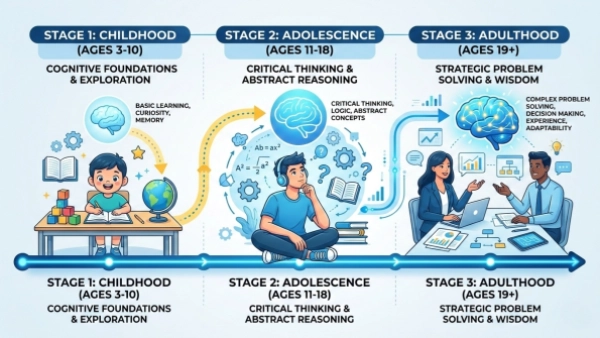
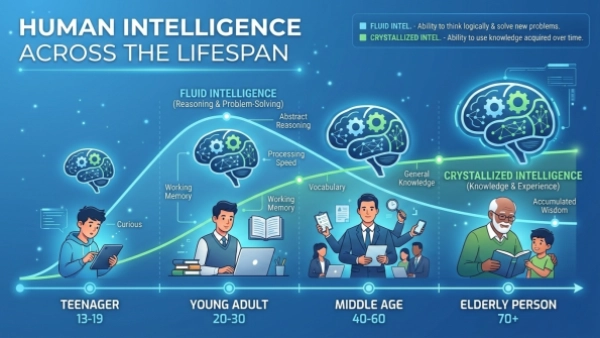
Age matters because cognitive abilities develop and change over time.
For example:
- IQ Score Ranges and What They Mean
- IQ scores are typically categorized into ranges to help interpret performance.
Fluid intelligence (problem solving and reasoning) often peaks in early adulthood.
Crystallized intelligence (knowledge and vocabulary) can continue improving into middle age.
This is why modern IQ tests adjust scores based on age norms rather than comparing a 10-year-old directly with a 40-year-old.
What IQ Scores Do—and Don’t—Measure
IQ tests can provide useful insights into cognitive ability, but they are not a complete measure of intelligence.
IQ tests typically do measure:
- Logical reasoning
- Pattern recognition
- Verbal ability
- Processing speed
However, they often do not measure:
- Creativity
- Emotional intelligence
- Social skills
- Motivation or persistence
These factors can be just as important for success in life.
Why a “Good” IQ Score Isn’t Everything
Many people believe that higher IQ guarantees success, but research shows that intelligence is only one piece of the puzzle.
Other important factors include:
- Education
- Work ethic
- Emotional intelligence
- Opportunities and environment
Someone with an average IQ but strong determination can achieve just as much—or more—than someone with a very high IQ.
Final Thoughts
A good IQ score for your age is generally anything above the population average of 100, with scores above 110 considered above average and 120+ considered very strong.
However, IQ scores are only one measure of human ability. They provide useful information about cognitive skills, but they do not define a person’s potential, creativity, or success.
Understanding your IQ score in context—rather than focusing on the number alone—is the best way to interpret what it really means.