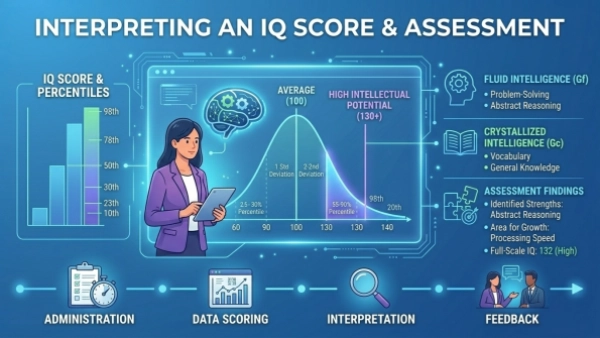
Intelligence Quotient (IQ) is one of the most widely known measures of cognitive ability. Many people have heard that the “average IQ” is 100, but fewer understand what that number actually means or how it is calculated. IQ scores are not simple counts of correct answers. Instead, they are statistical values designed to compare an individual’s cognitive performance with others in the same age group.
Understanding how the average IQ score is determined helps clarify what IQ tests measure, how scores are interpreted, and why the number 100 is considered the global average.
What Is an IQ Score?
An IQ score is a standardized number that represents a person’s performance on a set of cognitive tasks designed to measure reasoning, problem-solving, memory, and verbal ability. IQ tests are not intended to measure all forms of intelligence. Instead, they focus on specific cognitive processes related to analytical thinking and information processing.
Common abilities assessed in IQ tests include:
- Logical reasoning
- Pattern recognition
- Working memory
- Verbal comprehension
- Processing speed
- Spatial reasoning
These abilities together provide an estimate of general cognitive functioning, often referred to as general intelligence or g.
The Average IQ Score
In modern intelligence testing, the average IQ score is 100. This number represents the midpoint of the distribution of scores within a standardized population sample.
Most IQ tests are designed so that:
- The average score (mean) is 100
- The standard deviation is typically 15
- Most people fall within a predictable range around the mean
Because of this statistical structure:
- About 68% of people score between 85 and 115
- About 95% of people score between 70 and 130
This distribution forms a bell-shaped curve, also known as a normal distribution.
How IQ Scores Are Standardized
IQ scores are not calculated by simply counting how many questions a person answers correctly. Instead, the raw score is converted into a standardized score through a process called norming.
Norming involves testing a large and representative sample of people from different backgrounds and age groups. Researchers analyze how people perform and then create scoring rules that place individual performance within the overall distribution.
This process ensures that IQ scores reflect relative performance, not absolute knowledge.
Understanding the Statistical Framework
IQ scoring relies heavily on statistics, particularly the concept of a standard score, which compares an individual result to the population average.
z = (x - μ) / σ
This formula is the standard score (z-score) used in statistics.
Where:
- x = the individual’s raw score
- μ = the average score of the population
- σ = the standard deviation
The z-score indicates how far a person’s performance is from the population average. IQ scores are essentially scaled versions of these statistical comparisons, adjusted so that the mean equals 100.
From Raw Scores to IQ Scores
The calculation of an IQ score typically follows several steps:
- Raw Score Collection: The test measures how many problems a person answers correctly or how efficiently they complete tasks.
- Comparison with Norm Groups: The raw score is compared with results from people of the same age who previously took the test during the norming process.
- Standardization: Statistical adjustments convert the raw performance into a standardized IQ score.
- Score Scaling: The result is scaled so that the average equals 100 and the distribution follows the normal curve.
This process ensures that the score represents relative standing within a population, not simply the number of correct answers.
Why Age Matters in IQ Calculation
IQ tests are age-normed. This means that an individual’s performance is compared only with others in the same age group.
For example:
- A 10-year-old is compared with other 10-year-olds
- A 30-year-old is compared with other adults around the same age
This approach exists because cognitive abilities develop and change over time. Children, teenagers, and adults have different levels of experience, brain development, and knowledge. Age-based norms ensure that scores remain fair and meaningful across the lifespan.
Because of this design, the average IQ remains 100 for every age group.
Common IQ Score Ranges
Although interpretations may vary slightly between tests, IQ scores are often grouped into general ranges:
- 130 and above – Very superior intelligence
- 120–129 – Superior intelligence
- 110–119 – High average
- 90–109 – Average
- 80–89 – Low average
- 70–79 – Borderline range
- Below 70 – Extremely low range
These categories help psychologists interpret test results, but they are not strict labels for a person’s overall ability or potential.
Factors That Can Influence IQ Test Results
While IQ tests aim to measure cognitive ability objectively, several factors can influence performance.
These include:
- Quality of education
- Cultural background and language familiarity
- Test-taking experience
- Stress, fatigue, or motivation during the test
- Access to learning opportunities
Because of these influences, IQ scores are best viewed as estimates of cognitive performance at a specific moment, rather than permanent measures of intelligence.
What the Average IQ Score Really Means
When people hear that the average IQ is 100, they sometimes assume this number represents a universal level of intelligence. In reality, it is simply a statistical reference point.
An IQ score tells us how someone performs relative to others in the same population and age group. It does not measure creativity, emotional intelligence, practical wisdom, or many other forms of human ability.
For this reason, psychologists emphasize that intelligence is multidimensional and cannot be fully captured by a single number.
Final Thoughts
The average IQ score of 100 is not a fixed measure of human intelligence but a statistical benchmark created through standardized testing methods. IQ scores are calculated by comparing an individual’s cognitive performance with a large, representative group of peers, using carefully designed statistical models.
Understanding how IQ scores are calculated helps prevent common misunderstandings. Rather than viewing IQ as a rigid label, it is more accurate to see it as one tool among many for understanding cognitive strengths and learning potential.