Intelligence is not a fixed trait that appears fully formed at birth. Instead, it develops gradually through a complex interaction of biology, environment, education, and life experiences. From the early years of childhood to the responsibilities of adulthood, cognitive abilities grow, reorganize, and mature in meaningful ways.
Understanding how intelligence develops across the lifespan helps explain differences in learning, problem-solving, and decision-making at various stages of life.
Early Childhood: The Foundations of Intelligence
The earliest years of life are crucial for cognitive development. During infancy and early childhood, the brain forms millions of neural connections as children interact with their surroundings.
At this stage, intelligence primarily develops through:
- Sensory exploration: Babies learn by touching, seeing, hearing, and manipulating objects.
- Language exposure: Hearing and using language strengthens memory, comprehension, and communication.
- Social interaction: Caregivers and family members play a major role in shaping early thinking patterns.
Young children begin to develop basic cognitive skills such as recognizing patterns, remembering simple events, and understanding cause and effect. Curiosity and play are key drivers of intellectual growth during this period.
Middle Childhood: Rapid Learning and Skill Expansion
Between roughly ages 6 and 12, children experience a period of rapid intellectual growth. School environments introduce structured learning, which helps strengthen several important abilities.
During middle childhood, children develop:
- Logical thinking
- Improved memory strategies
- Reading and language mastery
- Mathematical reasoning
Children also begin to compare information, categorize ideas, and understand more complex relationships between concepts. Their attention spans increase, allowing them to focus on longer tasks and more challenging problems.
Education, nutrition, and emotional support all influence how strongly these abilities develop.
Adolescence: Abstract Thinking Emerges
Adolescence marks a major shift in cognitive development. Teenagers begin to develop the capacity for abstract reasoning, meaning they can think about ideas that are not directly tied to physical experiences.
At this stage, individuals become better at:
- Hypothetical thinking
- Evaluating different perspectives
- Planning for the future
- Understanding complex social dynamics
Adolescents also start forming personal values and beliefs, which requires higher-level reasoning and self-reflection. However, the brain regions responsible for impulse control and long-term planning are still developing, which explains some typical teenage behaviors.
Early Adulthood: Peak Cognitive Performance
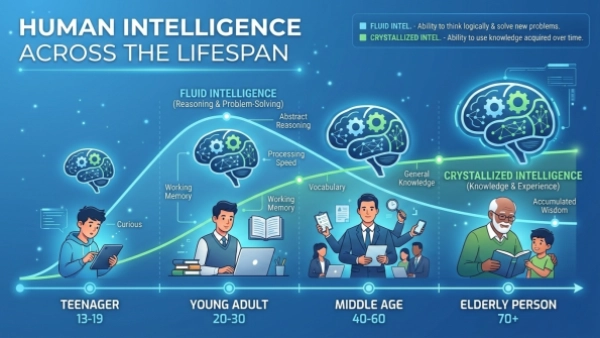
For many individuals, certain cognitive abilities reach their peak during early adulthood. Skills such as processing speed, working memory, and problem-solving efficiency are often strongest during the late teens through the 30s.
At this stage, intelligence becomes more specialized. Education, professional training, and life experience help individuals develop expertise in specific areas such as science, business, technology, or creative fields.
Adults also gain what psychologists call crystallized intelligence—knowledge accumulated through learning and experience. This type of intelligence tends to grow steadily over time.
Later Adulthood: Experience and Wisdom
Although some cognitive functions like processing speed may gradually slow with age, many aspects of intelligence remain stable or even improve.
Older adults often demonstrate strengths such as:
- Deeper knowledge and expertise
- Better judgment and decision-making
- Improved emotional understanding
- Strong pattern recognition based on experience
This stage is sometimes associated with wisdom, which combines knowledge, perspective, and emotional regulation.
Mental activity, social engagement, lifelong learning, and physical health can help maintain cognitive abilities well into older adulthood.
The Role of Environment and Genetics
Intelligence development is shaped by both biological and environmental factors.
Genetics influence brain structure and potential cognitive capacity, but environmental factors play a powerful role in determining how fully that potential develops.
Important influences include:
- Quality education
- Nutrition and health
- Parental involvement
- Social interactions
- Access to learning resources
- Cultural experiences
Children raised in stimulating environments with opportunities for learning and exploration tend to develop stronger cognitive skills.
Intelligence Is Dynamic, Not Fixed
One of the most important findings in modern psychology is that intelligence is not entirely fixed. While genetic factors set certain limits, cognitive abilities can be strengthened through learning, practice, and experience.
Activities that support lifelong cognitive development include:
- Reading and continuous learning
- Solving puzzles and complex problems
- Learning new skills or languages
- Maintaining social connections
- Engaging in physical exercise
These activities help keep the brain active and adaptable throughout life.
Conclusion
Intelligence develops through a lifelong process that begins in early childhood and continues well into adulthood. Each stage of life contributes unique cognitive strengths—from curiosity and exploration in childhood to expertise and wisdom later in life.
Rather than remaining static, intelligence evolves as people learn, adapt, and accumulate knowledge. By supporting healthy environments, education, and lifelong learning, individuals can continue developing their cognitive abilities at every stage of life.