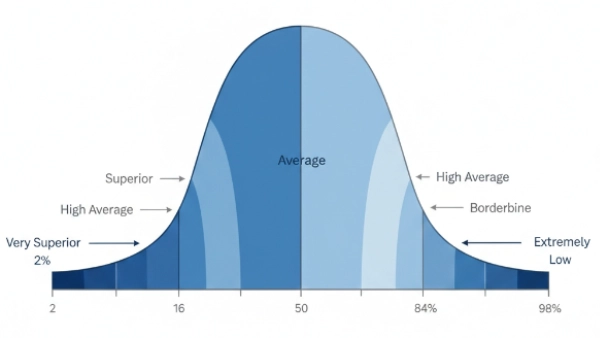
Spatial logic is the ability to mentally manipulate objects, understand their relationships in space, and visualize how shapes change when rotated, flipped, or transformed. It plays a critical role in problem-solving, technical thinking, and many real-world tasks—ranging from engineering and architecture to navigation and design.
In cognitive assessments and IQ-style tests, spatial logic is often measured through 3D visualization tasks. These questions evaluate how accurately and efficiently you can imagine objects from different perspectives without physically interacting with them.
The good news is that spatial logic is highly trainable. With the right strategies and consistent practice, anyone can significantly improve their performance. Our 30-day spatial reasoning training plan is a structured way to get started.
What Is Spatial Logic?
Spatial logic refers to the mental processes involved in understanding how objects exist and move in space. It includes the ability to:
- Visualize objects in three dimensions
- Mentally rotate shapes and structures
- Predict the result of folds, cuts, or rotations
- Understand spatial relationships between multiple objects
Unlike verbal or numerical reasoning, spatial logic relies less on learned rules and more on mental imagery and transformation.
Why Spatial Logic Matters
Strong spatial reasoning skills are associated with success in many fields, including:
- Engineering and architecture
- Computer graphics and game design
- Surgery and medical imaging
- Mathematics and physics
- Aviation, navigation and logistics
In cognitive testing, spatial logic often serves as a strong indicator of fluid intelligence, as it measures how well you can process unfamiliar visual information and apply logic in real time. To see how this compares with other cognitive skills, read our overview of spatial intelligence vs logical and verbal intelligence.
Core Components of 3D Visualization
To master spatial logic, it is essential to understand the fundamental cognitive skills involved in 3D visualization. These skills allow you to mentally represent objects, manipulate them in space, and predict how they change under various transformations. Most spatial reasoning questions are built from combinations of these core components rather than entirely new concepts.
Developing these abilities improves not only test performance but also real-world problem-solving in technical, creative, and analytical domains.
Mental Rotation
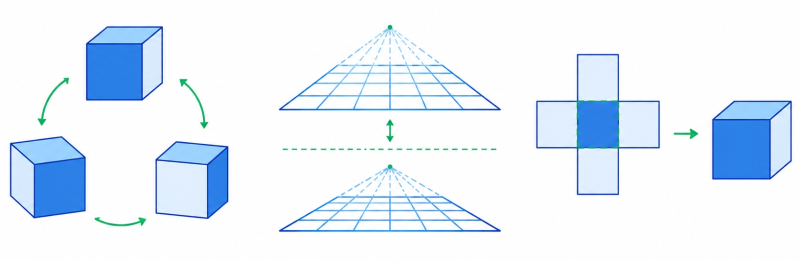
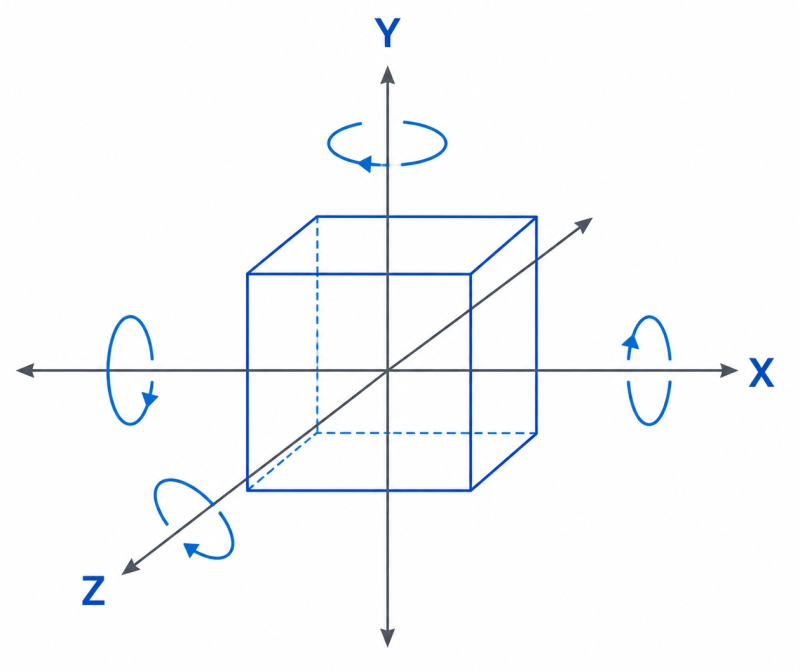
Mental rotation is the ability to imagine how an object appears after being rotated in space. This is one of the most common and heavily tested spatial skills in cognitive assessments.
In mental rotation tasks, you may be asked to:
- Rotate an object by 90°, 180°, or 270°
- Determine whether two objects are identical but shown from different orientations
- Track how specific faces, edges, or markings move after multiple rotations
- Identify mirror images versus true rotations
A crucial insight is that rotation does not alter the structure of an object. The shape, proportions, and relationships between elements remain constant—only the orientation changes. Errors often occur when test-takers unintentionally “reshape” the object while rotating it mentally.
To improve mental rotation:
- Focus on one reference face or corner at a time
- Rotate objects incrementally rather than all at once
- Practice visualizing rotations along a single axis before combining multiple axes
With practice, mental rotation becomes faster and more intuitive, reducing cognitive strain during timed assessments. For a full progression from beginner to advanced level, see our guide on mastering mental rotation.
Perspective Shifting
Perspective shifting involves imagining how an object looks when viewed from a different angle or position. Unlike rotation, the object itself does not move—your viewpoint does.
Perspective-based questions may ask you to visualize an object:
- From the top, bottom, front, back or side
- As seen from behind or underneath
- From an angled or isometric viewpoint
- Relative to another object in space
These problems require you to mentally “walk around” the object, reconstructing how its visible features change based on your viewing position. This skill is particularly important in professions that rely on technical drawings, schematics, and spatial layouts.
To succeed with perspective shifting:
- Mentally position yourself relative to the object
- Identify which surfaces would be visible and which would be hidden
- Keep track of depth and relative distance between elements
Perspective errors often stem from failing to account for hidden surfaces or confusing left-right orientation when the viewpoint changes.
Spatial Transformation
Spatial transformation goes beyond simple rotation or viewpoint changes. These questions require you to imagine how an object physically changes structure while maintaining internal consistency.
Common types of spatial transformations include:
- Folding and unfolding flat shapes into 3D forms
- Cutting solids and predicting resulting cross-sections
- Flipping objects horizontally or vertically
- Adding, removing, or rearranging components
These tasks demand both imagination and logic. You must track how every part of the object behaves during the transformation without losing spatial coherence.
Key strategies include:
- Visualizing transformations step by step
- Maintaining consistent orientation references
- Understanding which properties change and which remain fixed
Spatial transformation questions often separate average performers from strong spatial thinkers because they require sustained attention and structured mental modeling. Learn how to solve cross-section problems systematically to handle the trickiest transformation tasks.
Common Types of Spatial Logic Questions
Recognizing common question formats allows you to approach spatial problems strategically instead of relying on guesswork.
Cube and Block Rotation
In these questions, you are shown a cube or block with markings, symbols, colors, or numbers on its faces. After one or more rotations, you must determine where those markings end up.
These problems typically test:
- Mental rotation accuracy
- Orientation tracking
- Face-to-face relationships
Effective solving techniques include:
- Tracking one marked face throughout the rotation
- Using consistent reference points such as top or front faces
- Eliminating answer choices that violate basic cube geometry
Avoid relying on visual similarity alone—precise tracking is far more reliable.
2D to 3D Conversion
These questions ask you to imagine how a flat shape behaves when folded into a 3D object, or how a 3D object unfolds into a flat net.
They assess your ability to:
- Understand how edges connect
- Predict which faces meet
- Maintain orientation during folding
Success depends on visualizing hinge points and understanding that edges only connect in specific ways. A common mistake is assuming faces can bend freely without respecting geometric constraints.
Cross-Section Problems
Cross-section questions involve slicing a 3D object and identifying the shape produced by the cut.
Typical tasks include:
- Vertical, horizontal, or diagonal cuts
- Predicting internal shapes formed by intersections
- Recognizing how cut angle affects the resulting figure
These problems reward careful attention to:
- The direction of the cut
- The angle relative to the object’s base
- The object’s internal symmetry
Slow, deliberate visualization is far more effective than intuition alone in these questions. If you struggle with this question type, our step-by-step framework for 3D spatial problems breaks down the process clearly.
Object Assembly and Disassembly
These questions require you to determine how smaller components combine to form a larger object—or how a complex structure breaks down into parts.
They test:
- Structural awareness
- Part-to-whole reasoning
- Spatial sequencing and order
To solve them effectively:
- Identify how components align or interlock
- Visualize assembly one step at a time
- Eliminate options that violate physical constraints
These tasks strongly resemble real-world engineering and construction challenges.
Proven Strategies to Improve Spatial Logic
Spatial logic improves most effectively when visual imagination is combined with systematic reasoning.
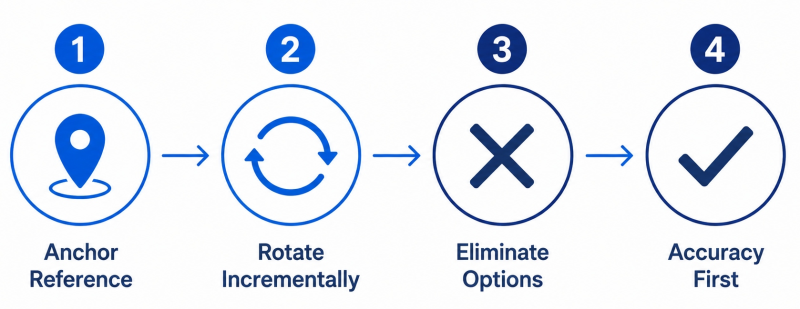
Strategy 1: Anchor Your Perspective
Always establish a reference point and keep it consistent throughout the problem. Anchors may include:
- A marked face or corner
- A unique color or symbol
- A fixed “front” or “top” orientation
Anchors prevent disorientation and help stabilize your mental model during complex transformations.
Strategy 2: Rotate Objects Incrementally
Instead of visualizing a full rotation at once, break it into manageable steps:
- One 90° turn at a time
- One axis of rotation at a time
This mirrors how objects move in real space and significantly reduces errors.
Strategy 3: Use Elimination Logic
You do not need perfect visualization to answer correctly. Often, one or two constraints are enough to eliminate incorrect choices.
Remove options that:
- Show impossible face relationships
- Ignore preserved features
- Violate rotation or folding rules
Logical elimination turns partial understanding into reliable accuracy.
Strategy 4: Practice Slow and Accurate First
Speed is a byproduct of mastery, not a prerequisite. Early practice should emphasize:
- Clear mental imagery
- Accurate tracking of changes
- Full comprehension of transformations
Once your mental models become stable, speed will naturally improve.
Practical Exercises to Train 3D Visualization
You can strengthen spatial logic outside of formal testing environments.
Effective exercises include:
- Building structures with blocks or construction kits
- Solving 3D puzzles or mechanical models
- Sketching objects from multiple viewpoints
- Visualizing routes, layouts or room arrangements without maps
These activities reinforce the same mental processes used in spatial logic assessments. For approaches that go beyond test prep, explore how to train spatial logic without tests or IQ questions and spatial logic in real-life applications.
Common Mistakes in Spatial Reasoning
Rotating the wrong direction: Always confirm clockwise versus counterclockwise movement.
Losing track of reference points: Without anchors, objects can mentally drift and distort.
Overcomplicating simple transformations: Many spatial problems rely on straightforward, repeatable rules rather than complex logic. Understanding why most people fail spatial logic questions can help you avoid the same pitfalls.
Final Thoughts: Spatial Logic Is a Skill You Can Build
Spatial logic is not an innate talent reserved for a few—it is a trainable cognitive skill. By learning how 3D objects behave in space, practicing systematic visualization, and reviewing mistakes thoughtfully, you can dramatically improve both accuracy and confidence.
Whether you are preparing for an IQ-style assessment, sharpening professional skills or simply challenging your mind, mastering 3D visualization opens the door to stronger problem-solving and deeper spatial understanding. To understand how the brain processes 3D space, explore the neuroscience behind this skill.
Ready to apply your spatial skills? Our free IQ exam includes 10 spatial visualization questions. You can also compare spatial ability with abstract reasoning and numerical patterns to understand your full cognitive profile.