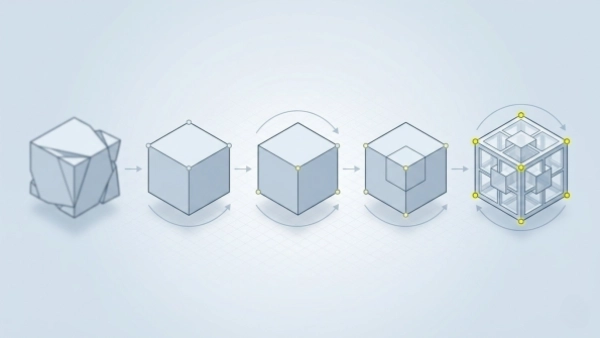
Cross-section problems are a classic test of spatial reasoning. You are shown a three-dimensional object—often a cube, cylinder, pyramid, or composite solid—and asked to determine the shape formed when a plane cuts through it.
At first glance, these problems seem abstract. But they follow strict geometric rules. When approached systematically, they become predictable rather than mysterious.
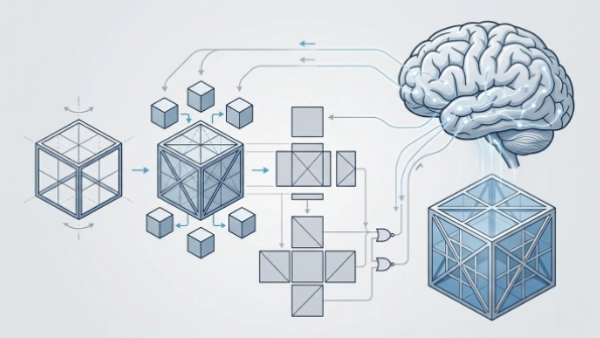
This guide will show you how to solve cross-section problems step by step — without guesswork and without relying on fragile intuition. Understanding how the brain processes 3D space will help you see why this systematic approach works better than pure visualization.
What Cross-Section Problems Actually Test
At a deeper level, cross-section problems test whether you can reason about invisible structure with precision.
They measure your ability to:
- Construct a stable mental model of a 3D solid
- Represent an invisible cutting plane accurately
- Track intersections between that plane and edges, faces, or curved surfaces
- Maintain geometric constraints throughout the transformation
- Eliminate outcomes that violate structural rules
What makes cross-sections challenging is that nothing is moving. There is no rotation to follow, no folding to track. Instead, you must imagine a fixed object being intersected by a flat plane—and determine the exact boundary of that intersection.
The essential skill is not creativity. It is disciplined spatial reasoning.
You are not guessing what the slice “looks like.”
You are determining precisely where the plane touches the solid.
Every cross-section is defined by intersection geometry.
If you identify the intersections correctly, the shape reveals itself logically.
Once you understand that principle, the problem stops being visual guesswork and becomes structured construction.
Step 1: Understand the Solid Completely
Before considering the cut, build a complete internal model of the object.
Ask yourself:
- How many faces does it have?
- How many edges and vertices?
- Which faces are parallel?
- Where are the symmetries?
- Are surfaces flat, curved, or mixed?
For example:
- A cube has six square faces, twelve edges, and three sets of parallel faces.
- A pyramid has a polygonal base and triangular sides converging at an apex.
- A cylinder has two flat circular bases and one continuous curved surface.
Cross-sections depend entirely on these structural properties. If your mental model is incomplete or unstable, the slicing plane will produce confusion.
Many mistakes originate not from misunderstanding the plane—but from misunderstanding the solid itself.
Before cutting anything, ensure the object is mentally solid and stable.
Step 2: Represent the Cutting Plane Precisely
The cutting plane must be treated as a real geometric entity.
It is:
- Flat
- Infinite
- Two-dimensional
- Extending fully wherever it intersects the solid
Most errors occur because people imagine the plane vaguely—as if it were a partial slice or arbitrary removal of material.
Instead, define it carefully:
- Is it horizontal (parallel to the base)?
- Vertical (perpendicular to the base)?
- Diagonal (tilted across multiple faces)?
- Does it pass through specific vertices or midpoints?
Clarity at this stage determines everything that follows.
You are not carving out pieces randomly.
You are placing a flat sheet through a solid and tracing where they meet.
The cross-section is the boundary formed by those intersection lines.
Step 3: Identify Intersection Points First
Do not try to imagine the final shape immediately.
Start with structure.
Locate exactly where the plane intersects:
- Edges (creating vertices of the cross-section)
- Faces (creating line segments)
- Curved surfaces (creating curved edges)
Each time the plane crosses an edge, it creates a corner of the cross-section.
This gives you a powerful deduction tool:
- If the plane intersects three edges → the cross-section is a triangle.
- Four intersections → a quadrilateral.
- Five intersections → a pentagon.
- Six intersections → a hexagon.
You can often determine the number of sides without visualizing the shape fully.
This transforms the task from abstract imagination into count-based reasoning. Instead of asking, "What does it look like?" ask, "How many intersection points exist?" Structure precedes appearance.

Step 4: Connect the Intersection Points Logically
After identifying intersection points, connect them in the order the plane encounters them.
Important principle:
The cross-section lies entirely along the plane and inside the solid.
This means:
- Edges of the cross-section trace the boundary where the plane passes across faces.
- Lines connect adjacent intersection points along the surface of the solid.
- Connections follow face boundaries—not arbitrary shortcuts.
For example:
- If a plane cuts across two adjacent faces of a cube, the cross-section edge runs continuously across their shared boundary.
- If the plane intersects a cylinder’s curved surface, the cross-section edge becomes curved—often forming an ellipse.
Avoid random point-connecting.
Follow the geometry of the surfaces being sliced.
Step 5: Preserve Geometric Constraints
Every cross-section must obey geometric laws.
Certain rules are non-negotiable:
- A plane slicing a polyhedron (like a cube) produces straight edges only.
- A plane slicing a curved surface may produce curved edges.
- The number of cross-section sides cannot exceed the number of intersected faces.
- The cross-section must lie entirely within the boundaries of the solid.
Check systematically:
- Does the shape include curved edges where none should exist?
- Does it include more vertices than intersections?
- Does it violate symmetry that the plane would preserve?
Many incorrect options are eliminated instantly when these constraints are applied.
Structural logic protects against visual illusion.
Step 6: Use Elimination Before Full Visualization
Perfect mental imagery is not required for most cross-section problems.
You can often eliminate wrong answers by checking:
- Number of sides
- Straight vs curved boundaries
- Symmetry properties
- Parallel or perpendicular edge relationships
For example:
If the plane intersects exactly four edges of a cube:
- Eliminate triangles immediately.
- Eliminate pentagons or hexagons.
- Focus only on quadrilaterals.
Logical filtering reduces cognitive strain and prevents over-imagining.
Visualization should confirm logic—not replace it.
Step 7: Reconstruct Only If Necessary
If two options remain, reconstruct carefully:
- Reconfirm all intersection points.
- Determine their order along the plane.
- Examine angles formed between segments.
- Ensure the shape lies flat within the cutting plane.
Move slowly.
Rushed visualization leads to structural distortion.
Controlled reconstruction preserves accuracy.
Common Cross-Section Scenarios
Cube
Possible cross-sections include:
- Triangle (cutting off a corner)
- Rectangle (parallel to a face)
- Parallelogram (angled slice)
- Trapezoid
- Hexagon (cutting across all six faces diagonally)
Key principle:
The maximum number of sides equals the number of faces the plane intersects.
If a plane intersects six faces, expect six sides.
Pyramid
Cross-sections depend on whether the apex is included:
- Passing through the apex → triangular cross-section.
- Missing the apex → polygon similar to the base but smaller or skewed.
The farther from the apex the cut occurs, the more the cross-section resembles the base.
Cylinder
Cuts vary dramatically by angle:
- Horizontal → Circle
- Vertical → Rectangle
- Diagonal → Ellipse
Curved surfaces introduce curved cross-sections. Straight-edged solids cannot.
Recognizing surface type immediately narrows answer possibilities.
Why Cross-Section Problems Feel Difficult
The challenge lies in invisibility.
You cannot see the interior cut directly. You must simulate it while preserving structure.
Beginners attempt to imagine the final shape instantly. This overloads working memory and leads to unstable guesses. To understand why this happens at a neurological level, read how the brain processes 3D space. And for a complete strategy to avoid this trap across all spatial problem types, see the step-by-step framework for solving 3D spatial problems.
Experts reverse the order:
- Count intersections.
- Apply geometric constraints.
- Construct logically.
- Confirm visually.
They treat cross-sections as deduction problems—not drawing exercises.
Systematic reasoning replaces intuition.
A Repeatable Framework
Whenever you face a cross-section problem:
- Fully model the solid.
- Define the cutting plane precisely.
- Count intersection points.
- Connect them logically along faces.
- Verify geometric constraints.
- Eliminate impossible options.
- Reconstruct carefully if needed.
Repeat this sequence consistently.
With practice, what once felt abstract becomes mechanical and reliable.
Training Cross-Section Skills
To improve steadily:
- Use transparent 3D models (physical or digital).
- Draw wireframe versions of solids.
- Practice cube slicing with increasing angles.
- Solve problems progressively—triangle cuts first, then quadrilaterals, then hexagons.
- Mix curved and flat solids.
Over time, you will begin to anticipate intersection lines automatically. Instead of struggling to "see" the shape, you will predict it from structure. That shift — from visual confusion to geometric control — is the mark of mastery in cross-section reasoning. To build this skill alongside other spatial abilities in a structured plan, follow our 30-day spatial reasoning training plan.
Final Insight
Cross-section problems are not about creative imagination.
They are about disciplined intersection tracking.
- The plane defines the cut.
- The solid defines the limits.
- The intersections define the shape.
When you focus on structure instead of appearance, cross-sections become systematic — and solvable. For the mental rotation skills that complement this ability, read our guide on mastering mental rotation from beginner to advanced. And if you want to understand why so many people struggle with spatial questions in the first place, see why most people fail spatial logic questions.
Ready to put your cross-section reasoning to the test? Try our free 18-minute IQ exam — spatial reasoning questions included with instant feedback.