Verbal intelligence is the ability to understand, analyze, and reason using language. It plays a critical role in communication, learning, problem-solving, and decision-making. In IQ tests, academic assessments, and real-world situations alike, strong verbal intelligence allows you to process information efficiently and express ideas clearly.
Unlike memorizing facts, verbal intelligence is about how you think with words—how you recognize relationships, infer meaning, and apply logic through language.
This guide explores the core components of verbal intelligence, common question types, and proven strategies to improve both verbal logic and vocabulary skills. If you are new to the concept, start with what verbal IQ is and how to improve it before diving deeper.
What Is Verbal Intelligence?
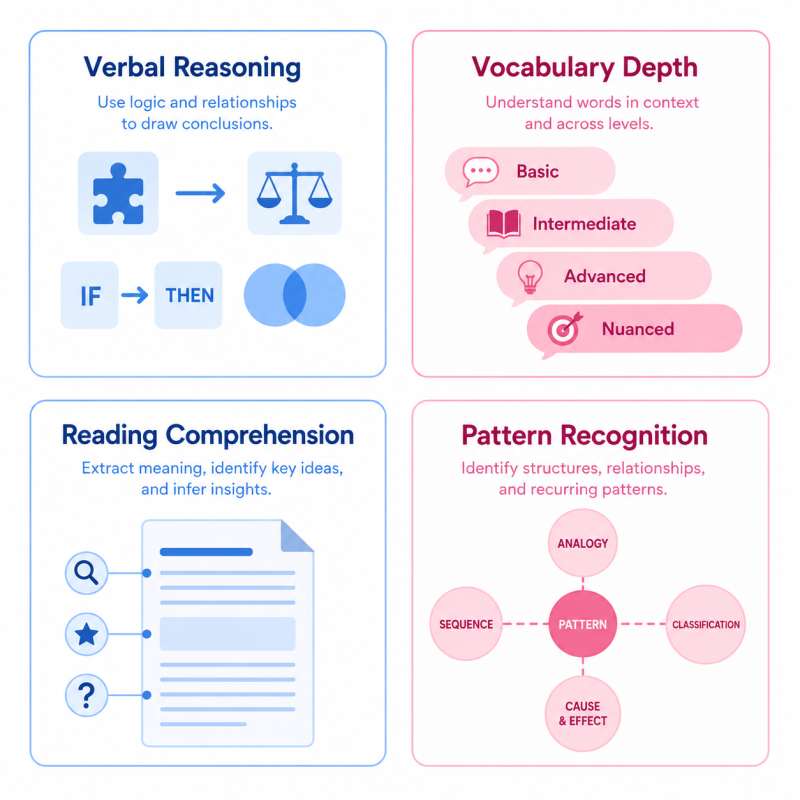
Verbal intelligence involves several interconnected abilities, including:
- Understanding word meanings and relationships
- Recognizing logical structures in language
- Drawing conclusions from written information
- Identifying patterns, analogies, and inconsistencies
- Using vocabulary precisely and appropriately
In assessments, verbal intelligence is often tested through reading comprehension, analogies, classification, and logical reasoning questions.
In everyday life, it affects how well you follow instructions, interpret arguments, negotiate, and learn new concepts. To understand how verbal intelligence compares with other cognitive skills, see our overview of verbal intelligence vs fluid intelligence.
Core Components of Verbal Intelligence
To meaningfully improve verbal intelligence, it is important to understand the core cognitive skills that support it. Verbal intelligence is not a single ability but a combination of reasoning, language awareness, and comprehension skills that work together when processing information expressed in words.
Below are the key components that form the foundation of strong verbal intelligence.
Verbal Reasoning and Logic
Verbal reasoning refers to the ability to follow, evaluate, and construct logical arguments using language. Rather than focusing on word knowledge alone, this skill tests how well you understand relationships, structure, and meaning within written statements.
In verbal logic questions, you may be asked to:
- Identify cause-and-effect relationships
- Understand conditional statements such as if–then or unless
- Detect underlying assumptions
- Recognize valid conclusions versus flawed reasoning
Strong verbal logic requires careful reading and deliberate analysis, not fast guessing. Many incorrect answers appear convincing on the surface but fail under logical scrutiny. High performers slow down just enough to verify whether each statement truly follows from the information given.
A key principle in verbal reasoning is this: a conclusion must be supported by the text, not by intuition or personal belief. For a structured approach to this skill, read our guide on how to analyze arguments logically.
Vocabulary Depth and Precision
Vocabulary is often misunderstood as simply knowing many words. In reality, verbal intelligence depends more on depth than quantity.
A strong vocabulary includes:
- Understanding multiple meanings of the same word
- Recognizing connotations (positive, neutral, or negative tone)
- Distinguishing between closely related words with subtle differences
For example, the words assertive, aggressive, and confident are related but not interchangeable. Knowing when each word is appropriate reflects nuanced language understanding rather than surface-level memorization.
Advanced vocabulary knowledge also includes awareness of:
- Formal vs. informal usage
- Contextual appropriateness
- Emotional or persuasive undertones
This precision is especially important in sentence completion and synonym-based questions.
Reading Comprehension
Reading comprehension measures how effectively you understand and interpret written material. It is one of the most important—and most underestimated—components of verbal intelligence.
This skill involves:
- Identifying the main idea or central argument
- Distinguishing facts from opinions or interpretations
- Understanding implied meaning rather than explicit statements
- Interpreting tone, intent and emphasis
Many verbal reasoning mistakes occur not because the question is difficult, but because the passage was read too quickly or too superficially. High verbal intelligence relies on the ability to extract meaning accurately, even from dense or complex text.
Good comprehension also requires resisting the urge to fill gaps with assumptions. What matters is what the text actually says, not what it suggests emotionally or culturally. Our guide on how to improve reading comprehension for complex texts covers practical techniques for handling dense or challenging passages.
Language-Based Pattern Recognition
Just as numerical intelligence relies on recognizing patterns in numbers, verbal intelligence relies on recognizing patterns in language.
These patterns may include:
- Word relationships (synonymy, contrast, function)
- Logical sentence structures
- Category membership and hierarchy
This ability is especially critical in analogy and classification questions, where success depends on identifying how concepts relate, not just what they mean individually.
Strong pattern recognition allows you to quickly see connections that others miss, turning complex verbal problems into structured, solvable tasks.
Common Types of Verbal Intelligence Questions
Recognizing common question formats helps you approach verbal problems systematically instead of relying on trial and error.
Verbal Analogies
Verbal analogies test your ability to recognize relationships between words and apply the same relationship to a new pair.
Example: Bird is to nest as bee is to ___
To solve analogies effectively:
- Identify the relationship between the first pair
- State that relationship clearly in words
- Apply the same relationship to the second pair
Avoid choosing answers based on surface similarity. The correct answer always reflects the same underlying relationship, not just a related concept.
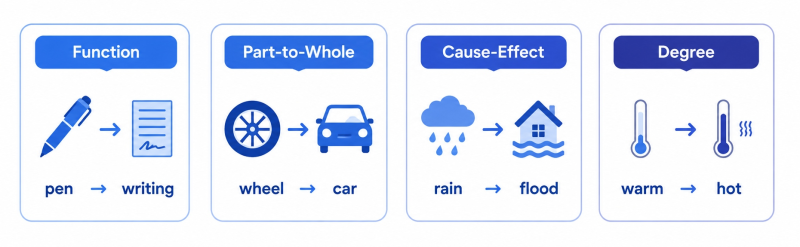
For a complete breakdown of analogy strategies, see our dedicated guide on mastering verbal analogies: patterns, logic and strategy. Common analogy relationships include:
- Function (tool → purpose)
- Part-to-whole
- Cause-and-effect
- Degree or intensity
Synonyms and Antonyms
These questions test vocabulary precision rather than simple memorization.
Key strategies include:
- Considering the context in which the word is used
- Eliminating options that are too broad or too extreme
- Paying attention to tone and emotional intensity
Antonym questions are especially tricky because the correct answer is often not a complete opposite, but the most accurate contrast in meaning.
Word Classification
Classification questions ask you to identify which word does not belong in a group.
Example: Apple – Banana – Carrot – Grape
Correct answer: Carrot (different category)
To solve these efficiently:
- Identify the shared category among most words
- Look for hidden or secondary classification rules
- Avoid being misled by superficial similarities
These questions reward structured thinking over quick intuition.
Sentence Completion
Sentence completion questions test vocabulary and logic at the same time.
Key skills include:
- Understanding overall sentence structure
- Identifying logical connectors such as however, therefore, or although
- Matching both meaning and tone
Always read the entire sentence before selecting an answer. Often, the correct choice becomes obvious only after understanding the sentence as a whole.
Logical Statements and Conclusions
These questions evaluate your ability to reason strictly from written information.
You may be asked whether a conclusion is:
- True
- False
- Cannot be determined
The most important rule here is discipline: use only the information provided. Do not rely on personal experience, assumptions, or general knowledge unless explicitly stated.
Proven Strategies to Improve Verbal Intelligence
Verbal intelligence improves most effectively when comprehension and reasoning are trained together.
Strategy 1: Read Actively, Not Passively
Instead of reading quickly, practice:
- Summarizing each paragraph mentally
- Identifying the author’s main point
- Tracking how ideas connect across sentences
Active reading strengthens both comprehension and logical processing.
Strategy 2: Learn Words in Context
Memorizing word lists is far less effective than learning words through usage.
Better approaches include:
- Reading articles slightly above your comfort level
- Writing your own sentences using new vocabulary
- Observing how meaning shifts depending on context
This builds long-term retention and real-world understanding. For a daily routine you can follow, explore our daily exercises to strengthen verbal intelligence in 20 minutes.
Strategy 3: Break Down Complex Sentences
Long sentences often contain multiple clauses and ideas.
Practice:
- Identifying the subject and main verb
- Temporarily removing extra clauses
- Rebuilding the sentence meaning step by step
This is especially helpful in logical reasoning and reading comprehension questions.
Strategy 4: Focus on Relationships, Not Definitions
In verbal reasoning, understanding how words relate is more important than knowing their dictionary definitions.
Ask yourself:
- What role does this word play?
- Is it a cause, result, tool, or category member?
This mindset dramatically improves performance in analogies and classification tasks.
Strategy 5: Eliminate Logically, Not Emotionally
When unsure, eliminate options that:
- Do not fit the logical structure of the sentence
- Introduce unrelated ideas
- Sound extreme, absolute or exaggerated
Even partial understanding can often lead to the correct answer through elimination.
Common Mistakes in Verbal Intelligence Tests
Rushing through questions: Speed without comprehension leads to avoidable errors. Our guide on common mistakes in verbal IQ tests and how to avoid them breaks down the most frequent errors and how to correct them.
Relying on intuition alone: Verbal reasoning rewards structured logic over gut feeling.
Ignoring qualifiers: Words like always, sometimes, only, and most significantly change meaning.
Assuming outside knowledge: Correct answers must be supported by the text itself.
How to Practice Verbal Intelligence Effectively
Consistent, focused practice leads to measurable improvement.
Effective methods include:
- Reading a wide range of materials (essays, science articles, opinion pieces)
- Solving verbal reasoning questions regularly
- Reviewing incorrect answers to understand the mistake
- Explaining your reasoning aloud or in writing
True improvement comes from understanding how language works, not from memorizing isolated facts. For structured practice material, our 50 challenging verbal reasoning questions with detailed explanations is one of the most effective resources to work through. You can also explore whether adults can increase their verbal IQ — the research-backed answer may surprise you.
Final Thoughts
Verbal intelligence is one of the most practical forms of cognitive ability. It affects how you learn, communicate, and reason in everyday life. With structured practice, anyone can improve their verbal logic and vocabulary over time.
By focusing on clarity, consistency, and logical relationships, you build skills that extend far beyond tests—and into real-world thinking. To see how these skills apply professionally, read about verbal intelligence in leadership, negotiation and career success.
Want to put your verbal skills to the test alongside other cognitive domains? Try our free 18-minute IQ exam. You can also strengthen related cognitive skills with our guides on abstract reasoning, numerical patterns, and spatial logic.