Abstract reasoning is a core cognitive skill that plays a major role in problem-solving, learning, and adapting to new situations. Unlike numerical or verbal reasoning, abstract reasoning focuses on identifying patterns, relationships, and logical rules without relying on language or prior knowledge.
This guide explains what abstract reasoning is, why it matters, and how you can improve it through practical strategies and consistent practice. If you want to test your skills right away, try our step-by-step abstract reasoning practice guide.
What Is Abstract Reasoning?
Abstract reasoning is the ability to understand complex ideas by analyzing patterns, shapes, symbols, or logical structures that are not tied to real-world objects or meanings.
Instead of asking what something is, abstract reasoning asks:
- How are these elements related?
- What rule governs this pattern?
- What changes from one step to the next?
Common abstract reasoning tasks include:
- Identifying the next shape in a sequence
- Completing visual matrices
- Detecting rules in symbol transformations
- Recognizing relationships between unfamiliar figures
Because abstract reasoning relies on logic rather than learned knowledge, it is often used in educational assessments and aptitude-style tests. To understand how these tests are structured, see how IQ scores are calculated.
Why Abstract Reasoning Matters
Abstract reasoning is not about memorization. It reflects how you approach unfamiliar problems.
Strong abstract reasoning skills are associated with:
- Faster pattern recognition
- Flexible thinking when rules change
- Efficient problem-solving under time constraints
- Better adaptation to new or complex tasks
In everyday learning contexts, abstract reasoning helps you:
- Understand new systems quickly
- Break down complex ideas into simpler rules
- Transfer solutions from one problem to another
Common Types of Abstract Reasoning Questions
Understanding the most common types of abstract reasoning questions is one of the fastest ways to improve performance. While the figures and symbols may look unfamiliar at first, most questions follow a limited number of logical structures. Once you learn to recognize these structures, patterns become easier to spot and solve.
Below are the three most common categories you will encounter in abstract reasoning assessments.
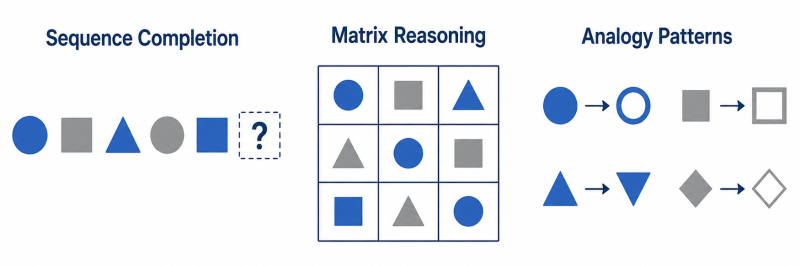
1. Sequence Completion
Sequence completion questions present a series of shapes, symbols, or figures arranged in a specific order. Your task is to identify the underlying rule that governs the sequence and determine which option logically comes next.
At first glance, these sequences may appear random, but they are almost always driven by consistent, step-by-step changes.
Common pattern changes include:
- Rotation: Shapes may rotate by a fixed number of degrees in each step (for example, 90° clockwise or 45° counterclockwise).
- Size increase or decrease: Elements may gradually grow larger or smaller, or alternate between two sizes.
- Color alternation: Colors may switch back and forth, follow a repeating cycle, or change based on position.
- Shape addition or subtraction: Each step may add or remove a line, corner, dot, or internal element.
More advanced sequences often combine two simple rules, such as rotation plus shape removal. These are common in the most common abstract reasoning patterns found in real IQ assessments.
2. Matrix Reasoning
Matrix reasoning questions often look complex, but they usually rely on simple, repeatable logic once broken down correctly. For a full walkthrough, read our guide on how to crack 3×3 matrix grids.
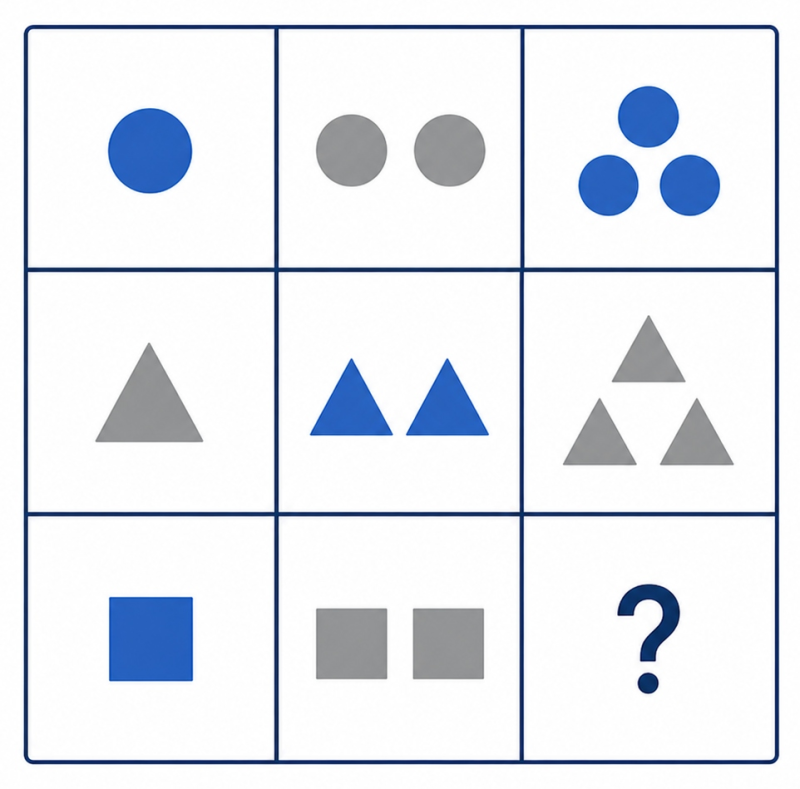
These questions reward structured thinking and careful observation.
Effective analysis involves:
- Analyzing rows first, then columns: Start by identifying how figures change from left to right. Once a rule is clear, verify whether a similar logic applies from top to bottom.
- Focusing on one change at a time: Examine individual attributes separately, such as shape count, position, rotation, shading or internal elements.
For example, a row may show shapes increasing in number, while a column controls rotation. The correct answer must follow both rules at once.
Matrix reasoning questions often look complex, but they usually rely on simple, repeatable logic once broken down correctly.
3. Analogy-Based Patterns
Analogy-based abstract reasoning questions focus on relationships rather than sequences. You are shown how one abstract figure transforms into another, and you must apply the same transformation to a new figure.
These questions test your ability to recognize and transfer logical relationships.
They commonly involve:
- Transformation logic: Changes such as rotation, reflection, duplication, or element replacement.
- Directional changes: Movement from left to right, top to bottom, inside to outside, or vice versa.
- Structural similarities: The overall structure may remain constant while specific components change.
A helpful approach is to clearly define the relationship between the first pair before looking at the answer options. If you can explain the transformation in words, applying it becomes much easier.
Practical Tips to Improve Abstract Reasoning
Improvement in abstract reasoning comes from learning how to think, not from memorizing specific patterns. The strategies below help build a systematic approach that works across many question types.
Tip 1: Look for One Rule at a Time
Trying to identify every change at once can quickly become overwhelming. This is one of the most common beginner mistakes in abstract reasoning — and one of the easiest to fix.
Instead, simplify the problem by asking targeted questions:
- Is something rotating?
- Is the number of elements changing?
- Is there a consistent color, position or orientation pattern?
Once you identify one rule, check whether it holds across the entire question. Only then should you look for a second rule if needed. Most abstract reasoning questions rely on two simple rules, not one complicated one.
Tip 2: Compare What Changes and What Stays the Same
One of the most effective techniques is to separate elements into two groups:
- What remains constant across figures
- What changes consistently from step to step
Stable elements often serve as anchors that help you isolate the logic behind the changing parts. If something never changes, it likely defines the structure of the pattern rather than the rule itself.
Tip 3: Practice Explaining the Pattern in Words
Even though abstract reasoning is visual, verbalizing the logic can dramatically improve clarity. Silently describe the pattern to yourself in simple language.
For example:
“Each step rotates 90 degrees clockwise and removes one shape from the center.”
If you can explain the rule clearly and concisely, you are far more likely to select the correct answer. If you struggle to explain it, the pattern may not be fully understood yet.
Tip 4: Don’t Rush Early Questions
In many assessments, early abstract reasoning questions are intentionally easier. These questions help you warm up, recognize common pattern types, and build confidence.
Use this phase to:
- Set a steady pace
- Establish accuracy
- Build momentum
Strong performance early often leads to better focus and decision-making later in the test.
Tip 5: Accept Uncertainty and Move On
Not every pattern will be immediately clear. If you reach a point where further analysis is not producing insight:
- Make the most logical choice based on the rules you do see
- Move on to the next question
- Avoid spending excessive time on a single problem
Abstract reasoning assessments reward consistency and time management, not perfection. A calm, forward-moving approach often leads to higher overall results.
How to Practice Abstract Reasoning Effectively
Effective practice focuses on building adaptable thinking skills rather than memorizing answers.
Use Varied Question Styles
Practicing only one type of abstract question can limit progress. Rotate between:
- Sequences
- Matrices
- Analogies
Exposure to varied formats trains your brain to recognize patterns more flexibly and prevents reliance on a single strategy.
Focus on Review, Not Just Scores
Scores alone provide limited value. Real improvement comes from reviewing your performance.
After each practice session:
- Review why the correct answer works
- Identify which rule you missed or misunderstood
- Look for recurring pattern types that challenge you
Understanding mistakes builds long-term skill far more effectively than simply repeating questions.
Practice Under Light Time Pressure
Once you are comfortable with basic patterns, introduce gentle time limits. Our guide on abstract reasoning practice tips for timed tests walks you through how to do this effectively.
This helps develop:
- Faster rule detection
- Efficient decision-making
- Better pacing control
Avoid extreme time pressure in early practice. Learning quality matters more than speed at the beginning.
Common Mistakes to Avoid
Overthinking simple patterns: Many abstract reasoning problems use straightforward logic disguised by visual complexity.
Ignoring rows or columns: In matrix questions, both horizontal and vertical relationships often matter equally.
Relying on intuition alone: While intuition can help, consistent improvement comes from supporting intuition with clear logical reasoning.
Final Thoughts
Abstract reasoning is a learnable skill. While some people may feel naturally comfortable with pattern-based problems, consistent practice and structured thinking can significantly improve performance over time.
Rather than focusing on labels or scores, focus on:
- Understanding patterns
- Developing logical explanations
- Building confidence with unfamiliar problems
With practice, abstract reasoning becomes less about guessing and more about recognizing structure. Research confirms that abstract reasoning can be improved — the key is consistent, deliberate practice. You can also explore a step-by-step method for solving abstract reasoning questions to build a reliable system.
Ready to apply what you've learned? Try our free 18-minute IQ exam which includes 10 abstract reasoning questions alongside spatial logic and numerical pattern challenges.