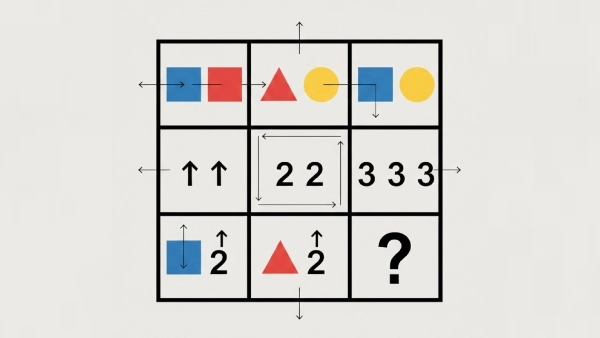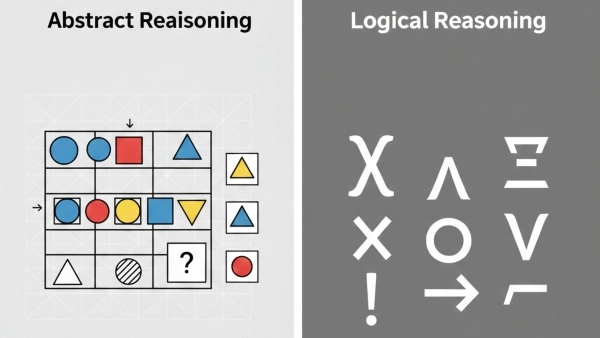
Abstract reasoning questions can look intimidating at first glance. Rows of unfamiliar shapes, symbols, and diagrams often give the impression that the problems are random or overly complex. In reality, most abstract reasoning questions are built from a limited set of recurring patterns. Once you understand these patterns, the questions become far more manageable.
This article breaks down the most common abstract reasoning patterns you must know, explains how they work, and shows you what to look for when solving these types of problems. If you're new to this topic, start with what abstract reasoning questions are in IQ tests before reading on.
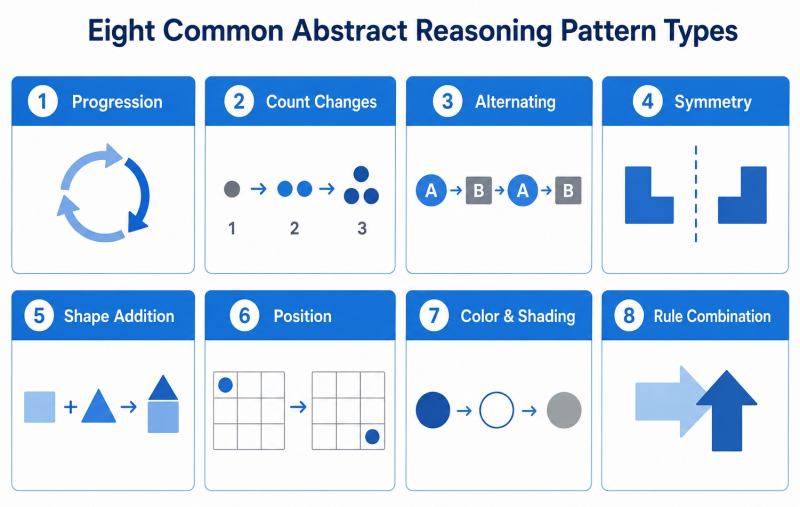
Pattern Progression
Pattern progression is one of the most frequently used principles in abstract reasoning tests because it directly measures how well a person can detect logical change over time. In these questions, elements evolve step by step according to a consistent rule, even if that rule is not immediately obvious.
The key idea behind progression patterns is continuity: each image is logically connected to the one before it. The challenge lies in identifying what is changing and how it is changing.
Common types of progression include:
- Rotation: A shape may rotate by a fixed number of degrees with each step, such as 45 or 90 degrees clockwise or counterclockwise. In more complex cases, different shapes may rotate in opposite directions at the same time.
- Movement across the page: An element may move systematically from left to right, top to bottom, diagonally, or around the edges of a square. Sometimes the movement follows a loop or circular path rather than a straight line.
- Changes in size: Shapes may grow or shrink gradually, either in equal increments or in alternating steps. In some questions, size progression applies to only one element while others remain constant.
- Orientation shifts: A shape may flip horizontally, vertically, or diagonally. These flips are often confused with rotation, so careful attention to direction is important.
How to spot it:
Compare each image directly with the next one and ask a simple question: What changed? Ignore details that stay the same and focus only on differences. For a full walkthrough of how to apply this systematically, read our guide on how to solve abstract reasoning questions step by step.
Number or Count-Based Patterns
Number or count-based patterns focus on quantity rather than appearance. These questions test your ability to track numerical changes hidden inside visual designs.
Instead of asking how a shape looks, these patterns ask how many elements are present and how that number changes across the sequence.
You may need to track:
- The number of shapes inside a figure
- The number of sides, corners, lines, or dots
- The frequency with which a specific symbol appears
The count may increase steadily, decrease, alternate between values, or follow a repeating cycle such as 1–2–3–1–2–3.
In more advanced questions, counting may need to be combined with another rule, such as position or color.
How to spot it:
If visual changes seem confusing or inconsistent, start counting. Many abstract reasoning questions are designed to distract you with visual complexity, while the true rule is purely numerical. This is one of the key insights in our guide on beginner mistakes in abstract reasoning — visual distraction is one of the most common traps.
Alternating Patterns
Alternating patterns switch between two or more distinct states. Rather than changing gradually, these patterns flip back and forth according to a fixed sequence.
For example:
- A shape may alternate between black and white
- An arrow may point left, then right, then left again
- A figure may alternate between filled and unfilled
These patterns often follow simple structures such as A–B–A–B or more complex cycles like A–B–C–A–B–C.
How to spot it:
Instead of analyzing the sequence as a whole, look at every other image. Compare positions 1, 3, and 5, then compare positions 2, 4, and 6. If each group follows its own consistent rule, the pattern is alternating.
Symmetry and Reflection
Symmetry-based patterns rely on balance and mirroring rather than movement or counting. These questions test spatial awareness and the ability to visualize transformations.
Shapes may be reflected:
- Horizontally (left to right)
- Vertically (top to bottom)
- Diagonally
You may be asked to:
- Identify which option is a true mirror image
- Find the figure that preserves symmetry
- Determine how a shape changes when reflected across an axis
How to spot it:
Mentally draw a line through the center of the image and imagine folding it along that line. If both halves match or align logically, symmetry or reflection is likely the governing rule.
Shape Addition and Subtraction
In shape addition and subtraction patterns, figures interact with each other logically. These questions are especially common in matrix-style problems, where multiple images must be compared at once.
Examples include:
- One shape disappearing while another appears
- Two overlapping shapes combining into a new form
- Shared elements between two figures being removed
In some cases, the final shape represents the result of combining previous shapes according to a fixed rule.
How to spot it:
Compare images side by side and focus on what remains constant and what changes. Instead of analyzing the final image alone, think in terms of transformation: What was added? What was removed? This type of logic is especially important in matrix reasoning questions, where shape interactions across rows and columns must be tracked simultaneously.
Position and Direction Patterns
Position-based patterns focus on where shapes are located rather than how they look. A shape might move between corners, edges, or fixed positions within a grid.
Common movements include:
- Clockwise or counterclockwise motion
- Zigzag paths
- Alternation between center and corners
Direction patterns often involve arrows or shapes that point in different orientations, such as up, down, left, or right.
How to spot it:
Temporarily ignore color, size, and shape type. Track only the position or direction of each element across the sequence. Once movement is identified, other details usually fall into place.
Color and Shading Patterns
Color and shading patterns involve logical changes in fill, contrast, or intensity. These patterns are often combined with other rules, making them easy to overlook.
For example:
- A shape turns black after appearing twice
- Colors rotate among shapes
- The darkest shape always moves to a specific position
Shading patterns may also involve filled versus outlined shapes rather than color alone.
How to spot it:
Track each color or shading style independently. Ask where it appears, where it disappears, and whether it follows a predictable path or cycle.
Rule Combination Patterns
Rule combination patterns are among the most difficult abstract reasoning questions. They use two or more rules simultaneously, such as rotation plus counting, or position plus color change.
These questions are designed to test deeper reasoning ability and mental organization, not just quick recognition. Learning to handle them is a major focus of our abstract reasoning practice tips for timed tests.
How to spot it:
If one rule explains part of the pattern but not everything, assume another rule is operating at the same time. Break the problem down and analyze one feature at a time until all elements are accounted for.
Why Recognizing Patterns Matters
Abstract reasoning tests are not about guessing or intuition. They reward structured thinking, attention to detail, and logical elimination.
By learning common pattern types, you reduce cognitive load and avoid being overwhelmed by visual complexity. Instead of starting from scratch on every question, you can quickly test known pattern categories and narrow down the correct answer.
Strong performers do not look for "clever tricks." They apply systematic reasoning, verify rules carefully, and eliminate options that do not fit. Over time, this approach turns abstract reasoning from a mystery into a predictable and manageable skill. To understand the science behind why this kind of structured thinking works, read about whether abstract reasoning can be improved.
Final Thoughts
Despite their complex appearance, abstract reasoning questions are highly predictable. Most rely on a small set of logical patterns that appear again and again across IQ tests, aptitude tests, and cognitive assessments.
By mastering common abstract reasoning patterns—such as progression, counting, symmetry, and rule combinations—you give yourself a clear advantage. With practice, these questions stop feeling abstract and start feeling logical. The next step is to put these patterns into action — read our guide on how to solve abstract reasoning questions step by step, then test yourself on our free IQ exam.