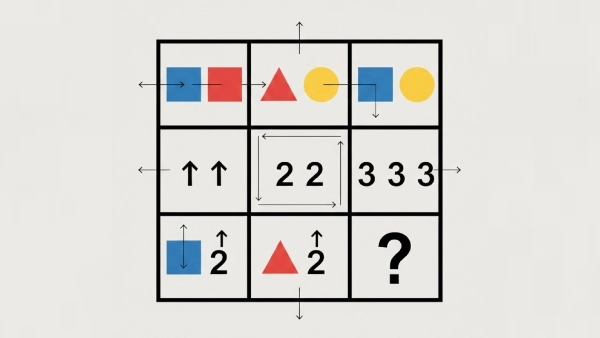
Abstract reasoning tests are not only about finding the correct pattern—they are also about doing so under strict time pressure. Many test-takers understand the logic but still struggle to finish on time. This is why effective practice, not just knowledge, is essential.
This article focuses on practical, proven tips to help you practice abstract reasoning efficiently and perform better in timed test conditions. If you haven't yet built a solid understanding of how these questions work, read what abstract reasoning questions are in IQ tests first.
Understand the Role of Time Pressure
Timed abstract reasoning tests are designed not only to measure logical ability, but also to evaluate how efficiently you process unfamiliar information under pressure. The goal is to see how quickly you can recognize patterns, adjust to new rules, and make accurate decisions without having unlimited thinking time.
Time pressure is intentional. It separates those who can apply logic automatically from those who rely on slow, step-by-step analysis. In real test conditions, hesitation costs points.
Instead of viewing the clock as an enemy, your preparation should teach you to work with time pressure. This means:
- Training your brain to recognize common patterns almost instantly
- Reducing hesitation by using a fixed problem-solving process
- Accepting that not every question needs to be solved perfectly
When time pressure becomes familiar, it loses its power to distract you.
Practice with Realistic Time Limits
One of the most common mistakes in preparation is practicing without a timer. Untimed practice improves understanding, but it does not build speed or decision-making confidence.
To practice effectively:
- Use official or test-style timing whenever possible
- Practice in short, focused sessions to maintain mental sharpness
- Gradually reduce the time allowed per question as your accuracy improves
For example, if a test allows 30 seconds per question, begin practice at 45 seconds, then reduce to 35, and finally to test speed. This gradual approach builds speed without sacrificing accuracy.
Training under realistic conditions also reduces anxiety on test day, because the environment feels familiar rather than threatening.
Learn Pattern Categories, Not Individual Questions
Abstract reasoning tests rarely invent new logic. Instead, they reuse the same underlying pattern types across different visual designs.
Practicing questions randomly without identifying the pattern type leads to slow progress. You may solve questions, but your speed does not improve.
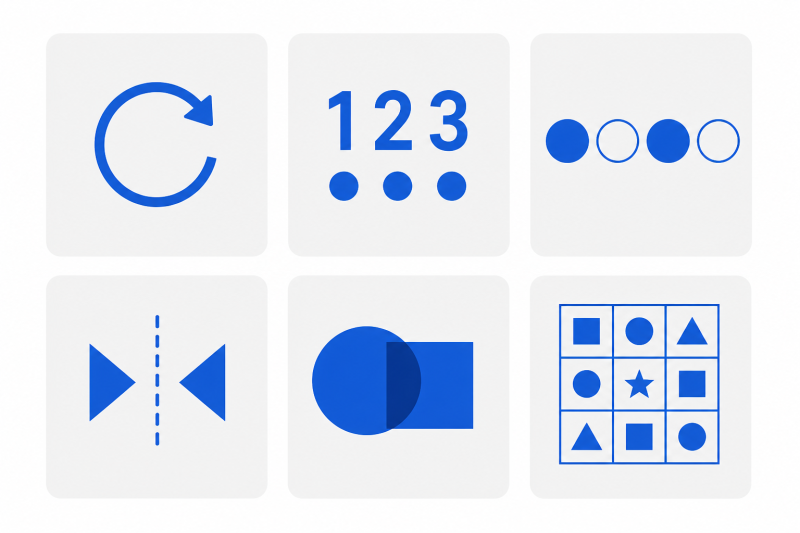
Instead, train by grouping questions into pattern categories such as:
- Rotation and progression
- Counting and number-based rules
- Alternating patterns
- Symmetry and reflection
- Shape combination and subtraction
- Multi-rule matrices
When your brain learns to recognize the category first, you skip unnecessary analysis. The question stops being "What is happening?" and becomes "Which familiar rule is this?" This shift dramatically reduces solving time. For a complete reference of all major pattern categories, see our guide on the most common abstract reasoning patterns you must know.
Use a Consistent Step-by-Step Method
Speed in abstract reasoning does not come from guessing—it comes from structure. A consistent method removes uncertainty and prevents mental overload.
An effective step-by-step approach includes:
- Quickly observing the structure of the problem
- Identifying what changes and what remains constant
- Testing common patterns before complex ones
- Isolating one feature at a time
- Eliminating incorrect answer choices
Using the same sequence for every question builds mental discipline. Over time, these steps become automatic, allowing you to move quickly without feeling rushed. For the full method laid out in detail, read how to solve abstract reasoning questions step by step.
Consistency is what transforms logical ability into test performance.
Set a Time Threshold for Each Question
In timed tests, time management is as important as problem-solving skill. Not every question deserves equal attention.
A practical rule is:
- Spend no more than 30–40 seconds on a question
- If no clear rule emerges, mark it and move on
- Return only if time remains at the end
This strategy ensures that difficult questions do not steal time from easier ones that you could solve confidently. Many test-takers lose points not because they lack ability, but because they misallocate time.
Learning when to let go is a skill—and it improves scores.
Train Elimination Skills
Elimination is one of the most powerful tools in timed abstract reasoning tests. You do not always need to find the perfect answer—you only need to remove the wrong ones.
Effective elimination practice includes:
- Identifying which rule an option violates
- Discarding choices that only partially follow the pattern
- Ignoring options that add unnecessary or inconsistent elements
In many cases, eliminating two or three options is faster than fully solving the pattern. Under time pressure, elimination often leads to correct answers more reliably than deep analysis. This technique is especially powerful in 3×3 matrix reasoning questions, where multiple rules interact and full analysis takes longer.
Practice Under Mild Stress Conditions
Test-day pressure can disrupt even well-prepared candidates. To prevent this, your practice should include mild stress exposure.
Useful techniques include:
- Practicing with background noise
- Occasionally using stricter time limits
- Practicing when slightly tired, not only when fully rested
These conditions help you stay focused despite discomfort. When the real test arrives, your brain recognizes the pressure as familiar, not overwhelming.
Review Incorrect Answers Thoroughly
Speed improves fastest when mistakes are understood, not ignored.
After each practice session:
- Review every incorrect answer
- Identify the exact step where your logic failed
- Determine whether the error was caused by speed, misinterpretation or rule confusion
Turn mistakes into lessons by labeling the missed pattern type. This prevents the same error from reappearing and strengthens pattern recognition. If you find yourself making the same types of errors repeatedly, read beginner mistakes in abstract reasoning and how to avoid them for targeted guidance.
Focus on Accuracy First, Then Speed
Many learners try to be fast before they are consistent. This usually leads to careless mistakes and frustration.
A better progression is:
- Practice slowly with full understanding
- Build accuracy and consistency
- Gradually increase speed
- Combine speed with confidence
Accuracy creates trust in your process. Once confidence grows, speed follows naturally.
Develop Pattern Recognition Habits
Strong abstract reasoning performers do not analyze every question from scratch. They recognize patterns almost instantly.
Build this ability by:
- Regularly reviewing solved examples
- Mentally naming the pattern type during practice
- Repeating similar question types until recognition is automatic
With enough exposure, pattern recognition becomes instinctive rather than analytical. At that point, timed abstract reasoning tests feel manageable, controlled, and predictable. The science behind this improvement is explored in our article on whether abstract reasoning can genuinely be improved.
Final Thoughts
Abstract reasoning timed tests reward preparation, discipline, and structure. Success does not come from rushing or guessing—it comes from practiced efficiency.
By training under realistic time limits, learning pattern categories, and using a consistent method, you can dramatically improve both speed and accuracy. With the right practice strategy, timed abstract reasoning tests become manageable rather than intimidating. To understand how abstract reasoning compares with other cognitive skills, also read about the difference between abstract and logical reasoning.
The best way to put these tips into practice right now is our free 18-minute IQ exam — 30 timed questions with instant results, giving you real experience with the pressure this guide prepares you for.