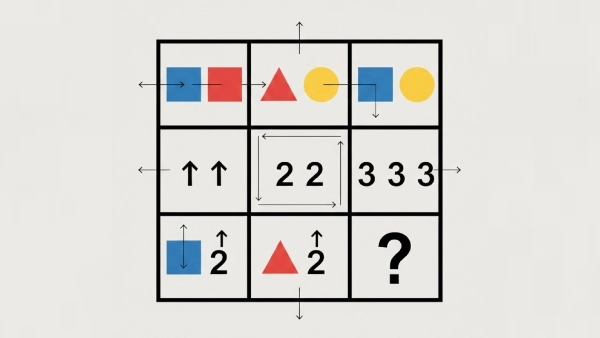
Abstract reasoning questions are a core component of many IQ tests. They are designed to measure how well a person can identify patterns, relationships, and logical rules using unfamiliar information—often without relying on language or prior knowledge. In simple terms, these questions test how you think, not what you know.
Because of this, abstract reasoning is widely considered one of the best indicators of general intelligence and problem-solving ability. For a broader overview of this skill, see our complete abstract reasoning guide.
What Is Abstract Reasoning?
Abstract reasoning refers to the ability to understand and manipulate concepts that are not tied to concrete objects, facts, or experiences. Instead of working with words or numbers you already recognize, you are asked to interpret shapes, symbols, or diagrams and determine how they relate to one another.
This skill plays a role in everyday tasks such as:
- Solving new or unfamiliar problems
- Recognizing trends or patterns
- Making logical decisions with limited information
- Adapting to new rules or systems
In professional settings, abstract reasoning is especially important in fields like engineering, software development, data analysis, and strategic planning.
How Abstract Reasoning Questions Work
Abstract reasoning questions are built around a simple idea: instead of testing learned knowledge, they test how well you can detect structure and logic in unfamiliar information. In a typical question, you are presented with a series of images, symbols, or diagrams that follow an underlying rule. Your task is to figure out that rule and apply it to choose the correct answer.
What makes these questions challenging is that the rule is never stated explicitly. You must infer it by carefully observing how the elements change from one image to the next. Sometimes the change is obvious, such as a shape rotating or increasing in size. Other times, the rule is subtle and requires you to compare multiple features at once, such as color, orientation, and number.
Another defining feature of abstract reasoning questions is that they are intentionally nonverbal. Instructions are usually brief, and the problems do not depend on vocabulary, grammar, arithmetic formulas, or cultural knowledge. This design reduces the influence of language proficiency and educational background, making abstract reasoning especially useful for assessing pure cognitive ability across diverse populations.
In many IQ tests, these questions are timed. This adds an additional layer of difficulty, as you must not only reason accurately but also do so efficiently. Successful test-takers learn to scan for patterns quickly while avoiding overthinking or focusing on irrelevant details.
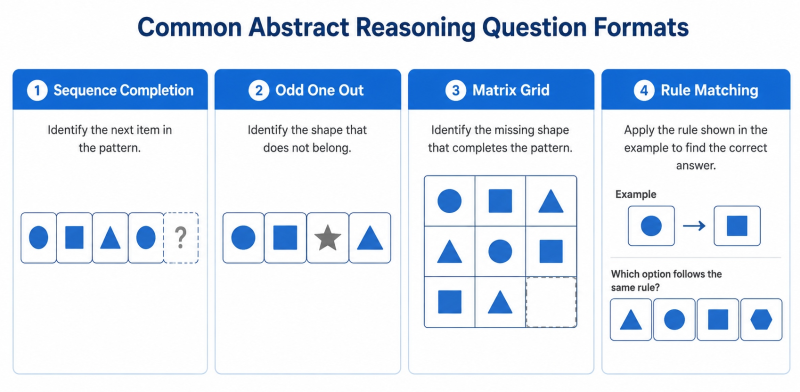
Common formats of abstract reasoning questions include:
- Completing a visual sequence: You are shown a sequence of images with one missing element and must determine which option logically completes the sequence.
- Identifying the odd one out: Several images are presented together, and you must identify which one does not follow the same rule as the others.
- Selecting the missing piece in a matrix: Often arranged in a grid (such as a 3×3 matrix), these questions require you to find the missing image by analyzing patterns across rows and columns.
- Determining which option follows the same rule as the example: You are given a reference example and must select another option that follows the same underlying logic.
Although the formats may vary, the core skill remains the same: identifying patterns and applying logical rules consistently. To see these formats broken down with examples, read our guide on the most common abstract reasoning patterns you must know.
Common Types of Abstract Reasoning Patterns
At first glance, abstract reasoning questions can appear complex or even random. In reality, most of them rely on a relatively small number of recurring logical principles. Learning to recognize these principles can greatly improve both speed and accuracy.
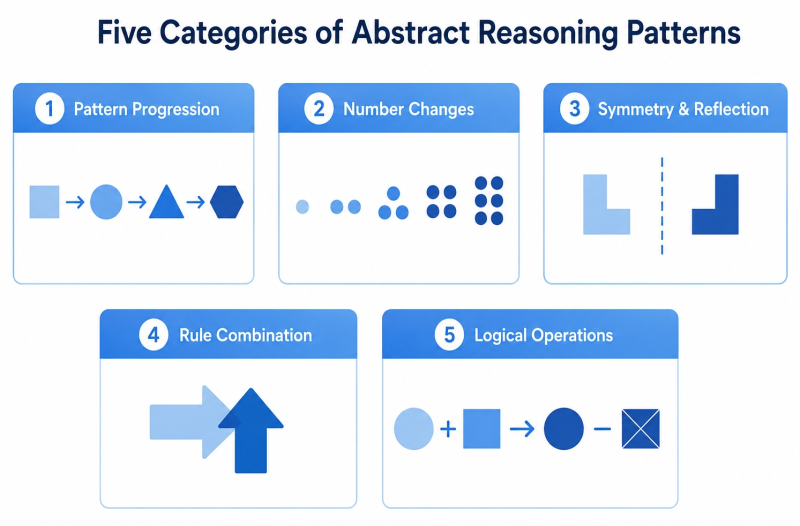
Pattern progression
Pattern progression questions present shapes or symbols that change in a predictable way from one step to the next — such as rotating, growing, or shifting position. Your task is to identify the consistent rule and apply it to find the next element in the sequence. These are explored in depth in our article on how to solve abstract reasoning questions step by step.
Number or count changes
Some questions focus on quantity rather than shape. The number of elements inside a figure—such as dots, lines, or smaller shapes—may increase, decrease, or alternate in a consistent pattern. Counting carefully is often essential in these problems.
Symmetry and reflection
Symmetry-based questions involve mirroring shapes horizontally, vertically, or diagonally. You may be asked to identify how a figure would look if reflected across an axis, or which option maintains the same symmetrical properties as the others.
Rule combination
More advanced questions often apply more than one rule at the same time. For instance, a shape may rotate while also changing color, or the number of elements may increase as their positions shift. These questions reward systematic analysis and the ability to track multiple variables simultaneously.
Logical operations
In some cases, shapes interact with each other according to logical operations. Elements may merge, overlap, cancel each other out, or be added and removed based on a fixed rule.
These questions are common in matrix-style problems and require careful comparison across rows and columns. For a complete breakdown of this format, read our guide on matrix reasoning and how to crack 3×3 grids.
Recognizing which type of rule—or combination of rules—is being used is often the key to solving the problem efficiently. Instead of guessing, strong abstract reasoning relies on methodical observation and elimination.
Why IQ Tests Use Abstract Reasoning
The primary goal of an IQ test is to measure general cognitive ability, not academic knowledge or test preparation. Abstract reasoning questions are particularly well suited to this goal.
First, they minimize language and cultural bias. Because the questions rely on images rather than words, they are less influenced by a person’s native language, reading level, or educational system. This makes comparisons across individuals and groups more meaningful.
Second, abstract reasoning tests raw problem-solving ability. They measure how well someone can analyze new information, identify patterns, and apply logical rules—skills that are central to learning and reasoning in real life.
Third, these questions assess how quickly a person can understand and adapt to new rules. In many situations, especially in modern work environments, success depends on learning unfamiliar systems rather than recalling memorized facts.
Research consistently shows that performance on abstract reasoning tasks strongly correlates with overall intelligence and learning capacity. To understand how this fits into the broader picture of what IQ tests measure, see our IQ basics 101 guide.
How Abstract Reasoning Is Scored
In most IQ tests, abstract reasoning is scored primarily on accuracy: each correct answer contributes to your overall score. In some tests, time is also a factor, meaning that faster correct responses may lead to higher scores.
The difficulty of questions usually increases as the test progresses. Early questions may involve a single, obvious rule, while later questions may require recognizing multiple interacting patterns. This graduated difficulty helps distinguish between different levels of reasoning ability.
Scores are typically standardized. Rather than being judged on the total number of correct answers alone, your performance is compared to that of a large reference group. This allows test results to reflect relative cognitive ability within a population.
Can You Improve Abstract Reasoning Skills?
Abstract reasoning ability can improve with practice, even though general intelligence has a relatively stable component. Familiarity with common pattern types and question formats can make a significant difference.
Effective ways to improve include:
- Practicing a wide range of abstract reasoning questions
- Learning to quickly identify common rule categories
- Training yourself to consider multiple patterns at the same time
- Developing strategies to manage time pressure during tests
Improvement often comes not from working faster, but from working more systematically. Our guide on abstract reasoning practice tips for timed tests gives you a concrete system to follow, and research confirms that abstract reasoning can genuinely be improved with the right approach.
Abstract Reasoning Beyond IQ Tests
Abstract reasoning is not limited to IQ assessments. It is widely used in many other contexts, including:
- Pre-employment aptitude and cognitive ability tests
- Graduate and professional school admissions exams
- Cognitive and psychological evaluations
- Leadership potential and talent identification programs
High performance in abstract reasoning is also a key criterion for Mensa membership, which requires scores in the top 2% of the population.
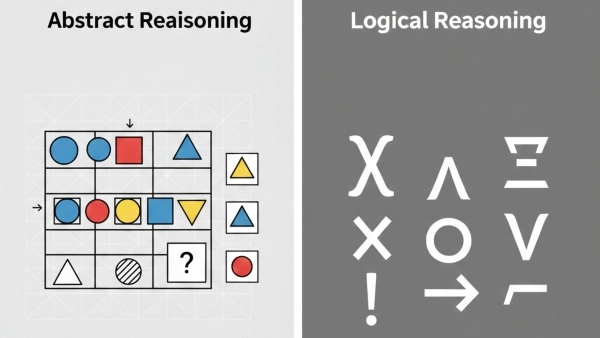
Employers and educators value abstract reasoning because it predicts how well an individual can handle complex, unfamiliar challenges. In a rapidly changing world, the ability to reason abstractly is often more important than specific technical knowledge. It's also worth understanding how abstract reasoning differs from logical reasoning — a distinction that matters in both test settings and real-world problem-solving.
Final Thoughts
Abstract reasoning questions in IQ tests are designed to reveal how the mind processes unfamiliar information. They measure logical thinking, adaptability, and pattern recognition—abilities that matter far beyond a test environment.
Understanding how these questions work can reduce anxiety, improve performance, and offer insight into your own thinking style.
Whether you are preparing for an IQ test, a job assessment, or simply curious about cognitive skills, abstract reasoning provides a meaningful window into how intelligence is measured. To practice what you've learned, explore our beginner mistakes in abstract reasoning and how to avoid them, then test your skills directly on our free IQ exam.