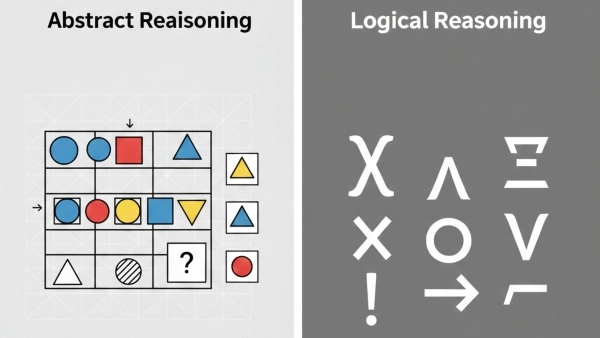
Matrix reasoning questions—especially the classic 3×3 grid—are among the most challenging and common problem types in IQ tests, aptitude tests, and cognitive assessments. At first glance, these grids can feel overwhelming: multiple shapes, symbols, and patterns interacting at once, with one missing cell you must identify.
The good news is that 3×3 matrix problems are highly structured. Once you understand how they are built and how to approach them systematically, they become far more predictable and solvable.
This guide explains matrix reasoning clearly and shows you how to crack 3×3 grids step by step. If you're new to abstract reasoning altogether, first read what abstract reasoning questions are in IQ tests to build the right foundation.
What Is Matrix Reasoning?
Matrix reasoning is a form of abstract reasoning where images are arranged in a grid—most commonly a 3×3 matrix—with one image missing. Your task is to identify the logical rule or rules governing the rows and columns and choose the option that correctly completes the matrix.
Unlike verbal or numerical questions, matrix reasoning relies entirely on visual logic. It tests your ability to:
- Recognize patterns
- Track multiple variables at once
- Apply logical rules consistently
- Solve unfamiliar problems without prior knowledge
Because of this, matrix reasoning is widely regarded as a strong measure of general intelligence.
Why 3×3 Grids Are Difficult
Compared to simpler sequences or pair-based patterns, 3×3 matrices are harder because they usually involve:
- More than one rule operating at the same time
- Relationships across both rows and columns
- Interactions between shapes rather than simple progression
Many people struggle because they try to solve the grid intuitively instead of analytically. Matrix reasoning rewards structure, not guesswork.
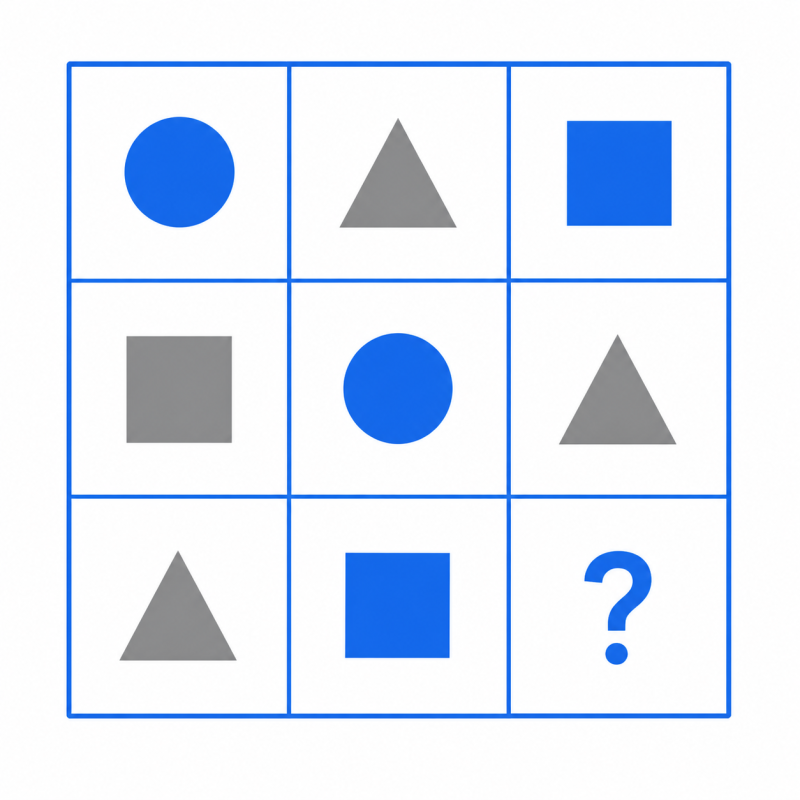
Step 1: Understand the Grid Structure
Before analyzing any patterns, the first and most important step is to understand how the 3×3 matrix is organized. Many mistakes happen simply because people apply the right rule in the wrong direction.
Start by stepping back and looking at the grid as a whole.
Ask yourself:
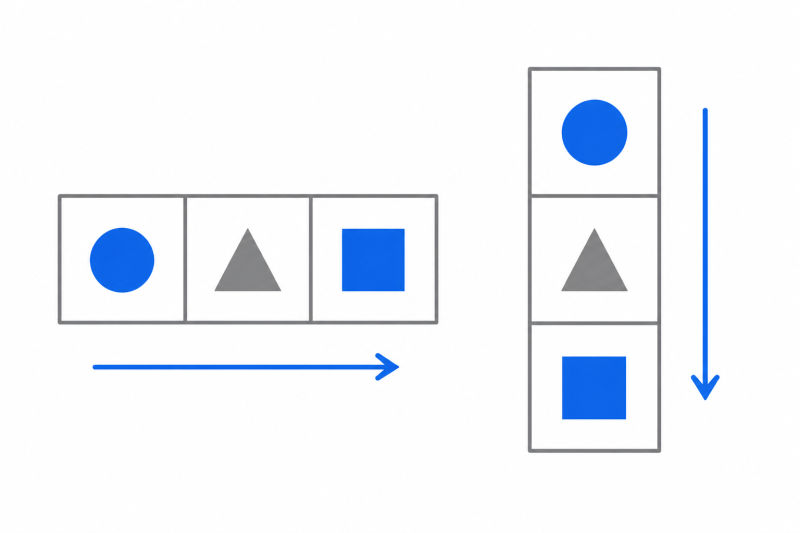
- Are the rules applied row by row, column by column, or both?
- Does the missing cell appear at the end of a row, at the bottom of a column, or at the intersection of a row and column?
- Do rows look independent from one another, or does each row build on the previous one?
Most 3×3 matrices follow one of three structural models:
- Each row follows the same internal rule
- Each column follows the same internal rule
- Rows use one rule, while columns use a different rule
Identifying this structure early prevents wasted effort. If you assume a row-based rule when the logic actually operates vertically, even a correct pattern will lead to the wrong answer.
Step 2: Look for Simple Rules First
Matrix reasoning problems often appear complex because they contain multiple shapes, colors, or visual distractions. However, the underlying logic is usually straightforward.
Before considering advanced explanations, always check for simple and common rule types:
- Rotation or orientation changes
- Movement or position shifts
- Number or count changes
- Color or shading patterns
- Shape addition or subtraction
- Symmetry or reflection
Test each possibility quickly and logically. Many difficult-looking matrices are built on basic counting or rotation rules that become obvious once distractions are ignored. For a full breakdown of each rule type, see our guide on the most common abstract reasoning patterns you must know.
Avoid the trap of assuming complexity too early. Simple rules are far more common than clever tricks.
Step 3: Analyze One Feature at a Time
A major source of confusion in matrix reasoning is trying to understand all changes simultaneously. This approach overloads working memory and leads to missed patterns.
Instead, isolate each feature and analyze it independently.
Work through the grid methodically:
- First, observe what happens to the shape type
- Then, examine the number of elements
- Next, analyze position or alignment
- Finally, consider color or shading
If one feature follows a clear and consistent rule, mentally lock it in and move on. Treat each feature as a separate puzzle. This structured approach turns visually complex grids into manageable components.
Step 4: Check How Rows and Columns Interact
In many 3×3 matrices, the third image in a row or column is not independent—it is the result of applying a logical operation to the first two images.
Common interaction rules include:
- Overlaying shapes
- Adding elements together
- Removing shared elements
- Subtracting one image from another
- Keeping only overlapping components
For example, if the first image contains a circle and the second contains a square, the third may include both shapes—or only what they share—depending on the rule.
Always test whether the third cell is derived from the first two. This is one of the most reliable ways to solve matrix problems efficiently.
Step 5: Watch for Number-Based Matrix Rules
Counting is one of the most powerful tools in matrix reasoning, yet it is often overlooked.
You may need to track:
- The number of shapes in each cell
- The total number of sides, corners, or dots
- The number of filled versus unfilled elements
A very common rule is:
- Cell 3 = Cell 1 + Cell 2
In other cases, numbers may increase, decrease, or alternate consistently across rows and columns.
If visual logic feels unclear or inconsistent, switch to counting. Numerical patterns often reveal the rule instantly when visual analysis does not.
Step 6: Identify Multi-Rule Matrices
More advanced 3×3 grids almost always involve more than one rule operating at the same time. These questions are designed to test mental organization rather than speed.
Examples include:
- Shapes rotate across rows while colors change down columns
- The number of elements increases horizontally while positions shift vertically
- One rule governs shape type, another governs shading
If a single rule explains only part of the grid, do not discard it. Instead, assume a second rule is present and analyze remaining features separately. Multi-rule matrices reward patience and systematic thinking. For the broader step-by-step approach that applies to all abstract reasoning questions, see how to solve abstract reasoning questions step by step.
Step 7: Predict the Missing Cell Before Looking at Options
Before checking the answer choices, pause and try to visualize what the missing cell should look like.
Ask yourself:
- How many shapes should it contain?
- What orientation should they have?
- Where should the elements be positioned?
- What color or shading should appear?
This mental prediction prevents you from being distracted by answer choices that look appealing but do not fully match the logic of the matrix.
Step 8: Eliminate Incorrect Answers Systematically
Once you examine the answer options, apply the rules you identified and eliminate choices logically.
Remove any option that:
- Violates one or more confirmed rules
- Fits one rule but contradicts another
- Introduces elements that never appear in the matrix
Even when unsure between two options, elimination significantly improves accuracy and reduces guesswork.
Common Mistakes in Matrix Reasoning
Even strong candidates make predictable mistakes. Be careful to avoid:
- Ignoring either rows or columns entirely
- Overcomplicating simple patterns
- Focusing on appearance instead of logic
- Forgetting to check for number-based rules
- Guessing without elimination
Most errors result from rushing or skipping steps, not from lack of intelligence.
How to Improve at 3×3 Matrix Reasoning
Matrix reasoning is a learnable skill that improves with structured practice.
Effective strategies include:
- Practicing matrices grouped by pattern type
- Carefully reviewing incorrect answers
- Timing practice sessions to build efficiency
- Training yourself to follow a consistent, step-by-step method
With enough exposure, matrix logic becomes familiar, and many 3×3 grids can be recognized and solved almost instantly. To build your overall abstract reasoning confidence, also explore practice tips for timed abstract reasoning tests and read whether abstract reasoning can genuinely be improved with practice.
Final Thoughts
3×3 matrix reasoning questions are not designed to trick you—they are designed to test structured thinking. Once you learn how to break the grid down, isolate features, and apply logical rules consistently, these questions become far less intimidating.
Matrix reasoning is not about intelligence alone. It is about method. With the right approach, even the most complex-looking grid can be cracked. To see how matrix logic connects to the broader topic, read about the difference between abstract and logical reasoning.
Ready to apply your matrix reasoning skills under real time pressure? Try our free 18-minute IQ exam — it includes 10 abstract reasoning questions with matrix-style problems built into the assessment.