
Numerical pattern questions are a core component of IQ tests, aptitude exams, and logical reasoning assessments. At first glance, number series problems may look intimidating, but most follow a limited set of logical rules. Once you learn how to recognize these rules quickly, solving number series becomes far more efficient and accurate.
This guide breaks down how numerical patterns work, the most common pattern types, and proven strategies to help you identify solutions fast—without relying on guesswork. If you want to jump straight into practice, our collection of 50 number series practice questions with step-by-step solutions is a great starting point.
What Are Numerical Pattern Questions?
Numerical pattern questions present a sequence of numbers with one or more missing values. Your task is to determine the underlying rule that governs the sequence and use it to identify the correct next number or missing term.
These questions test several cognitive skills at once, including:
- Logical reasoning
- Working memory
- Pattern recognition
- Mathematical intuition
Importantly, they do not require advanced math. Most number series rely on simple operations applied in structured ways.
Core Principles Behind Number Series
Before analyzing specific pattern types, it is essential to understand the fundamental principles that govern most numerical sequences. These principles act as mental shortcuts, helping you eliminate incorrect rules quickly and focus only on patterns that make logical sense.
Mastering these core ideas will dramatically improve both your speed and accuracy when solving number series questions.
Principle 1: Consistency
A valid numerical pattern must follow a rule that applies uniformly across the entire sequence. If a proposed rule explains only part of the series but fails at another point, it is almost certainly incorrect.
For example, if a sequence increases by +3 at first but suddenly requires +4 without a clear reason, the rule lacks consistency.
To apply this principle effectively:
- Always test your rule from the first term onward
- Check every transition, not just the last few numbers
- Be cautious of rules that “almost” work
Consistency is one of the fastest ways to eliminate incorrect patterns.
Principle 2: Simplicity
Most number series are designed around simple, elegant logic, even when the numbers look complex. Test designers prefer rules that are easy to explain once discovered.
If you find yourself using:
- Multiple unrelated operations
- Conditional rules that change randomly
- Long explanations
…then the pattern is likely incorrect.
When multiple explanations are possible, the simplest rule that fits all numbers is almost always the correct one. This is one of the key insights covered in our guide on hidden traps in number series questions — thinking like a test designer reveals why simple rules dominate.
A useful mindset is:
“Could this rule be explained in one clear sentence?”
If not, keep looking.
Principle 3: Stepwise Change
Most numerical sequences evolve in predictable steps, rather than jumping randomly. These steps may be:
- Constant (e.g., +2 each time)
- Gradually increasing or decreasing
- Alternating between two rules
- Applied to specific positions in the sequence
Understanding how numbers change from one term to the next—rather than focusing on the numbers themselves—is often the key to solving the problem.
Common Types of Numerical Patterns
While number series can appear highly varied, the majority fall into a limited set of recognizable categories. Learning these categories allows you to identify patterns quickly instead of relying on trial and error.
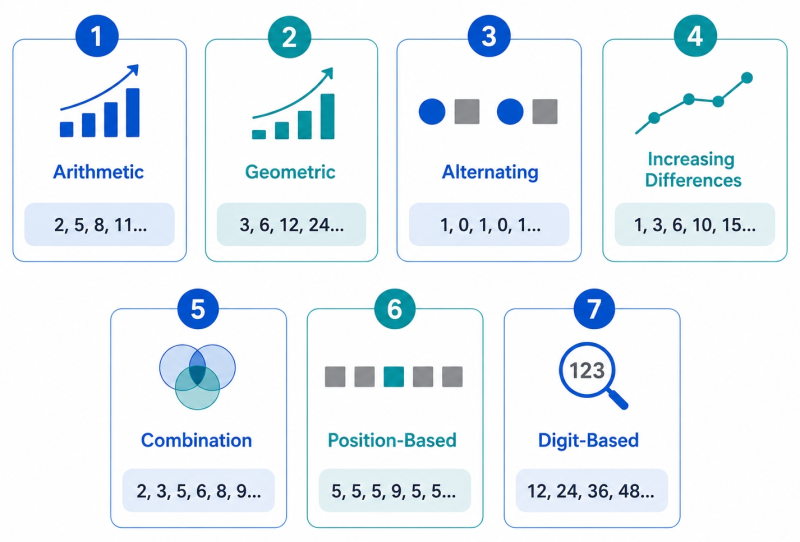
Arithmetic Sequences
Arithmetic sequences increase or decrease by a fixed amount each step.
Example: 2, 5, 8, 11, 14
Rule: Add 3 each time
To identify arithmetic sequences:
- Subtract each number from the next
- Look for a constant difference across the series
These patterns are typically the easiest and fastest to solve and often appear in early or lower-difficulty questions.
Geometric Sequences
Geometric sequences follow a constant multiplication or division rule.
Example: 3, 6, 12, 24, 48
Rule: Multiply by 2
Detection tips:
- Divide each number by the previous one
- Watch for rapid increases or sharp decreases
Geometric sequences often appear in medium-difficulty questions and can be identified quickly once ratios are checked.
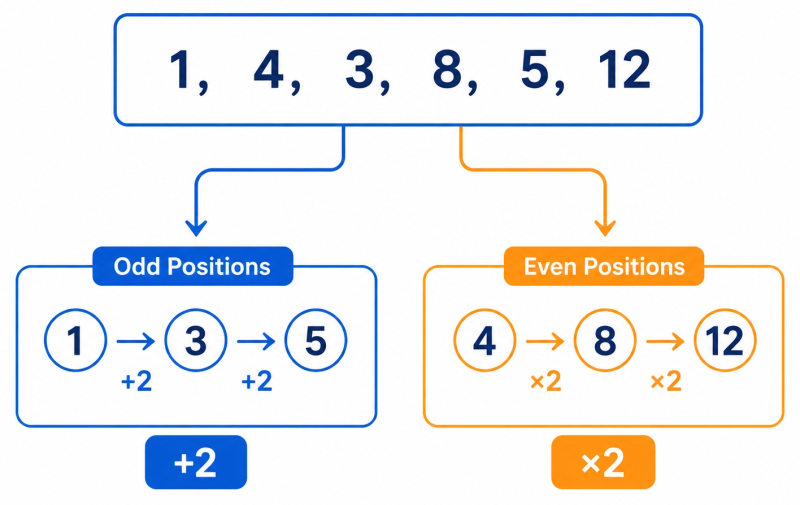
Alternating Patterns
Alternating sequences apply two or more rules in turn, often switching between odd and even positions.
Example: 1, 4, 3, 8, 5, 12
Rule:
- Odd positions: +2
- Even positions: ×2
How to identify alternating patterns:
- Separate the sequence into odd and even terms
- Analyze each subsequence independently
- Look for repetition or symmetry
These sequences may look complicated initially, but they usually become straightforward once split correctly. For a visual breakdown of all major pattern types including alternating sequences, see our visual guide to numerical pattern types.
Increasing or Decreasing Differences
In these sequences, the difference between numbers changes progressively.
Example: 2, 4, 7, 11, 16
Differences: +2, +3, +4, +5
Key insights:
- Always check the differences between terms
- If needed, check the differences of those differences
This pattern type is very common in IQ tests and often rewards systematic analysis.
Multiplication and Addition Combinations
Some number series combine multiplication with addition or subtraction.
Example: 2, 6, 14, 30
Rule: ×2 + 2, ×2 + 2, ×2 + 2
Practical tips:
- Test simple combinations first
- Try ×2 ± 1, ×2 ± 2, ×3 ± 1
These sequences reward methodical testing rather than intuition or guessing.
Position-Based Patterns
In position-based sequences, each number is determined by its position index, not the previous number.
Example: 1, 4, 9, 16, 25
Rule: n² (perfect squares)
Other common position-based rules include:
- n × 2
- n³
- n + n
These sequences are often clean and mathematically elegant, making them easier to verify once identified. Advanced versions involving Fibonacci numbers, prime sequences, and factorials are covered in advanced numerical patterns in IQ tests.
Digit-Based Patterns
Digit-based patterns depend on the digits within the numbers, rather than their overall value.
Example: 19, 28, 37, 46
Rule:
- Each number increases by 9
- Each digit increases by 1
Watch closely for:
- Digit sums
- Digit reversal patterns
- Repeating digit movement
These patterns test attention to detail and are easy to miss if you focus only on arithmetic value.
Step-by-Step Strategy to Solve Number Series Fast
Speed comes from having a repeatable system, not from rushing. If you need to get faster without sacrificing accuracy, our high-speed strategy guide for solving number series in under 20 seconds walks through exactly how to do this.

Step 1: Scan the Sequence
Before calculating anything, observe:
- Is the sequence increasing or decreasing?
- Does growth appear steady or rapid?
- Is there a visible alternation?
This initial scan often points you toward the correct pattern type.
Step 2: Check Differences
Subtract consecutive terms.
- Constant difference → arithmetic sequence
- Changing difference → higher-order pattern
This single step solves a large percentage of problems.
Step 3: Check Ratios
If differences fail, divide consecutive numbers.
- Constant ratio → geometric sequence
This is especially effective when numbers grow quickly.
Step 4: Split the Sequence
If the pattern remains unclear:
- Separate odd and even positions
- Analyze each subsequence independently
Many hidden patterns reveal themselves immediately after splitting.
Step 5: Test Simple Rules First
Always test the most common rules before complex ones:
- +1, +2, +3
- ×2, ×3
- ±1 after multiplication
Complex rules are rarely necessary.
Elimination Techniques for Multiple-Choice Questions
You do not always need to find the exact rule.
Eliminate answer choices that:
- Break the pattern you have identified
- Do not fit earlier numbers
- Introduce unnecessary complexity
Often, only one option remains logically consistent.
Common Mistakes in Numerical Pattern Problems
Overthinking the rule: If a rule requires several unrelated steps, it is likely wrong.
Ignoring early terms: A valid rule must work from the beginning of the sequence.
Rushing calculations: Small arithmetic errors can invalidate a correct idea.
Missing alternating structures: Always check for dual-pattern sequences before moving on. If you find yourself making the same errors repeatedly, read why you keep getting number series questions wrong — it covers the most common failure patterns and how to fix them.
How to Train Numerical Pattern Recognition
Improvement comes through deliberate, focused practice.
Effective training methods include:
- Solving timed number series daily
- Explaining the rule aloud after each solution
- Creating your own sequences and solving them
- Gradually increasing difficulty levels
Track which pattern types challenge you most and target them specifically for faster improvement. For a structured approach, our 30-day pattern recognition training plan gives you a day-by-day schedule designed for steady, measurable progress. You can also explore how numerical patterns compare to other question types in our guide on number series vs other IQ question types.
Final Thoughts
Numerical pattern questions are not about advanced math—they are about recognition, structure, and discipline. When you learn to approach each sequence with a clear method, patterns reveal themselves quickly and reliably.
With consistent practice and the strategies outlined in this guide, you can dramatically improve your speed, accuracy, and confidence when solving number series under pressure. To explore the deeper mathematics behind sequences, read about recursive rules, polynomials and logical structures in number sequences.