If you want to master number series questions for exams like the GMAT, SHL assessments or Mensa admission tests, practice is non-negotiable.
But not just random practice.
You need structured exposure:
- Easy patterns for speed
- Medium patterns for flexibility
- Hard patterns for abstraction and control
Below are 50+ carefully selected questions, organized by difficulty, each with step-by-step reasoning. Before starting, make sure you understand the core pattern types — our guide on numerical pattern types explained gives you the visual reference you'll need to categorize each question quickly.
Part 1: 20 Easy Questions (Core Patterns)
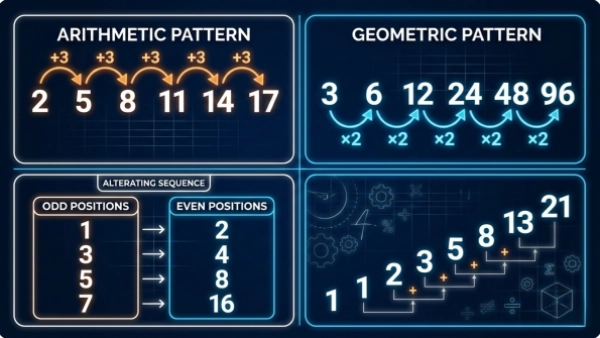
Focus: arithmetic sequences, geometric sequences, perfect squares, cubes, simple alternation, and basic Fibonacci logic.
These problems train rapid pattern recognition. At this level, your goal is immediate identification of structure. Most should be solved in under 10 seconds once you’re comfortable.
1. 2, 4, 6, 8, ?
First, check the differences between consecutive terms:
- 4 − 2 = 2
- 6 − 4 = 2
- 8 − 6 = 2
The difference is constant (+2). This is a classic arithmetic sequence.
Rule: Add 2 each time.
Answer: 10
2. 5, 10, 15, 20, ?
Each term increases by 5.
- 10 − 5 = 5
- 15 − 10 = 5
- 20 − 15 = 5
Rule: Arithmetic sequence (+5).
Answer: 25
3. 3, 6, 12, 24, ?
Check ratios instead of differences:
- 6 ÷ 3 = 2
- 12 ÷ 6 = 2
- 24 ÷ 12 = 2
Each term doubles.
Rule: Multiply by 2 each time.
Answer: 48
4. 1, 4, 9, 16, ?
Recognize perfect squares:
- 1 = 1²
- 4 = 2²
- 9 = 3²
- 16 = 4²
Next term: 5² = 25
Answer: 25
5. 7, 14, 21, 28, ?
Each term increases by 7.
Rule: Arithmetic (+7).
Answer: 35
6. 1, 3, 5, 7, ?
These are consecutive odd numbers.
Rule: Add 2 each time (odd sequence).
Answer: 9
7. 10, 20, 40, 80, ?
Each term is multiplied by 2.
Rule: Geometric sequence (×2).
Answer: 160
8. 4, 8, 12, 16, ?
Constant increase of 4.
Answer: 20
9. 1, 2, 4, 7, 11, ?
Check differences:
- 2 − 1 = 1
- 4 − 2 = 2
- 7 − 4 = 3
- 11 − 7 = 4
The differences increase by 1 each time.
Next difference = 5
11 + 5 = 16
Answer: 16
10. 9, 18, 27, 36, ?
Add 9 each time.
Answer: 45
11. 2, 5, 8, 11, ?
Add 3 each time.
Answer: 14
12. 100, 90, 80, 70, ?
Subtract 10 each time.
Answer: 60
13. 1, 8, 27, 64, ?
Recognize cubes:
- 1³ = 1
- 2³ = 8
- 3³ = 27
- 4³ = 64
Next: 5³ = 125
Answer: 125
14. 6, 12, 24, 48, ?
Multiply by 2.
Answer: 96
15. 3, 9, 27, 81, ?
Multiply by 3.
Answer: 243
16. 11, 22, 33, 44, ?
Add 11 each time.
Answer: 55
17. 2, 6, 10, 14, ?
Add 4 each time.
Answer: 18
18. 5, 4, 3, 2, ?
Subtract 1 each time.
Answer: 1
19. 8, 16, 24, 32, ?
Add 8 each time.
Answer: 40
20. 1, 1, 2, 3, 5, ?
Each term equals the sum of the two previous terms.
- 1 + 1 = 2
- 1 + 2 = 3
- 2 + 3 = 5
Next: 3 + 5 = 8
Answer: 8
Part 2: 20 Medium Questions (Mixed & Second-Order Logic)
Focus: alternating patterns, second-level differences, compound operations, factorial growth, and layered rules. At this level, you must systematically test differences, ratios, and positional logic. If you find yourself consistently making the same types of errors, read hidden traps in number series questions to understand exactly what's catching you out.
21. 4, 7, 12, 19, 28, ?
Differences:
+3, +5, +7, +9
The differences increase by 2 each time.
Next difference = +11
28 + 11 = 39
Answer: 39
22. 2, 5, 4, 7, 6, ?
Split into two sequences:
- Odd positions: 2, 4, 6
- Even positions: 5, 7
Even positions increase by 2.
Next even term = 9
Answer: 9
23. 3, 8, 15, 24, 35, ?
Differences:
+5, +7, +9, +11
Next difference = +13
35 + 13 = 48
Answer: 48
24. 1, 4, 2, 8, 3, 16, ?
Odd positions: 1, 2, 3
Even positions: 4, 8, 16
Odd sequence increases by 1.
Next odd term = 4
Answer: 4
25. 5, 9, 17, 33, ?
Observe the pattern:
- 5 × 2 − 1 = 9
- 9 × 2 − 1 = 17
- 17 × 2 − 1 = 33
Continue:
33 × 2 − 1 = 65
Answer: 65
26. 6, 11, 21, 36, 56, ?
Differences:
+5, +10, +15, +20
These increase by 5.
Next difference = +25
56 + 25 = 81
Answer: 81
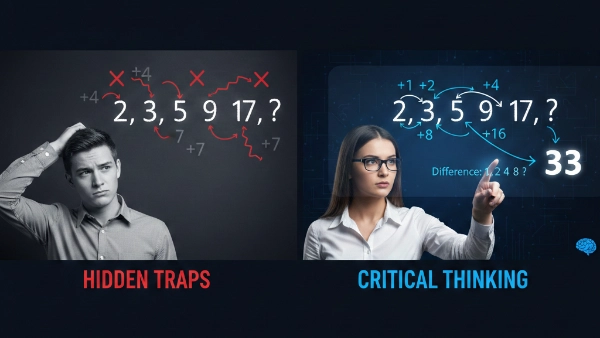
27. 2, 3, 5, 9, 17, ?
Differences:
+1, +2, +4, +8
Each difference doubles.
Next difference = +16
17 + 16 = 33
Answer: 33
28. 1, 2, 6, 24, 120, ?
Recognize factorial growth:
- 1! = 1
- 2! = 2
- 3! = 6
- 4! = 24
- 5! = 120
Next: 6! = 720
Answer: 720
29. 4, 9, 19, 39, 79, ?
Differences:
+5, +10, +20, +40
Each difference doubles.
Next difference = +80
79 + 80 = 159
Answer: 159
30. 10, 13, 18, 25, 34, ?
Differences:
+3, +5, +7, +9
Next difference = +11
34 + 11 = 45
Answer: 45
31. 2, 4, 3, 6, 4, 8, ?
Alternating
Odd: 2, 3, 4
Even: 4, 6, 8
Next odd: 5
Answer: 5
32. 3, 5, 9, 17, 33, ?
Differences double
+2, +4, +8, +16
Next: +32
Answer: 65
33. 7, 14, 28, 31, 62, ?
×2, +3 alternating
31×2 = 62
Next +3 → 65
Answer: 65
34. 1, 3, 7, 15, 31, ?
×2 +1
Next: 63
Answer: 63
35. 5, 10, 20, 25, 50, ?
×2, +5 alternating
Next +5 → 55
Answer: 55
36. 8, 6, 9, 7, 10, ?
Alternating
Odd: 8, 9, 10
Even: 6, 7
Next even: 8
Answer: 8
37. 3, 7, 6, 14, 9, ?
Odd: 3, 6, 9
Even: 7, 14
Next even: 21
Answer: 21
38. 1, 5, 14, 30, 55, ?
Differences: +4, +9, +16, +25
Squares
Next: +36
Answer: 91
39. 9, 7, 10, 8, 11, ?
Odd: 9, 10, 11
Even: 7, 8
Next even: 9
Answer: 9
40. 2, 6, 7, 21, 22, ?
×3 alternating
Next: 22×3 = 66
Answer: 66
Part 3: 10 Hard Questions (Advanced Logic)
Focus: recursive, position-based, layered structures. For a deeper understanding of the advanced logic behind these questions — including Fibonacci, primes, and factorials — read advanced numerical patterns in IQ tests before attempting this section.
41. 2, 5, 7, 12, 19, ?
Recursive
Answer: 31
42. 1, 4, 10, 20, 35, ?
Differences: +3, +6, +10, +15
Triangular numbers
Next: +21
Answer: 56
43. 3, 6, 18, 72, 360, ?
×2, ×3, ×4, ×5
Next ×6
Answer: 2160
44. 1, 2, 4, 7, 13, 24, ?
Each = sum of previous two +1
Next: 44
45. 2, 9, 28, 65, ?
Cubes +1
1³+1=2
2³+1=9
3³+1=28
4³+1=65
Next: 5³+1 = 126
Answer: 126
46. 5, 6, 9, 18, 45, ?
×1, ×1.5, ×2, ×2.5
Next ×3
Answer: 45×3 = 135
47. 4, 10, 22, 46, ?
×2 +2
Next: 94
48. 2, 4, 12, 48, 240, ?
×2, ×3, ×4, ×5
Next ×6
Answer: 1440
49. 1, 3, 12, 60, 360, ?
×3, ×4, ×5, ×6
Next ×7
Answer: 2520
50. 6, 13, 28, 59, ?
×2 +1
Next: 119
How to Use This Practice Set Effectively
Do not simply read the answers. Train the method.
For each problem:
- Observe your first instinct.
- Check differences.
- Check ratios.
- Test alternation.
- Look for squares, cubes, or factorials.
- Confirm consistency across all terms.
Time Targets
- Easy: under 10 seconds
- Medium: under 20 seconds
- Hard: under 30 seconds
Speed comes from structured thinking, not guessing. For a proven framework to solve any number series within 20 seconds, see our high-speed strategy guide for solving number series in under 20 seconds.
Final Advice
Mastery of number series is not about memorizing patterns. It is about recognizing structural templates, avoiding traps, managing cognitive load, and practicing under time pressure. Work through these repeatedly. The more structures you internalize, the faster recognition becomes. And eventually — you won't just solve number series. You'll anticipate them.
When you're ready to test your skills in a real timed environment, try our free IQ exam.