Most test-takers approach number series questions like students.
Top performers approach them like test designers.
That shift in perspective changes everything.
In high-level assessments such as the GMAT, SHL reasoning tests, or Mensa admission exams, number sequences are not just math problems. They are psychological filters.
They are built to exploit predictable thinking errors.
If you want to solve them faster and more accurately, you must understand how they are constructed — and how they are designed to mislead you.
Why Test Designers Build Traps
A well-designed number series question is not created to test whether you can add or multiply.
It is built to measure how you think under uncertainty.
A strong question must accomplish three things simultaneously:
- Reward structured reasoning
- Penalize shallow pattern recognition
- Differentiate flexible thinkers from rigid ones
If a sequence is too obvious, everyone answers correctly — and it fails as a discriminator.
If it is too random, no one can solve it — and it fails as a reasoning test.
The ideal question lives in a narrow psychological zone:
- It presents a rule that looks familiar.
- It partially confirms your expectation.
- It encourages early commitment.
Then it quietly violates that expectation.
That moment — when your brain says, “This must be it” — is exactly where the trap is placed.
Test designers understand something critical about human cognition: we prefer fast closure over prolonged ambiguity. And number series traps exploit that preference. To understand the cognitive mechanisms being exploited here, read the science of pattern recognition: how your brain solves number series.
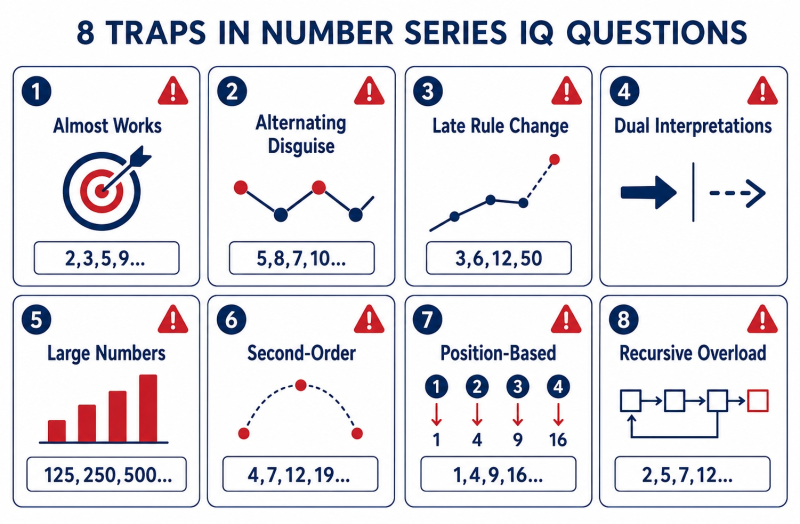
Trap #1: The “Almost Works” Pattern
Consider:
2, 3, 5, 9, 17, ?
At first glance, it resembles Fibonacci.
- 2 + 3 = 5
- 3 + 5 = 8 (not 9)
Many candidates stop checking after the first confirmation. The brain sees:
“Addition of previous two numbers.”
It matches a familiar template. That familiarity creates confidence.
But the rule fails at the second transition.
This is where premature commitment happens.
Now check differences:
+1, +2, +4, +8
That’s powers of 2.
Next difference: +16
17 + 16 = 33
Why is this trap effective?
Because the first step confirms a known structure. That partial confirmation is enough for many people to stop verifying.
The brain values pattern recognition speed — but tests reward pattern verification. Lesson: A rule that works once is coincidence. A rule that works every time is structure. Never commit before full consistency testing. For a structured testing order to follow, see our high-speed strategy guide for solving number series in under 20 seconds.
Trap #2: Alternating Patterns Disguised as Linear Growth
Example:
5, 8, 7, 10, 9, 12, ?
At first glance, the sequence feels messy:
+3, -1, +3, -1, +3…
That inconsistency creates cognitive friction.
But split it:
- Odd positions: 5, 7, 9
- Even positions: 8, 10, 12
Now it becomes clean.
Answer: 11
Alternating patterns are powerful traps because they overwhelm linear thinkers. Many test-takers only analyze consecutive differences. When that fails, they assume complexity.
Designers use alternation to disguise simplicity inside surface irregularity.
The surface looks chaotic. The structure is elegant.
Lesson: When differences look unstable, split the sequence before assuming difficulty.
Trap #3: Changing Rule in the Final Steps
Example:
3, 6, 12, 24, 50
Most people instantly see doubling:
×2, ×2, ×2…
Then:
24 × 2 = 48 — but the sequence says 50.
This trap targets autopilot thinking.
Some candidates rationalize:
- “Maybe it’s a small arithmetic variation.”
- “Maybe they added 2 at the end.”
But high-level questions often introduce a late-stage violation to test consistency monitoring.
The test designer’s goal here is simple:
- Who verifies every transition?
- Who assumes continuity without checking?
If even one step breaks the rule, the rule is wrong.
Consistency is non-negotiable.
Trap #4: Dual Valid Interpretations
Consider:
1, 4, 9, 16, ?
The obvious answer is 25 (perfect squares).
But imagine answer choices include:
- 25
- 24
- 26
- 32
Now imagine a slightly modified sequence:
2, 6, 12, 20, ?
Differences:
+4, +6, +8
Next difference: +10
20 + 10 = 30
But a candidate might also attempt:
- 2×1 + 4
- 2×2 + 2
- 2×3 + 6
The brain begins constructing complicated algebraic explanations.
When multiple interpretations partially fit, weaker test-takers assume complexity equals correctness.
Designers intentionally craft sequences where:
- One rule is perfectly clean
- Another rule is messy but plausible
The trap rewards overthinking.
Lesson: The correct rule explains every step cleanly with minimal assumptions.
Simplicity plus consistency beats creativity plus patchwork logic.
Trap #5: Large Numbers to Create Cognitive Overload
Example:
125, 250, 500, 1000, ?
Under time pressure, large numbers trigger anxiety.
Working memory becomes strained. Candidates begin second-guessing.
But the rule is simple doubling.
Answer: 2000
The trap here is emotional, not mathematical.
Large values increase perceived difficulty. Stress reduces cognitive efficiency.
Designers know that under pressure:
- Arithmetic feels harder
- Estimation feels unreliable
- Confidence drops
But structure doesn’t change because magnitude increases.
Lesson: Strip away size. Focus on transformation.
Big numbers are often camouflage.
Trap #6: Hidden Second-Order Patterns
Example:
4, 7, 12, 19, 28, ?
Differences:
+3, +5, +7, +9
The second differences are constant (+2).
Next difference: +11
28 + 11 = 39
Many candidates check for constant differences only. When they don’t see repetition, they panic.
Advanced tests frequently use second-order logic because it filters shallow scanners.
If first differences aren’t constant, don’t stop.
Check whether the differences themselves follow a pattern.
This small extra step separates structured thinkers from surface calculators. For a complete guide to the pattern types that rely on second-order logic — including Fibonacci, primes, and factorials — read advanced numerical patterns in IQ tests.
Trap #7: Position-Based Patterns
Example:
1, 4, 9, 16, 25, ?
This sequence isn’t about consecutive change at all.
It’s about position:
1², 2², 3², 4², 5²
Answer: 36
Position-based patterns require abstraction. You must stop thinking locally and think globally.
Instead of asking:
“What changed from one number to the next?”
Ask:
“What is the formula for the nth term?”
Designers use these patterns to test abstraction ability — the capacity to represent numbers symbolically rather than concretely. For a full visual reference of all major pattern types including position-based ones, see numerical pattern types explained: a visual breakdown for faster recognition.
Trap #8: Recursive Sequences That Increase Cognitive Load
Example:
2, 5, 7, 12, 19, ?
Check:
- 2 + 5 = 7
- 5 + 7 = 12
- 7 + 12 = 19
Recursive rule.
Next:
12 + 19 = 31
Recursive patterns are not conceptually hard. They are cognitively demanding.
They require holding multiple prior values in working memory.
Under time pressure, mental tracking errors occur:
- Forgetting a term
- Adding incorrectly
- Losing sequence order
The trap here is overload.
Designers increase complexity not through mathematics, but through memory strain.
Psychological Traps
Not all traps involve numbers.
Some exploit cognitive biases.
1. Anchoring Bias
You fixate on the first plausible rule and resist abandoning it.
2. Confirmation Bias
You search for evidence supporting your hypothesis instead of testing it rigorously.
3. Complexity Bias
You assume the rule must be complicated because the test is difficult.
In reality, many advanced questions hide simple rules behind misleading surfaces.
Often the simplest consistent explanation wins.
Think Like a Test Designer
Shift perspective.
Ask yourself:
- If I wanted to mislead candidates, which familiar pattern would I imitate?
- Where would I insert partial confirmation?
- How could I create surface irregularity over structural simplicity?
- What mistake would rushed candidates make?
This mental inversion is powerful.
When you anticipate deception, you become resistant to it.
Defensive Strategy Checklist
Before choosing an answer, confirm:
- The rule works for every transition
- No single step violates consistency
- You checked for alternation
- You considered second-order differences
- You evaluated position-based logic
- You rejected partial matches
- You chose the simplest complete explanation
This verification process takes seconds. But those seconds prevent avoidable mistakes. To put this checklist into practice with real examples across all difficulty levels, work through our 50+ number series practice questions with step-by-step solutions.
Once you understand how traps are built, test yourself against real timed questions — take our free 18-minute IQ exam and see how well your trap-detection holds up under actual time pressure.