In high-pressure exams like the GMAT, SHL assessments, or Mensa admission tests, speed is not a luxury — it’s survival.
Number series questions are designed to measure reasoning under time constraints. The difference between average and elite performers isn’t mathematical ability. It’s pattern recognition speed.
This guide will show you exactly how to reduce your solving time to under 20 seconds — consistently.
Why Most People Waste Time
When test-takers see a sequence like:
4, 9, 19, 39, 79, ?
their brain immediately feels pressure.
The jumps look irregular. The numbers grow quickly. There’s no obvious +2 or ×2 pattern. That uncertainty triggers a common mistake: unstructured thinking.
Most people:
- Start calculating random differences
- Jump to multiplication because the numbers “look big”
- Try two or three rules halfway
- Stick to the first idea that almost works
- Refuse to reset when it fails
For example, someone might test doubling:
- 4 × 2 = 8 (not 9)
- Close — but not correct.
Instead of abandoning the idea immediately, they tweak it:
- “Maybe it’s ×2 + 1?”
- “Maybe it alternates?”
- “Maybe it’s exponential?”
Now they are guessing, not diagnosing.
Meanwhile, the clock keeps moving.
The real issue isn't intelligence. It's lack of structure under time pressure. High-speed solvers don't panic when they don't see the pattern instantly. They follow a fixed decision tree. That's the difference. To understand why the brain behaves this way under pressure, read the science of pattern recognition: how your brain solves number series.
The 20-Second Framework
The goal is not to rush.
The goal is to eliminate possibilities fast and methodically.
Think of it as a triage system for patterns.
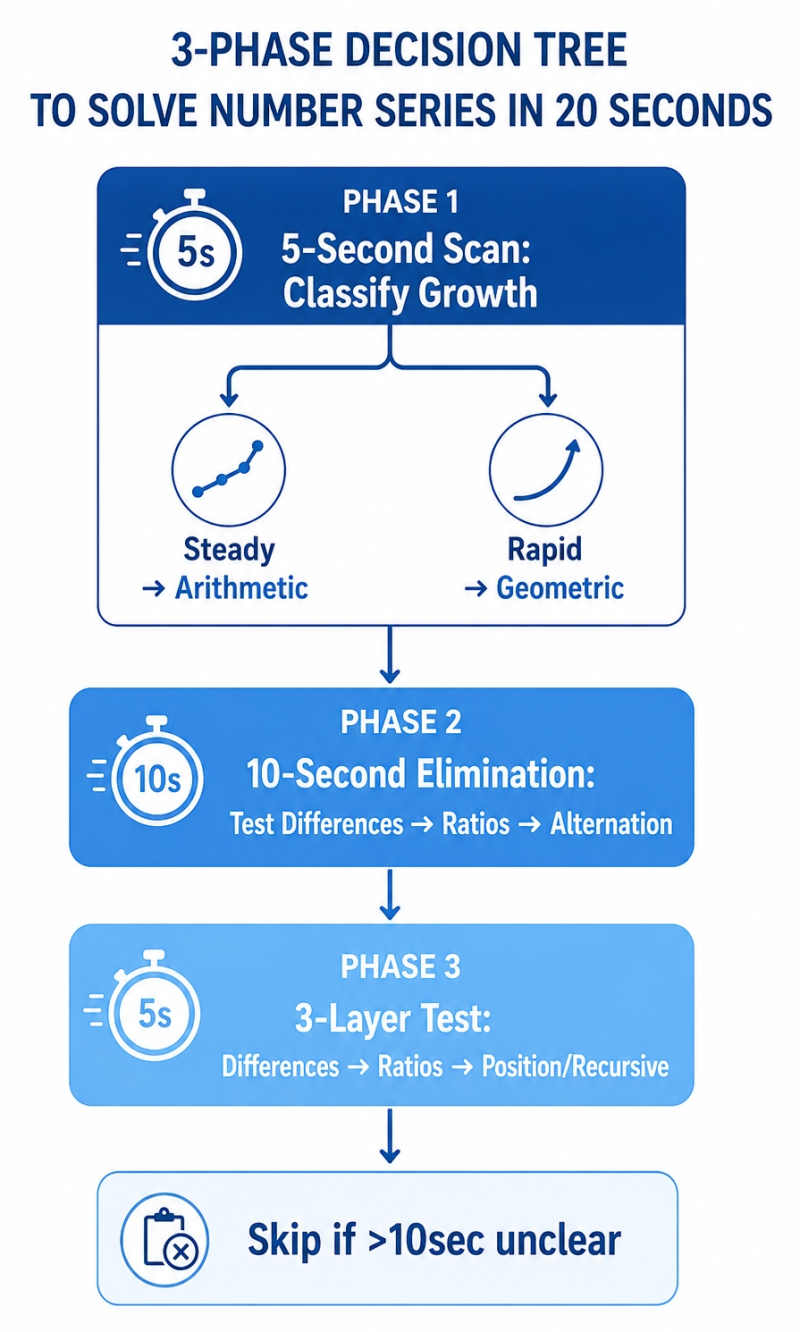
Phase 1: The 5-Second Scan Rule
Time limit: 5 seconds
Your job here is not to solve the sequence.
Your job is to classify it.
Immediately check two things:
1. Growth Speed
Ask yourself:
- Is the increase small and steady?
- Is it exploding rapidly?
- Does it look uneven or jumpy?
Small steady increase → likely arithmetic
Rapid explosion → geometric or exponential
Irregular jumps → alternating or mixed structure
Your brain is excellent at detecting visual magnitude changes. Use that instinct before calculating anything.
2. Visual Symmetry
Now ask:
Do odd and even positions look different?
Example:
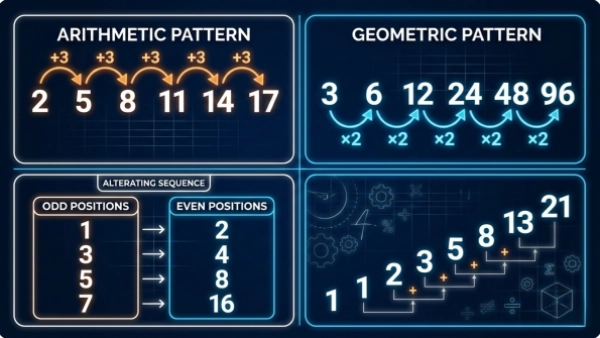
2, 5, 4, 7, 6, 9, ?
Within seconds, you should notice:
- Odd positions: 2, 4, 6
- Even positions: 5, 7, 9
Two clean mini-sequences.
Answer: 8
- No heavy arithmetic required.
- No difference tables.
- No complex modeling.
The first five seconds determine your path.
If you misclassify the structure, you waste the next fifteen seconds.
Diagnosis first. Calculation second.
Phase 2: The 10-Second Elimination Rule
Time limit: 10 seconds
Now you test rules — but in strict order.
Not randomly.
Not emotionally.
Systematically.
Step 1: Check Differences (Always First)
Subtract consecutive numbers.
This single action eliminates most patterns immediately.
If differences are:
- Constant → Arithmetic
- Increasing consistently → Second-order
- Alternating → Split the sequence
Example:
3, 6, 11, 18, 27, ?
Differences:
+3, +5, +7, +9
Now you see it: consecutive odd numbers.
Next difference = +11
27 + 11 = 38
Differences first is powerful because it reveals hidden structure beneath surface noise. In most exams, this step alone solves the majority of questions. For a complete visual reference of what each difference pattern means, see numerical pattern types explained: a visual breakdown for faster recognition.
Step 2: Check Ratios
If differences don’t behave, divide.
Example:
3, 6, 12, 24, ?
Ratios:
×2, ×2, ×2
Answer: 48
Geometric sequences reveal themselves through rapid growth.
Your brain should instantly flag patterns that double or triple.
If numbers are escalating dramatically, think multiplication before anything else.
Step 3: Check Alternation
If neither differences nor ratios are clean, split the sequence.
Example:
1, 4, 2, 8, 3, 16, ?
- Odd positions: 1, 2, 3
- Even positions: 4, 8, 16
Answer: 4
Alternating patterns are common traps in higher-level aptitude tests because they look chaotic at first glance.
But once separated, they become simple.
Phase 3: The 3-Layer Testing Method
If the pattern still isn’t obvious, escalate logically.
First Layer: Differences
Second Layer: Ratios
Third Layer: Position-based or Recursive Logic
Never jump to layer three first.
Example:
1, 4, 9, 16, 25, ?
Differences increase: +3, +5, +7, +9
That suggests a quadratic pattern.
Or you instantly recognize:
1², 2², 3², 4², 5²
Answer: 36
Now consider a recursive pattern:
2, 3, 5, 8, 13, ?
Each term equals the sum of the previous two.
Answer: 21
Recursive sequences feel harder because they require tracking relationships across positions, not just adjacent numbers. They increase cognitive load — but the testing order remains the same. For a full breakdown of recursive sequences including Fibonacci, primes, and factorials, read advanced numerical patterns in IQ tests.
When to Skip (Elite Strategy)
Speed is not solving everything instantly.
Speed is knowing when something isn’t worth immediate effort.
Skip immediately if:
- You cannot classify the pattern in 10 seconds
- The numbers are messy and inconsistent
- Multiple rules appear partially valid
- You feel cognitive friction building
Top scorers don’t fight difficult questions early.
They collect easy points first.
Returning later with a calmer brain often reveals the pattern instantly.
Stubborn persistence is the enemy of high scores. Many of the situations where skipping is the right call arise from deliberate traps built into the question. Understanding how those traps are constructed makes it easier to recognize them quickly — read hidden traps in number series questions: think like a test designer.
Common High-Speed Recognition Triggers
Train your eye to spot structural templates automatically:
- 1, 4, 9, 16 → Squares
- 2, 4, 8, 16 → Powers of 2
- 1, 1, 2, 3, 5 → Fibonacci structure
- +2, +4, +8 → Doubling differences
Clear odd/even separation → Alternating
The faster you map structure, the less computation you perform.
Speed comes from recognition, not arithmetic power.
Mental Efficiency Tricks
1. Stop Calculating Everything
You do not need full difference tables for obvious patterns.
Often two transitions are enough to predict direction.
Over-calculating wastes time and increases error risk.
2. Use Approximation
If answer choices are:
- 40
- 80
- 160
You don’t need precision.
You need magnitude.
Is the sequence doubling?
Then 160 is likely.
Rough estimation is faster than exact calculation.
3. Test the Entire Sequence Before Committing
A rule that explains the first half but fails later is a classic trap.
Example:
3, 6, 12, 24, 50
Doubling works — until 50 appears.
Strong solvers verify consistency across the entire sequence before choosing.
Why This Works (Cognitive Perspective)
Fast solving relies on cognitive mechanisms such as:
- Pattern abstraction – seeing relationships, not surface numbers
- Working memory efficiency – holding transformations mentally
- Rapid hypothesis rejection – discarding wrong rules quickly
- Inhibitory control – resisting attractive but incorrect patterns
You are not memorizing sequences.
You are building a mental library of structural templates.
With repetition, detection becomes automatic.
You no longer “search” for patterns.
You recognize them.
5 Practice Speed Drills
Solve each in under 20 seconds:
- 5, 9, 17, 33, ?
- 7, 14, 28, 56, ?
- 4, 7, 12, 19, 28, ?
- 2, 6, 7, 21, 22, ?
- 1, 3, 6, 10, 15, ?
Answers:
- 65
- 112
- 39
- 66
- 21
Time yourself honestly. Identify where you hesitated — classification, difference testing, or alternation detection — and improve the weakest link. For a larger bank of timed practice with detailed explanations, work through our 50+ number series practice questions with step-by-step solutions.
The 20-Second Mindset
Speed is not rushing.
It is:
- Structured testing
- Fast elimination
- Controlled flexibility
- Confident skipping
Average test-takers search for answers. Top performers search for structure. When you internalize this framework, number series stop feeling random. They become compressed logic systems. And once you recognize the structure — 20 seconds isn't stressful. It's plenty.
To put this framework into practice right now, try our free IQ exam — it includes numerical pattern questions under real time pressure, giving you an honest benchmark of your current speed and accuracy.