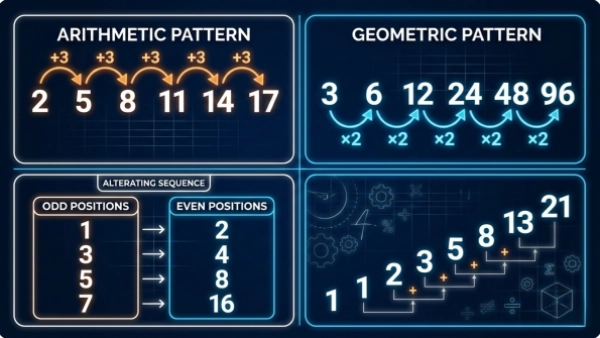
When you solve a number series like:
2, 4, 8, 16, ?
It may feel like a simple math task. You notice the pattern, double the last number, and answer 32.
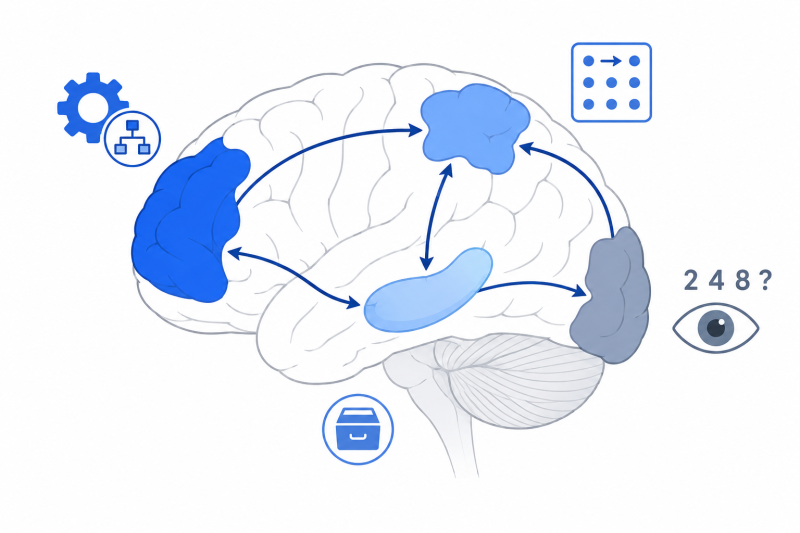
But beneath that quick insight lies a sophisticated network of cognitive processes. Your brain is not just “doing math.” It is detecting structure, testing hypotheses, holding multiple possibilities in working memory, and suppressing incorrect interpretations—all within seconds.
Understanding the science behind pattern recognition does more than satisfy curiosity. It helps you solve number series faster, avoid common cognitive traps, and train your reasoning more effectively.
Let’s explore what is actually happening inside your brain when you face a numerical pattern.
1. Pattern Recognition Is a Survival Skill
Long before IQ tests, classrooms, or mathematics textbooks existed, pattern recognition was a survival mechanism.
Early humans depended on it every day.
They needed to:
- Predict animal behavior from movement patterns
- Detect seasonal shifts by observing temperature and plant cycles
- Recognize social hierarchies within groups
- Identify threats from subtle environmental changes
A rustling sound in tall grass was not just noise. It was data. The brain had to decide:
- Is that the wind?
- Or a predator?
The ability to detect structure in uncertain environments increased survival odds. Those who recognized patterns quickly were more likely to respond correctly—and survive.
Over thousands of years, the human brain became extraordinarily sensitive to regularities. It constantly scans the environment for repetition, rhythm, symmetry, and deviation.
This is why, when you look at a number series, your mind automatically asks:
Is there order here?
Even before you consciously calculate, your brain searches for structure. It compares differences, notices growth rates, and looks for rhythm. That impulse is not learned in school—it is biological.
Number series questions simply compress that ancient evolutionary skill into a timed mental puzzle. Instead of predicting animal movement, you are predicting numerical structure.
The context changed. The cognitive mechanism did not.
2. The Role of Fluid Intelligence
Fluid intelligence is the ability to solve new problems without relying on stored knowledge. It is reasoning in its purest form.
When you encounter a familiar multiplication table, you use memory.
When you encounter an unfamiliar number sequence, you use fluid intelligence.
Consider:
3, 6, 11, 18, 27, ?
There is no obvious formula at first glance. Your brain begins exploring possibilities:
- Is it doubling?
- Is it multiplying?
- Is it adding a fixed number?
- Is it alternating operations?
You test hypotheses mentally.
Check differences:
- 6 − 3 = 3
- 11 − 6 = 5
- 18 − 11 = 7
- 27 − 18 = 9
Now a pattern emerges: +3, +5, +7, +9.
You recognize consecutive odd numbers.
That moment of clarity—the instant when the structure “clicks”—is fluid intelligence in action.
You did not memorize this sequence.
You constructed the rule.
High-level number series are powerful measures of fluid intelligence because they require:
- Generating multiple possible explanations
- Testing those explanations logically
- Rejecting incorrect rules quickly
- Committing only when consistency is verified
Fluid intelligence is not about speed alone. It is about adaptability. The more efficiently you test and discard weak hypotheses, the stronger your reasoning performance. To see how this applies in practice across different pattern types, read our guide on numerical pattern types explained.
To understand the science behind improving fluid intelligence through practice, read our article on whether abstract reasoning can be improved.
3. Working Memory: The Mental Workspace
Working memory functions like a temporary mental whiteboard.
When solving:
5, 9, 17, 33, ?
Your brain must:
- Hold several previous numbers in mind
- Compute differences
- Compare multiple results
- Track possible rules simultaneously
That is cognitively demanding.
Working memory capacity varies between individuals, and it strongly predicts performance on complex reasoning tasks. The more information you can hold and manipulate at once, the easier it is to detect layered relationships.
Now consider recursive sequences.
If each term depends on the previous two, you must retain at least two values while generating the third. If the rule also includes a modifier, cognitive load increases further.
This is why advanced recursive sequences feel harder than simple arithmetic ones. They require relational tracking, not just step-by-step progression.
When working memory becomes overloaded, common errors appear:
- Forgetting to test earlier transitions
- Mixing up intermediate calculations
- Accepting partial rules too early
Strong performers often reduce working memory strain by externalizing steps (mentally organizing differences in order) rather than juggling everything at once.
4. The Prefrontal Cortex: The Executive Control Center
The prefrontal cortex acts as the brain’s executive manager. It oversees reasoning, planning, impulse control, and structured thinking.
When solving a number series, this region helps you:
- Resist the first obvious (but wrong) answer
- Check for logical consistency
- Switch strategies when needed
- Maintain focus under time pressure
Consider:
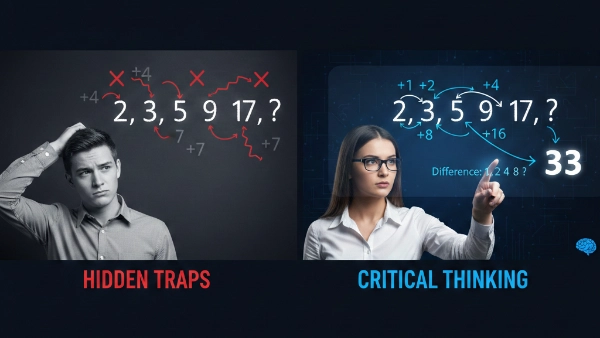
2, 3, 5, 9, 17, ?
At first glance, it resembles Fibonacci.
- 2 + 3 = 5
- 3 + 5 = 8
But the sequence gives 9, not 8.
Your brain must suppress the automatic “Fibonacci” interpretation. That suppression requires inhibitory control—one of the core functions of the prefrontal cortex.
Without strong inhibitory control, you would prematurely lock onto the wrong rule and stop searching.
High-level reasoning requires restraint. The ability to pause and say:
“This doesn’t fully work. Let me re-evaluate.”
That pause is executive control in action.
5. Cognitive Flexibility: Switching When You’re Wrong
Cognitive flexibility is the ability to shift perspectives when new information invalidates your current interpretation.
Suppose you see:
4, 7, 12, 19, 28, ?
First hypothesis: multiplication.
Fails.
Second hypothesis: constant addition.
Fails.
Third hypothesis: check differences.
+3, +5, +7, +9
Now the structure is clear.
Your brain shifted strategies multiple times without frustration or fixation. That adaptability is cognitive flexibility.
In advanced IQ tests, sequences are intentionally misleading. They often resemble one pattern before revealing another. Success depends on abandoning incorrect interpretations efficiently.
People who struggle often cling to their first idea too long. Strong reasoners treat every hypothesis as temporary until fully validated.
Flexibility reduces wasted time and increases accuracy. Many of the deliberate traps in number series questions are specifically designed to exploit inflexibility — read hidden traps in number series questions: think like a test designer to see exactly how this works.
6. Abstraction: Seeing Structure, Not Numbers
Novices focus on surface values.
Experts focus on transformations.
Instead of thinking:
“4 becomes 7.”
They think:
“What rule transforms 4 into 7?”
Abstraction means stepping back from specific values and identifying underlying relationships.
Take:
1, 4, 9, 16, 25
A beginner sees individual numbers.
An abstract thinker sees:
n²
That shift—from concrete values to symbolic representation—is fundamental to advanced reasoning.
Abstraction reduces cognitive load. Instead of tracking five separate numbers, you hold one structural rule.
The more abstract your thinking, the easier complex sequences become.
7. Error Detection and Consistency Checking
Your brain constantly monitors for logical coherence.
If a rule works for the first three steps but fails on the fourth, an internal error signal activates.
Consider:
3, 6, 12, 24, 50
Multiplying by 2 works until 24.
24 × 2 = 48, not 50.
That inconsistency triggers reevaluation.
Strong problem-solvers instinctively test a rule across the entire sequence before committing. Weak solvers stop after partial confirmation.
Consistency checking protects against premature closure.
In advanced pattern recognition, full-sequence validation is non-negotiable.
8. Why Some Patterns Feel Harder
Certain sequences increase mental strain because they:
- Require multi-step transformations
- Involve recursion
- Combine alternating rules
- Hide structure within second or third differences
- Depend on positional formulas
Example:
2, 5, 10, 17, 26
Differences:
3, 5, 7, 9
The pattern lies one level deeper—in second-order growth.
Multi-layer patterns demand:
- More working memory
- Stronger abstraction
- Higher inhibitory control
- Greater flexibility
The difficulty is rarely about arithmetic complexity. It is about structural layering. The deeper the structure, the heavier the cognitive load. For a complete guide to the most cognitively demanding patterns including Fibonacci, primes, and factorials, read advanced numerical patterns in IQ tests.
9. The Illusion of Randomness
Humans are pattern-seeking machines—even when no pattern exists.
This tendency, known as apophenia, explains why people sometimes overcomplicate simple sequences.
If the series is:
5, 10, 15, 20, 25
Some test-takers assume hidden complexity.
Under time pressure, the brain often prefers elaborate explanations because they feel more intellectually satisfying.
Ironically, high-level performance often requires restraint—choosing the simplest rule that fits all terms.
Elegance, not complexity, usually signals correctness.
10. Training Your Brain for Better Pattern Recognition
Pattern recognition improves because the brain is adaptable. Repeated exposure strengthens neural pathways related to abstraction, hypothesis testing, and executive control.
Effective training strategies include:
- Practicing diverse sequence structures
- Reviewing incorrect solutions carefully
- Explaining reasoning out loud
- Solving under timed constraints
- Working deliberately with difference tables
- Segmenting alternating sequences intentionally
Over time, your brain builds a mental library of structural templates. When you encounter a new sequence, it feels familiar — not because you've memorized it, but because you recognize its architecture. To build this library quickly, work through our 50+ number series practice questions with step-by-step solutions. And to develop the speed component alongside accuracy, read our high-speed strategy guide for solving number series in under 20 seconds.
That recognition becomes faster and more automatic with practice.
And eventually, what once looked like chaos begins to look structured.
That transformation—from confusion to clarity—is the hallmark of trained pattern recognition and advanced cognitive reasoning.
The Big Picture
When you solve a number series, you are engaging fluid intelligence, working memory, inhibitory control, cognitive flexibility, and abstract reasoning. What feels like "just math" is actually a coordinated cognitive performance.
That's why number series questions remain powerful tools in intelligence testing. They isolate reasoning ability from memorized knowledge and reward structured thinking under pressure. The next time you solve a sequence quickly, remember: your brain just executed a high-level pattern recognition operation in seconds. And that ability — the capacity to detect structure within apparent chaos — is one of the defining features of human intelligence. To measure that ability right now, try our free IQ exam.