If you’ve ever stared at a number sequence and thought, “I know there’s a pattern here… but I can’t see it,” you’re not alone.
The difference between struggling and solving quickly isn’t raw intelligence. It’s pattern classification. When you instantly recognize what type of numerical pattern you’re looking at, your brain narrows the search space and finds the rule faster.
This guide breaks down the most common numerical pattern types in a visual, structured way — so you can recognize them almost automatically. It serves as the foundational reference for all other articles in this cluster — bookmark it and return whenever you encounter an unfamiliar sequence type.
Why Pattern Type Recognition Matters
Most number series questions are not random. They are constructed around predictable structural categories. Test designers rarely invent entirely new mathematical rules—they combine familiar pattern types in clever ways.
Average test-takers experiment blindly:
- Add something.
- Multiply something.
- Guess something.
High performers do something different.
They classify first, solve second.
Instead of randomly testing operations, strong problem-solvers mentally sort sequences into recognizable pattern families:
- Arithmetic
- Geometric
- Second-order
- Alternating
- Positional
- Recursive
- Factorial or exponential growth
- Hybrid structures
The moment you identify the category, you eliminate 70–80% of wrong approaches.
Think of it as the difference between:
- Guessing a disease from symptoms
- Diagnosing based on pattern recognition
Once the pattern type is clear, the answer usually follows quickly.
1. Arithmetic Sequences (Constant Differences)
Visual Structure
Number → +d → +d → +d
Example
2, 5, 8, 11, ?
Differences:
+3, +3, +3
Rule: Add 3
Answer: 14
Why It Works
Arithmetic sequences follow the simplest structural logic: a constant additive change. The distance between numbers never varies.
They often appear early in IQ tests because they measure basic logical stability under time pressure.
Recognition Clues
- Differences are constant.
- Growth is steady and linear.
- No explosive jumps.
- No alternating irregularity.
If the numbers increase at a calm, predictable pace, suspect arithmetic first.
Speed Tip
Always check subtraction first.
In most standardized tests, arithmetic sequences are the most common foundational pattern. If subtraction works immediately, move on confidently.
2. Geometric Sequences (Constant Ratios)
Visual Structure
Number → ×r → ×r → ×r
Example
3, 6, 12, 24, ?
Ratios:
×2, ×2, ×2
Answer: 48
Why It Works
Instead of adding, geometric patterns multiply by a fixed ratio. This causes accelerated growth.
Arithmetic grows linearly.
Geometric grows exponentially.
Recognition Clues
- Numbers increase rapidly.
- Differences grow larger each step.
- Division produces a constant value.
If subtraction gives messy results but division produces consistency, you’ve found it.
Speed Tip
If differences are inconsistent but seem to double or triple, test division immediately.
3. Second-Order Difference Patterns
Sometimes the sequence hides its structure one layer deeper.
Example
1, 4, 9, 16, 25, ?
First differences:
+3, +5, +7, +9
Second differences:
+2, +2, +2
The differences themselves form an arithmetic sequence.
Why It Works
When the first layer looks irregular but structured, the pattern may exist in the differences.
This is common in:
- Square numbers
- Quadratic growth
- Structured polynomial patterns
Recognition Clues
First differences are not constant.
Differences grow steadily.
Second differences become constant.
Visual Model
Layer 1: Original numbers
Layer 2: Differences
Layer 3: Pattern inside differences
When layer 2 looks organized, you’re dealing with a second-order structure.
4. Perfect Squares and Cubes
Certain sequences rely on memorized mathematical foundations.
Squares
1, 4, 9, 16, 25 = 1², 2², 3², 4², 5²
Cubes
1, 8, 27, 64 = 1³, 2³, 3³, 4³
Why It Works
Power sequences grow at predictable acceleration rates. Their difference patterns are highly structured.
For example, square numbers increase by odd numbers: +3, +5, +7, +9...
Recognition Clues
- Numbers look familiar.
- Differences steadily increase.
- Values resemble memorized square or cube values.
Speed Tip
Memorize:
- Squares up to 15²
- Cubes up to 10³
This dramatically reduces cognitive load during exams.
5. Alternating Patterns
Some sequences contain two interwoven patterns.
Example
2, 5, 4, 7, 6, 9, ?
Split by position:
- Odd positions: 2, 4, 6
- Even positions: 5, 7, 9
Each follows its own arithmetic rule.
Why It Works
Alternating structures intentionally create confusion. When viewed linearly, they look chaotic.
When split, they become simple.
Recognition Clues
Differences look inconsistent.
Every other term appears smooth.
The sequence seems “noisy.”
Visual Breakdown
Odd: A → B → C
Even: X → Y → Z
Whenever subtraction and division both fail, immediately test positional splitting.
6. Multiplication + Addition Hybrids
These patterns blend two operations.
Example
5, 11, 23, 47, ?
Pattern:
×2 +1
- 5 × 2 +1 = 11
- 11 × 2 +1 = 23
- 23 × 2 +1 = 47
Next:
47 × 2 +1 = 95
Why It Works
Test designers use hybrid patterns to trick people who stop at “almost geometric.”
The ratio is close—but not exact.
Recognition Clues
- Ratio appears nearly constant.
- Differences double.
- Numbers grow quickly but imperfectly.
If something looks geometric but slightly off, test multiply-then-add.
7. Recursive Sequences
Recursive patterns depend on previous terms.
Fibonacci Type
1, 1, 2, 3, 5, 8
Each term = sum of previous two.
Extended Recursive
1, 2, 4, 7, 13, 24
Each term = sum of previous three.
Why It Works
Recursive sequences grow unevenly but logically.
They cannot be solved by subtraction or division alone.
Recognition Clues
Growth feels irregular.
Differences lack clear structure.
Adding previous terms produces exact matches.
Whenever nothing standard works, try combining prior terms. For the full science behind why recursive patterns are cognitively demanding to detect, read the science of pattern recognition: how your brain solves number series.
8. Factorial Growth
Factorials explode rapidly.
Example
1, 2, 6, 24, 120, ?
- 1! = 1
- 2! = 2
- 3! = 6
- 4! = 24
- 5! = 120
Next:
6! = 720
Recognition Clues
- Extremely rapid growth.
- Each term equals previous × increasing integer.
- 2, 6, 24 are strong visual clues.
These appear less frequently but are easy to identify if recognized early.
9. Position-Based Patterns
Some sequences rely entirely on term position.
Example
2, 6, 7, 21, 22, 66
Possible logic:
Odd positions increase by 5.
Even positions multiply by 3.
Or:
×3, +1 alternating.
Recognition Clue
When all other approaches fail, label positions explicitly:
1st, 2nd, 3rd, 4th…
Then test each position stream independently.
10. Layered or Multi-Step Patterns
Advanced problems may combine:
- Alternation
- Second differences
- Recursive logic
- Multiply-add hybrids
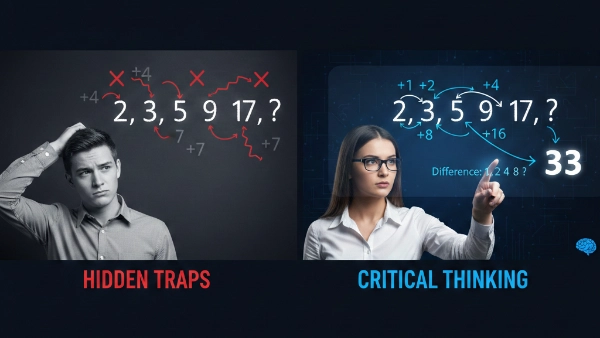
These are not random — they are structured puzzles designed to test cognitive flexibility. For a complete guide to the most advanced layered patterns including Fibonacci, primes, and factorials, read advanced numerical patterns in IQ tests. And to understand how test designers deliberately exploit each pattern type to mislead you, read hidden traps in number series questions: think like a test designer.
The key is disciplined testing.
Never guess before completing this checklist:
- Check subtraction.
- Check division.
- Split positions.
- Check second differences.
- Test recursive addition.
- Test multiply-add hybrid.
System beats intuition.
A Fast Recognition Framework
When facing a new sequence, mentally run this rapid scan:
- Constant difference?
- Constant ratio?
- Alternating positions?
- Increasing differences?
- Squares or cubes?
- Recursive addition?
- Hybrid multiply-add?
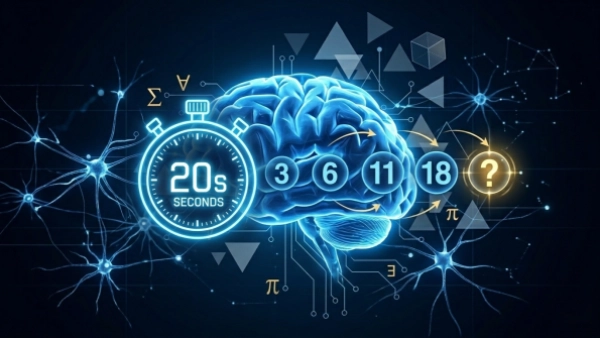
This structured internal checklist prevents wasted time and reduces panic. For a timed application of this framework under real exam pressure, see our high-speed strategy guide for solving number series in under 20 seconds.
Why Visual Structuring Speeds Recognition
Your brain processes visual organization faster than abstract reasoning.
When you:
- Write differences clearly
- Align odd/even positions
- Stack layers vertically
You convert confusion into visible structure.
Pattern recognition is not mystical talent.
It is:
Classification
- Elimination
- Structured testing
Once you stop guessing and start diagnosing, number series questions become predictable systems—not intimidating puzzles.
Final Insight
Nearly every number series question is a variation of a small set of pattern types. Once you internalize these categories, unfamiliar sequences feel familiar.
The fastest solvers don’t calculate more.
They recognize sooner.
Nearly every number series question is a variation of a small set of pattern types. Once you internalize these categories, unfamiliar sequences feel familiar. The fastest solvers don't calculate more. They recognize sooner.
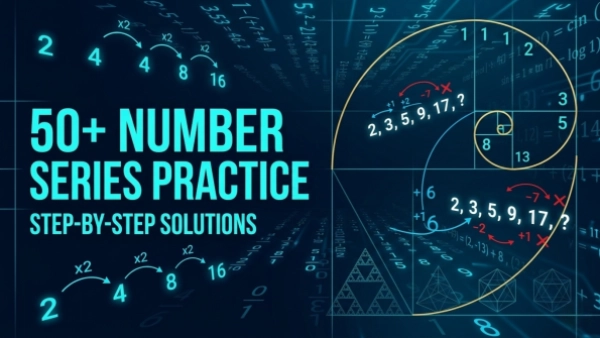
To put this framework into practice across 50 graded examples, work through our 50+ number series practice questions with step-by-step solutions. And to benchmark your recognition speed on a real timed test, try our free IQ exam.