Intelligence Quotient (IQ) is one of the most widely discussed—and often misunderstood—concepts in psychology and education. People frequently ask what IQ really measures, how scores are calculated, and whether an IQ score defines intelligence or potential.
This guide explains the fundamentals of IQ clearly and responsibly, helping you understand what IQ can tell you, what it cannot, and how to use it constructively. After reading, you can put theory into practice with our free online IQ exam.
What Is IQ?
IQ stands for Intelligence Quotient, a standardized score designed to measure certain cognitive abilities relative to others in the same age group.
Rather than measuring intelligence in an absolute sense, IQ compares an individual’s performance on reasoning tasks to a large, representative population. This makes IQ a relative measure, not a fixed or universal one.
Modern IQ tests are built to assess how efficiently a person can reason, identify patterns, and solve unfamiliar problems—not how much information they have memorized.
A Brief History of IQ Testing
IQ testing began in the early 20th century as a way to identify children who needed educational support. Over time, tests evolved to become more standardized, statistically grounded, and age-adjusted.
Early tests focused heavily on verbal and numerical skills. Modern assessments aim to reduce cultural bias and measure broader reasoning abilities, including abstract and spatial thinking.
Despite these improvements, IQ testing remains a tool with limitations—not a complete portrait of intelligence.
How IQ Scores Are Calculated
Modern IQ scores are norm-referenced, meaning an individual’s results are interpreted by comparing their performance to that of a large, representative group of people in the same age range. Rather than measuring intelligence in absolute terms, IQ testing focuses on relative performance within an age-based population.
This approach ensures that a score reflects how someone performs compared to their peers, not against a fixed standard or raw number of correct answers. For a more detailed explanation, see our dedicated guide on what an IQ score is and how it is calculated.
Key Features of IQ Scoring
Several statistical principles are used to make IQ scores consistent and comparable across populations:
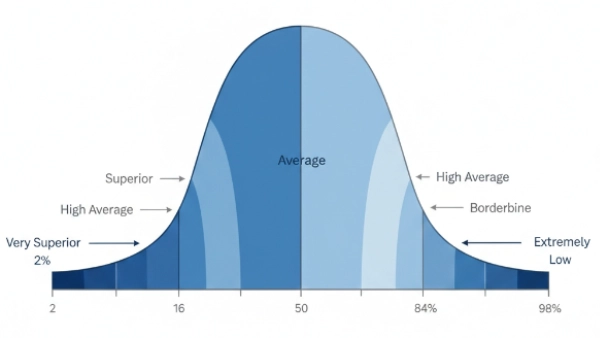
- Average score of 100: The midpoint of the distribution is set at 100, representing the average performance for a given age group.
- Standard deviation of 15: This indicates how much scores typically vary from the average. A difference of 15 points represents one standard deviation above or below the mean.
- Bell curve distribution: IQ scores follow a normal (bell-shaped) distribution, meaning most people cluster near the average, with progressively fewer individuals at higher or lower extremes.
As a result, approximately 68% of people score between 85 and 115, while scores below or above this range become increasingly less common.
What an IQ Score Really Means
IQ scores are often misunderstood as percentages or grades. In reality, they represent relative standing, not correctness.
For example, an IQ score of 120 does not mean a person answered 120% of the questions correctly. Instead, it means their performance was higher than that of most people in their age group, typically placing them in the upper portion of the distribution.
IQ scores describe how efficiently someone reasons under standardized conditions, not how intelligent they are in every aspect of life.
What Cognitive Abilities Do IQ Tests Measure?
IQ tests focus primarily on reasoning-based cognitive abilities. These abilities are considered core components of how humans process information, solve unfamiliar problems and recognize patterns.
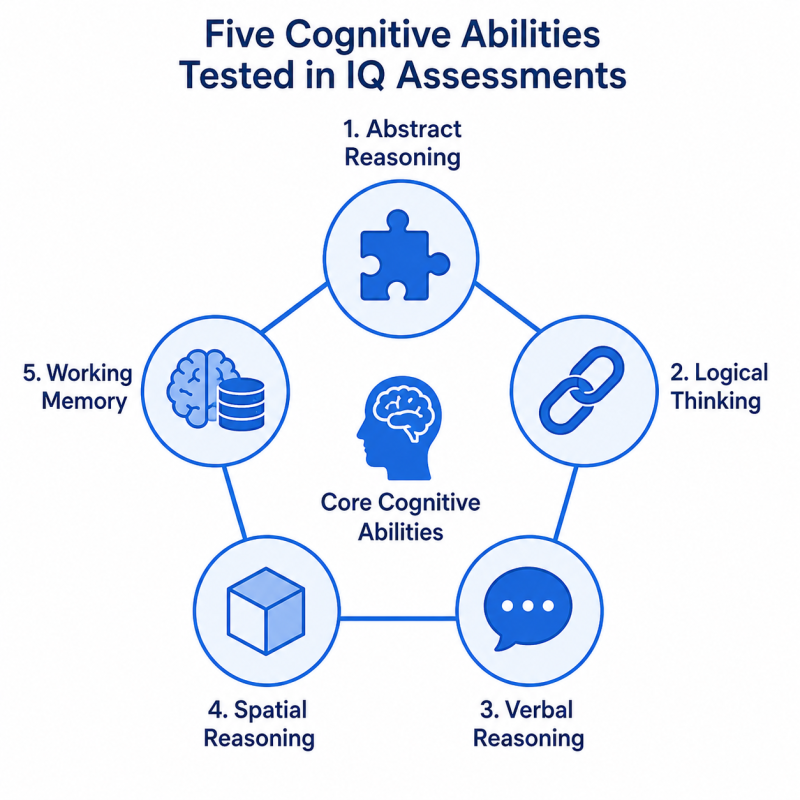
Abstract Reasoning
Abstract reasoning measures the ability to identify patterns, relationships, and rules in novel situations without relying on prior knowledge. Tasks often involve shapes, symbols, or sequences that require logical inference rather than memorization.
This ability is strongly associated with learning speed and adaptability in unfamiliar environments. To improve this skill, explore our full guide on abstract reasoning tips and practice.
Logical Thinking
Logical thinking evaluates how well a person can follow structured rules, identify cause-and-effect relationships, and draw valid conclusions from given information. These tasks often require step-by-step reasoning and consistency in thought.
Strong logical thinking supports problem-solving in mathematics, science, technology, and many real-world decision-making contexts.
Verbal Reasoning
Verbal reasoning assesses understanding and manipulation of language-based information. This includes recognizing relationships between words, interpreting meanings, and solving problems presented in written form.
It reflects how effectively a person can reason using language, rather than how large their vocabulary is. Our verbal intelligence guide covers how to develop this skill systematically.
Spatial Reasoning
Spatial reasoning measures the ability to visualize objects in space, mentally rotate shapes, and understand how parts relate to a whole. These skills are important for fields such as engineering, architecture, design, and navigation.
Spatial tasks rely heavily on mental imagery rather than verbal processing. See our guide on spatial logic and 3D visualization for practical strategies to improve this ability.
Working Memory and Processing Speed
Working memory refers to the ability to hold information temporarily and manipulate it, while processing speed reflects how quickly simple cognitive tasks can be completed accurately.
Together, these abilities influence how efficiently someone can handle complex information under time pressure.
General Intelligence (“g”)
Psychologists often group these abilities under a broader construct known as general intelligence, or "g." For a deeper exploration of this concept, read our article on the g factor and what it means for intelligence testing.
What IQ Tests Do Not Measure
Despite their usefulness, IQ tests capture only a limited slice of human ability. Many essential qualities are outside their scope.
IQ tests do not measure:
- Creativity and imaginative thinking
- Emotional intelligence and empathy
- Social awareness and communication skills
- Motivation, perseverance, or work ethic
- Moral or ethical reasoning
- Artistic, musical, or athletic talent
- Practical intelligence in real-world situations
Because of these limitations, a high or low IQ score should never be interpreted as a complete assessment of a person’s intelligence, potential, or value.
Common IQ Score Ranges
IQ scores are often grouped into general ranges to help describe patterns in large populations. These categories are descriptive, not diagnostic.
| IQ Range | Classification | Approx. Population |
| 130 and above | Very High / Exceptional | ~2% |
| 115 – 129 | Above Average | ~14% |
| 85 – 114 | Average | ~68% |
| 70 – 84 | Low Average | ~14% |
| Below 70 | Below Average | ~2% |
These ranges are intended for educational understanding only. They should not be used as labels or limits on personal growth, learning, or achievement. For a full breakdown of each range and what it represents, see our IQ score chart. You can also read about why most people score around 100 for a clearer statistical picture.
Is IQ Fixed or Can It Change?
IQ is generally more stable than many psychological traits, but it is not completely fixed.
Short-term variations in scores can occur due to:
- Differences in test format or question types
- Familiarity with similar problems
- Stress, anxiety, or fatigue
- Physical health or sleep quality
- Motivation, confidence, and focus
- Practice effects from repeated exposure
Over longer periods, especially during childhood and adolescence, changes in education, environment, nutrition, and cognitive stimulation can influence test performance.
For this reason, most professionals view IQ as a range of potential performance, rather than a single, unchangeable number. Our article on common myths and misconceptions about IQ addresses this and many other frequently misunderstood points.
IQ Across the Lifespan
IQ tests are age-normed, meaning scores are adjusted to reflect what is typical at each stage of life.
- Children and adolescents tend to show greater variability in scores
- IQ becomes more stable during adulthood
- Certain abilities, such as processing speed, may decline with age, while others, such as verbal reasoning, often remain stable or improve
Because norms are age-based, a healthy older adult can still score near the average for their age group, even if certain cognitive processes change over time. See how this plays out across life stages in our guide on average IQ by age.
IQ and Real-World Success
IQ shows moderate correlations with some outcomes, particularly those involving structured learning and analytical reasoning.
IQ may be associated with:
- Academic performance
- Ease of learning complex or abstract material
- Certain technical, scientific, or analytical skills
However, IQ alone does not reliably predict:
- Career success or income
- Leadership ability
- Happiness or life satisfaction
- Creativity or innovation
- Ethical judgment or integrity
In real-world settings, qualities such as discipline, curiosity, emotional awareness, adaptability, resilience, and social skills often play an equal—or greater—role than raw cognitive ability.
Common Myths About IQ
Myth: IQ measures how smart you are overall
Reality: IQ measures specific types of reasoning, not total intelligence.
Myth: A high IQ guarantees success
Reality: Success depends on many factors beyond cognitive ability.
Myth: IQ cannot change at all
Reality: Scores can shift with learning, experience, and context.
Myth: Online quizzes provide official IQ scores
Reality: Most online tests are educational or recreational, not clinical assessments. Read our honest analysis of whether free online IQ tests are accurate to understand what to expect from different types of assessments.
How to Use IQ Information Constructively
The healthiest way to view IQ is as a tool for self-understanding, not as a judgment or ranking.
IQ-related insights can help you:
- Identify reasoning strengths and weaknesses
- Choose learning methods that suit your thinking style
- Understand why certain tasks feel easier or more challenging
- Track cognitive engagement and improvement over time
Rather than asking, “Is my IQ good or bad?”, a more useful question is:
“How can I think, learn, and grow more effectively with the abilities I have?”
When used thoughtfully, IQ information becomes a guide for development—not a definition of limits.
Final Perspective
IQ is a useful concept when understood correctly—and misleading when overemphasized.
It provides insight into how you process information, not who you are or what you can become. Intelligence is multifaceted, dynamic, and deeply influenced by experience, environment, and personal effort.
When used responsibly, IQ is a starting point for learning—not a finish line. To go deeper, explore what truly defines human intelligence beyond IQ scores and the difference between high IQ and being a genius.
Ready to put these basics into practice? Take our free 18-minute IQ exam and see how your own reasoning compares. Then explore our guides on abstract reasoning, numerical patterns, and verbal intelligence to understand your full cognitive profile.