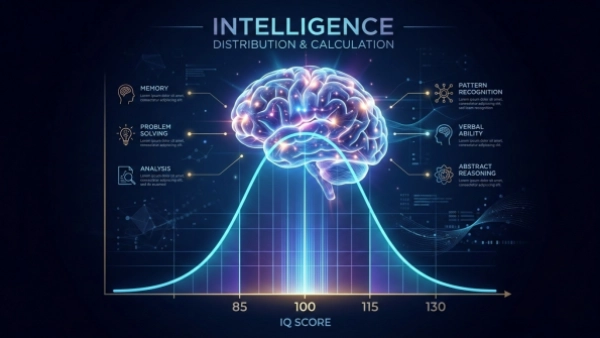
Human intelligence is a complex and fascinating subject studied by psychologists for over a century. One of the most influential ideas in intelligence research is the concept of general intelligence, often called the g factor.
This theory suggests that a single underlying cognitive ability influences performance across many different mental tasks. Understanding the g factor helps explain why people who perform well in one type of intellectual task often perform well in others.
What Is the g Factor?
The g factor, short for general intelligence, is a theory proposing that a broad mental ability underlies many different cognitive skills.
The concept was first introduced by the British psychologist Charles Spearman in the early 20th century. While analyzing test scores, Spearman noticed something interesting:
People who performed well on one mental task—such as vocabulary—often performed well on others, like mathematics or spatial reasoning.
This pattern suggested that all these abilities were influenced by a shared underlying cognitive capacity, which Spearman called general intelligence (g).
How Spearman Discovered General Intelligence
Spearman used a statistical method called factor analysis to examine correlations between different mental tests.
He observed that performance across different tests tended to be positively related. This phenomenon became known as the positive manifold—the idea that most cognitive abilities are correlated.
To explain this pattern, Spearman proposed that intellectual performance consists of two components:
- General intelligence (g) – the broad mental ability affecting all tasks
- Specific abilities (s) – skills unique to particular tasks
For example:
- Solving a math problem requires general reasoning ability (g)
- But also specific mathematical knowledge (s)
The Relationship Between IQ and the g Factor
Modern intelligence tests are largely designed to measure general intelligence.
Psychologists often interpret scores using standardized statistics.
z = (x - μ) / σ
This formula shows how an individual's score compares to the population average.
- x = individual score
- μ = population mean
- σ = standard deviation
IQ tests such as the Wechsler Adult Intelligence Scale aim to capture the general cognitive ability that Spearman described.
Organizations like Mensa International use approved IQ tests to identify individuals who fall within the top 2% of the population in measured intelligence.
Examples of Abilities Related to the g Factor
General intelligence influences many types of cognitive tasks, including:
- Logical reasoning
- Problem-solving
- Pattern recognition
- Verbal comprehension
- Working memory
- Learning speed
People with high levels of general intelligence often find it easier to adapt to new intellectual challenges and learn unfamiliar concepts quickly.
Alternative Theories of Intelligence
While the g factor remains highly influential, some psychologists believe intelligence is more complex than a single general ability.
Several alternative models have been proposed.
Multiple Intelligences Theory
Psychologist Howard Gardner proposed that humans possess several distinct types of intelligence, including:
- Linguistic intelligence
- Musical intelligence
- Bodily-kinesthetic intelligence
- Interpersonal intelligence
- Spatial intelligence
According to this view, a person may excel in one domain while being average in another.
Triarchic Theory of Intelligence
Another model developed by Robert Sternberg divides intelligence into three components:
- Analytical intelligence (problem-solving ability)
- Creative intelligence (innovation and imagination)
- Practical intelligence (real-world problem-solving)
This framework suggests that success in life depends on more than just traditional IQ.
Why the g Factor Is Still Important
Despite alternative theories, the concept of general intelligence remains one of the most supported findings in psychology.
Research has shown that general intelligence correlates with several important outcomes, including:
- Academic performance
- Job performance
- Learning speed
- Problem-solving ability
However, it is also widely accepted that intelligence is influenced by both genetics and environment, including education, nutrition, and life experiences.
Final Thoughts
The g factor represents the idea that a general cognitive ability influences many aspects of human thinking and learning. First proposed by Charles Spearman, the theory continues to shape modern intelligence research and IQ testing.
While intelligence is undoubtedly complex and multidimensional, the concept of general intelligence helps explain why cognitive abilities across different domains are often closely related.
Ultimately, understanding the g factor provides valuable insight into how humans think, learn, and solve problems—making it one of the most important concepts in the study of intelligence.