IQ scores are often misunderstood. Many people see a single number and assume it fully defines intelligence, potential, or future success. In reality, an IQ score is one measurement of cognitive performance, taken at a specific moment, under specific conditions.
This guide explains how IQ scores are structured, what different score ranges generally represent, and—just as importantly—what IQ scores do not measure. If you haven't taken a test yet, you can try our free IQ exam and then return here to interpret your result.
What Is an IQ Score?
IQ stands for Intelligence Quotient. An IQ score is a standardized score designed to compare an individual’s performance on certain cognitive tasks with that of a larger population.
Modern IQ tests typically measure abilities such as:
- Logical reasoning
- Pattern recognition
- Numerical problem-solving
- Spatial visualization
- Verbal reasoning
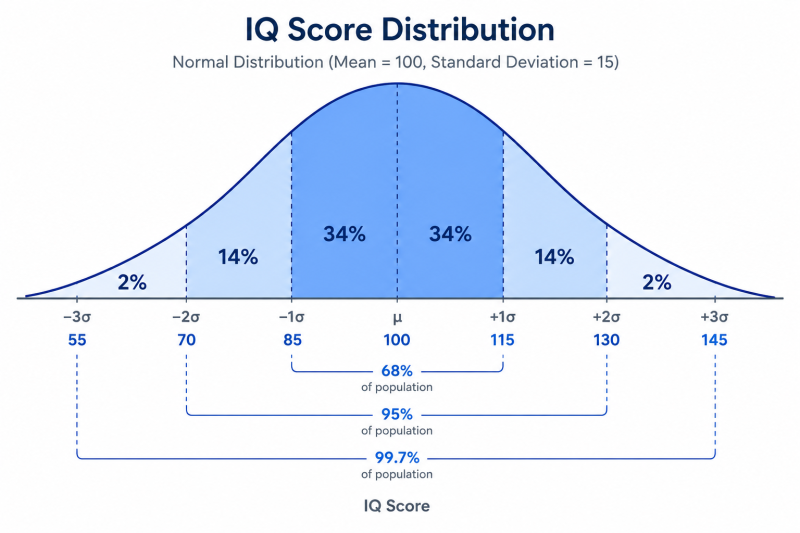
Most standardized IQ tests are designed so that:
- The average score is 100
- Most people score between 85 and 115
IQ scores are scaled using statistical models so that results follow a predictable distribution across the population. For a deeper explanation of how this works, see our guide on what an IQ score is and how it is calculated.
How IQ Scores Are Calculated
Modern IQ scores are norm-referenced, not percentage-based. This means your score reflects how you performed relative to a large comparison group, rather than how many questions you answered correctly.
In other words, an IQ score does not tell you "how much you know." It tells you how your performance compares to others who took the same or a similar test under standardized conditions. To understand what an IQ score actually measures, it helps to look at the specific cognitive domains being tested.
The Role of Norms and Standardization
When an IQ test is developed, it is administered to a large, diverse sample of people. The results are used to establish norms, which define how scores are distributed across the population.
Key principles behind IQ scoring include:
- A score of 100 represents the population average: This is not a passing score or a target—it is simply the statistical center of the distribution.
- Each 15-point difference represents one standard deviation: This means that as scores move farther from 100, they become progressively less common.
- Scores are adjusted based on age: Performance is compared to others in the same age group, recognizing that cognitive abilities develop and change over time. See how scores typically shift across life stages in our average IQ by age guide.
Because of this structure, an IQ score is best understood as a comparison tool, not an absolute or universal measure of intelligence.
Standard IQ Score Chart and Ranges
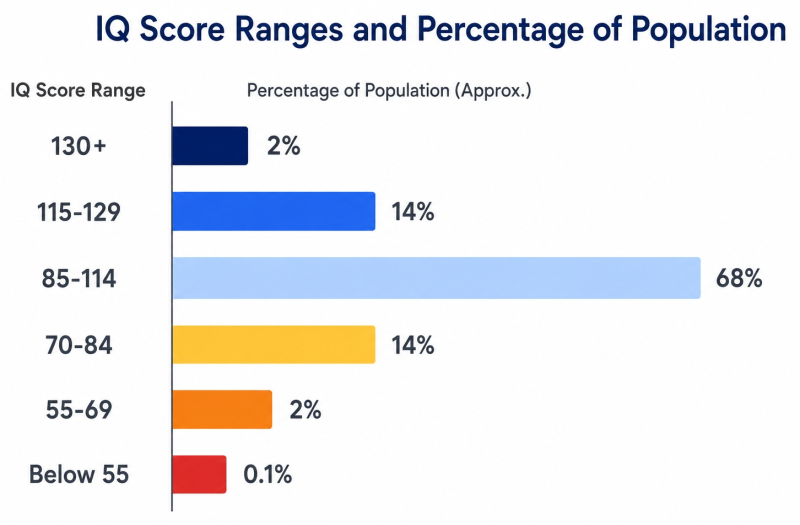
| IQ Range | Classification | Population % | Percentile |
| 130 and above | Very Superior / Exceptional | ~2% | Top 2% |
| 115 – 129 | Above Average / High Ability | ~14% | Top 16% |
| 100 – 114 | Average (Upper Half) | ~34% | 50th – 84th |
| 85 – 99 | Average (Lower Half) | ~34% | 16th – 50th |
| 70 – 84 | Low Average | ~14% | Bottom 16% |
| Below 70 | Below Average | ~2% | Bottom 2% |
The ranges below represent commonly accepted interpretations of IQ scores. These descriptions are general, educational, and non-diagnostic. Individual abilities and real-world functioning can vary widely within every range.
IQ Below 70: Below Average Range
Scores in this range indicate significantly lower performance on the specific cognitive tasks measured by standardized IQ tests.
Individuals in this range may:
- Learn best through structured, step-by-step instruction
- Benefit from concrete examples rather than abstract explanations
- Perform strongly in hands-on, practical, or experience-based roles
It is essential to understand that this range does not measure creativity, emotional intelligence, work ethic, or practical life skills. Many valuable abilities fall outside the scope of IQ testing.
IQ 70–84: Low Average Range
This range reflects below-average performance on standardized reasoning tasks but still falls within the broad spectrum of normal cognitive functioning.
People in this range often:
- Learn effectively through repetition and clear guidance
- Perform well in structured and predictable environments
- Develop strong applied skills through practice and experience
Many successful individuals fall into this range, particularly in roles that emphasize reliability, consistency, and real-world problem-solving rather than abstract analysis.
IQ 85–99: Average Range (Lower Half)
This range represents performance slightly below the statistical mean but remains fully within the average range.
Common characteristics include:
- Solid understanding of everyday concepts and procedures
- Effective problem-solving in familiar or practical situations
- Learning that improves significantly with examples and repetition
This range includes a large portion of the population and reflects normal variation in cognitive performance.
IQ 100–114: Average Range (Upper Half)
Scores in this range indicate above-average performance on standardized reasoning tasks.
Individuals may demonstrate:
- Faster recognition of patterns and relationships
- Strong comprehension of abstract ideas when clearly presented
- Efficient learning in academic or technical environments
When combined with motivation and consistent effort, this range is often associated with strong academic and professional outcomes.
IQ 115–129: Above Average / High Ability
This range reflects noticeably stronger-than-average cognitive performance.
People scoring here often show:
- Quick understanding of complex relationships
- Strong analytical and abstract reasoning
- High adaptability to unfamiliar problem types
Many professionals in technical, analytical, or research-oriented fields fall into this range. However, success still depends heavily on education, experience, and persistence.
IQ 130 and Above: Very High / Exceptional Range
Scores in this range are statistically uncommon and indicate exceptionally strong performance on standardized cognitive tasks.
Typical traits may include:
- Rapid learning and high mental flexibility
- Advanced pattern recognition and abstraction
- Strong capacity for complex reasoning
While this range is sometimes associated with advanced academic achievement, it does not guarantee creativity, emotional balance, or real-world success on its own. Explore what research actually shows about high IQ and success for a more nuanced perspective.
Scores above 130 also meet the threshold for Mensa membership — the world's oldest high-IQ society.
What an IQ Score Can Tell You
When interpreted correctly, an IQ score can provide insight into:
- How you compare to others on specific reasoning tasks
- Which types of cognitive challenges feel easier or more demanding
- Your relative strengths in logic-based and analytical thinking
Used appropriately, an IQ score serves as a starting point for self-awareness, not a final judgment of ability or potential.
What an IQ Score Does Not Measure
IQ tests do not capture many important aspects of human intelligence, including:
- Creativity and original thinking
- Emotional intelligence and empathy
- Social and communication skills
- Motivation, discipline, and perseverance
- Moral reasoning and ethical judgment
- Artistic, musical, or athletic talent
High achievement in life is shaped by a combination of cognitive ability, personality, environment, and sustained effort. Our article on what truly defines human intelligence explores these broader dimensions in detail.
Why IQ Scores Can Vary
An IQ score is not fixed or absolute. Scores can change based on multiple factors, such as:
- Test format and question style
- Familiarity with similar problem types
- Stress, fatigue, or emotional state
- Time pressure or testing conditions
- Practice effects and learning over time
For this reason, many professionals view IQ as a range of performance rather than a single permanent number. If you're wondering whether IQ can change over time, the answer is more nuanced than most people expect.
IQ Scores and Real-World Success
While IQ can correlate with academic performance and certain job skills, it does not reliably predict:
- Happiness or life satisfaction
- Leadership ability
- Personal fulfillment
- Ethical decision-making or character
History shows that people with average IQ scores often achieve extraordinary success through curiosity, emotional awareness, resilience, and sustained effort. Read about how to develop cognitive skills regardless of your IQ score and which career paths align with different cognitive strengths.
How to Use Your IQ Score Constructively
Instead of focusing on the number itself, a healthier approach is to use your score to:
- Identify areas for cognitive development
- Choose learning strategies that match your strengths
- Track progress over time rather than comparing yourself to others
True improvement comes from understanding how you think, not just how you score. For a practical starting point, explore how to interpret your IQ score correctly and what research says about whether IQ can be increased.
Final Thoughts
An IQ score is a tool for insight, not a label. It reflects performance on specific tasks under specific conditions and should always be interpreted in context.
True intelligence is multidimensional. Reasoning ability matters—but so do curiosity, effort, adaptability and lifelong learning.
Understanding your IQ score is not about defining limits. It is about understanding patterns—and deciding how to grow beyond them. To explore the science that underpins IQ testing, read the science behind IQ tests: reliability, validity and limitations.
Ready to get your own score? Take our free 18-minute IQ exam and return here to interpret your result using the chart above. You can also compare your score with average IQ by age or see how it measures up against famous genius IQ scores.