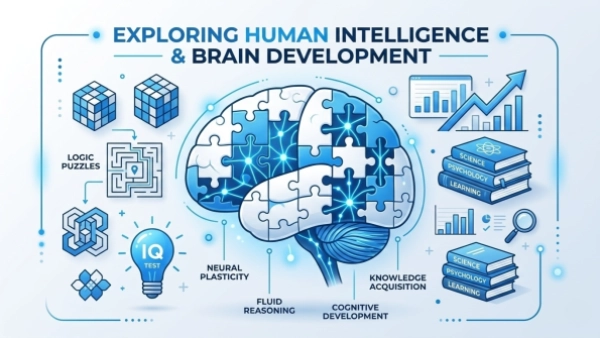
Many people believe that intelligence is fixed and that an IQ score defines the limits of their mental ability. In reality, while IQ can reflect certain aspects of cognitive potential, it does not determine how much you can grow intellectually. Cognitive skills—such as memory, attention, reasoning, and problem-solving—can be strengthened through deliberate practice and healthy habits.
Regardless of your IQ score, you can improve how effectively your brain processes information. Developing cognitive skills is less about innate intelligence and more about consistent learning, curiosity, and mental engagement.
Understanding Cognitive Skills
Cognitive skills are the mental processes your brain uses to acquire knowledge, understand information, and apply it to solve problems. These skills include:
- Memory – the ability to store and recall information
- Attention – the capacity to focus on tasks without distraction
- Logical reasoning – analyzing information and drawing conclusions
- Processing speed – how quickly your brain handles information
- Problem-solving – identifying solutions to complex challenges
These abilities form the foundation for learning, decision-making, and everyday functioning.
Why IQ Isn’t the Whole Story
An IQ test measures certain types of reasoning and problem-solving abilities under controlled conditions. However, real-world intelligence is influenced by many factors beyond test scores, including:
- Education and learning opportunities
- Motivation and persistence
- Emotional intelligence
- Creativity
- Experience and environment
Someone with an average IQ who continuously practices learning strategies can outperform someone with a higher IQ who rarely challenges their brain.
Practical Ways to Strengthen Cognitive Skills
Improving cognitive abilities requires regular mental stimulation and healthy lifestyle choices. The following strategies can help strengthen your brain over time.
1. Engage in Lifelong Learning
Learning new information forces your brain to form new neural connections. Activities such as reading books, taking online courses, or studying a new subject stimulate cognitive development.
Subjects that require analytical thinking—like mathematics, science, or philosophy—can be particularly effective in strengthening reasoning skills.
2. Practice Problem-Solving Activities
Puzzles and strategy-based games challenge the brain to think critically. Examples include:
- Logic puzzles
- Chess and strategy games
- Sudoku or number puzzles
- Brain-training apps
These activities improve pattern recognition, memory, and logical reasoning.
3. Strengthen Your Memory
Memory can be improved with specific techniques such as:
- Spaced repetition, reviewing information at increasing intervals
- Association, linking new information to existing knowledge
- Visualization, creating mental images of concepts
Regularly practicing these techniques can significantly improve recall ability.
4. Improve Focus and Attention
In a world full of distractions, focus has become an essential cognitive skill. You can strengthen concentration by:
- Practicing mindfulness or meditation
- Limiting multitasking
- Working in distraction-free environments
- Using structured work methods like the Pomodoro technique
Improved attention leads to better learning and more efficient thinking.
5. Maintain Physical Health
Your brain depends heavily on physical health. Research consistently shows that healthy lifestyle habits support cognitive performance.
Important habits include:
- Regular exercise, which increases blood flow to the brain
- Quality sleep, which supports memory consolidation
- Balanced nutrition, especially foods rich in omega-3 fatty acids and antioxidants
- Stress management, since chronic stress can impair cognitive function
Taking care of your body directly benefits your mind.
6. Develop Critical Thinking
Critical thinking involves evaluating information objectively and questioning assumptions. You can strengthen this skill by:
- Analyzing arguments in articles or debates
- Asking “why” and “how” questions
- Considering alternative perspectives
- Reflecting on your own reasoning process
These habits improve decision-making and intellectual independence.
The Power of Consistency
Cognitive development does not happen overnight. Just like physical fitness, mental ability improves gradually with regular practice. Small daily habits—reading, solving problems, learning new skills—can compound into significant intellectual growth over time.
Even short periods of mental training, when done consistently, can lead to measurable improvements in attention, memory, and reasoning.
Final Thoughts
Your IQ score is only one snapshot of certain cognitive abilities at a particular moment in time. It does not define your potential for growth or your capacity to learn.
By cultivating curiosity, challenging your brain, and maintaining healthy habits, you can continuously strengthen your cognitive skills. In the long run, persistence and lifelong learning often matter far more than any single number on an intelligence test.