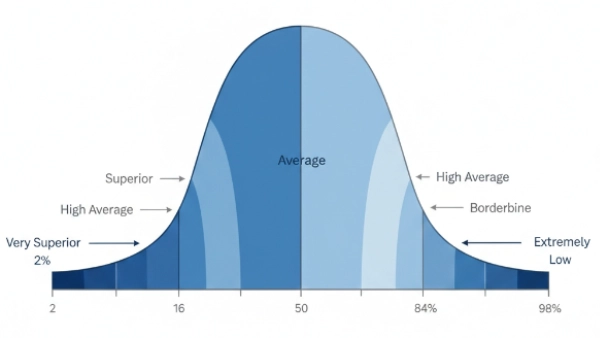
For many people interested in intelligence testing, Mensa represents a clear benchmark: membership is limited to individuals who score in the top 2% of the population on an approved intelligence test. While the idea of joining an elite intellectual society is appealing, the requirements—and the reality of membership—are often misunderstood.
This guide explains what Mensa is, what IQ score you need, how qualification works, and what joining Mensa actually means. Before reading, it helps to understand how IQ scores are structured — see our IQ score chart for a clear breakdown of what different score ranges represent.
What Is Mensa?
Mensa is an international, non-profit organization founded in 1946 with the goal of identifying and fostering human intelligence for the benefit of society.
Mensa’s core objectives include:
- Recognizing individuals with high general intelligence
- Providing a social and intellectual community for members
- Encouraging research into the nature and uses of intelligence
Importantly, Mensa does not promote a single definition of intelligence, nor does it claim that high IQ alone predicts success, morality, or creativity.
What Does “Top 2%” Mean?
Mensa does not require a specific IQ number like “130” in all cases. Instead, eligibility is based on percentile rank.
Key Concept: Percentile, Not Percentage Correct
The top 2% corresponds to the 98th percentile or higher
On most modern IQ tests:
- IQ 130 (SD = 15) ≈ 98th percentile
- IQ 132 (SD = 16) ≈ 98th percentile
Because different tests use different scoring systems, Mensa evaluates results based on statistical equivalence, not raw scores. To understand how these standardized measurements work in practice, read how IQ scores are calculated.
Typical Mensa IQ Score Requirements
Although Mensa does not publish a single universal cutoff, the following are commonly accepted equivalents:
| Test Type | Approximate Qualifying Score |
| Stanford–Binet (SD 15) | 130+ |
| Wechsler tests (WAIS, WISC) | 130+ |
| Tests using SD 16 | 132+ |
| Percentile-based scoring | 98th percentile or higher |
The standard deviation (SD) matters because it affects how scores are distributed. Mensa adjusts for this to ensure fairness across tests.
How Mensa Determines Eligibility
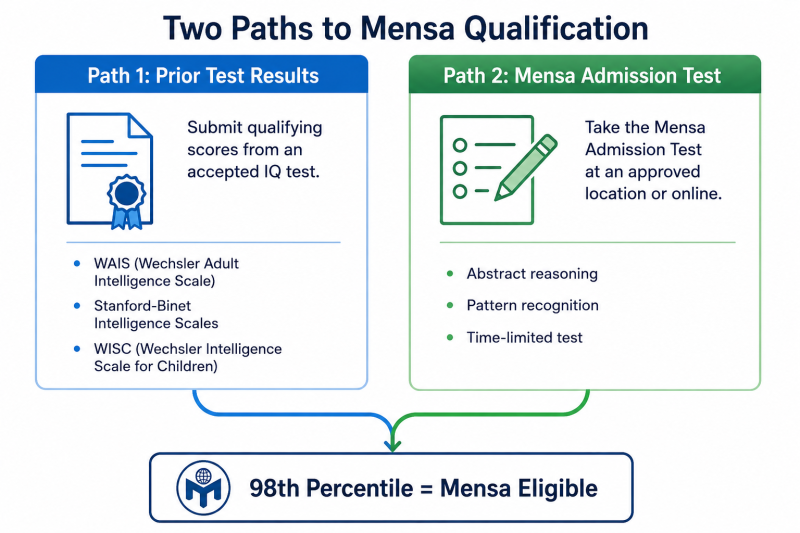
Mensa uses standardized, objective criteria to determine eligibility. Membership is open only to individuals who demonstrate performance in the top 2% of the population on an approved intelligence assessment. There are two primary paths to qualification, each designed to ensure fairness and consistency across different testing backgrounds.
1. Submitting Prior Test Results
One way to qualify for Mensa membership is by submitting scores from a professionally administered and recognized intelligence test. This option is commonly used by individuals who were tested previously for educational, clinical, or research purposes.
Commonly Accepted Tests Include:
- WAIS (Wechsler Adult Intelligence Scale)
- WISC (Wechsler Intelligence Scale for Children)
- Stanford–Binet Intelligence Scales
- Other nationally recognized, standardized IQ tests approved by Mensa
Each accepted test has a specific minimum qualifying score, adjusted for that test’s scoring system and standard deviation.
Important Requirements to Understand:
- Online or self-administered “IQ quizzes” are not accepted
- The test must be administered by a qualified psychologist or licensed professional
- Results must be official, documented, and verifiable
- Scores must meet or exceed the 98th percentile equivalent
Mensa maintains a detailed and regularly updated list of accepted tests and qualifying thresholds to ensure consistent standards worldwide.
This pathway is ideal for individuals who already have valid test documentation and prefer not to take another exam.
2. Taking the Mensa Admission Test
If you do not have qualifying prior results, you may take the Mensa Admission Test, which is administered by local Mensa chapters in many countries.
What the Test Typically Includes:
- Multiple-choice questions
- Abstract and logical reasoning problems
- Pattern recognition tasks
- Time-limited sections designed to assess reasoning efficiency
The test is structured to measure how you think, not what you have learned.
What the Mensa Test Does Not Measure:
- Academic subject knowledge
- Memorized vocabulary lists
- Mathematical formulas or advanced calculations
- Cultural or educational background
Because of this design, the Mensa test minimizes the advantage of formal schooling or test-specific coaching and focuses instead on general reasoning ability.
Test formats may vary slightly by location, but all are standardized and normed to ensure equivalence.
What Types of Intelligence Does Mensa Measure?
Mensa tests primarily assess general intelligence (often referred to as “g”), which represents the common cognitive abilities underlying many types of reasoning.
Key Abilities Assessed Include:
- Abstract reasoning (recognizing patterns and relationships)
- Logical problem-solving
- Spatial reasoning and mental manipulation
- Pattern detection under time constraints
These skills are strongly associated with success in complex reasoning tasks and novel problem-solving situations.
What Mensa Does Not Directly Measure:
- Emotional intelligence
- Creativity or artistic ability
- Social or leadership skills
- Practical or hands-on intelligence
- Motivation, curiosity or perseverance
For this reason, Mensa membership should be understood as recognition of a specific cognitive profile, not as a complete measure of human intelligence or potential. Our guide on what truly defines human intelligence beyond IQ scores explores the broader dimensions that tests like this do not capture.
Is It Possible to “Train” for Mensa?
This is one of the most frequently asked questions—and the answer is nuanced.
What You Can Improve
You can improve your test performance by improving how effectively you demonstrate your ability. This includes:
- Becoming familiar with common test formats
- Reducing test anxiety through exposure and practice
- Improving time management under pressure
- Learning to recognize common abstract pattern types
These improvements help ensure your score reflects your true reasoning ability, rather than being lowered by stress or unfamiliarity. Our guides on how to prepare for the Mensa test and how hard the Mensa test actually is give a realistic picture of what to expect.
What You Cannot Easily Change
You generally cannot dramatically alter core cognitive traits, such as:
- Baseline reasoning speed
- Working memory capacity
- Fundamental abstract reasoning ability
Mensa tests are designed to reduce the impact of rote memorization and coaching, making them resistant to short-term “training” effects.
Preparation improves expression of ability, not the underlying capacity itself.
What Happens After You Join Mensa?
Mensa membership is not competitive and does not involve ranking or continued testing.
Once admitted:
- There are no levels, tiers, or score comparisons
- All members are considered equals
- Participation is entirely voluntary and interest-driven
Membership simply confirms that you met the qualification threshold at the time of testing. For a detailed look at what the experience is actually like, read about Mensa membership benefits, costs and what members actually do and what the Mensa test looks like.
Common Mensa Activities
Members may choose to participate in a wide variety of activities, including:
- Discussion groups and special-interest communities
- Lectures, workshops, and educational events
- Local, national, and international gatherings
- Online forums and collaborative intellectual projects
Some members are highly involved, while others enjoy Mensa primarily as a personal milestone or quiet affiliation.
Common Myths About Mensa
Myth 1: Mensa Members Are Geniuses at Everything
Reality: Members have widely varying strengths, careers, and personalities.
Myth 2: Mensa Guarantees Career or Academic Success
Reality: Success depends heavily on motivation, opportunity, emotional intelligence, and effort. Research confirms this — see what research actually shows about high IQ and success.
Myth 3: Mensa Is Only for Scientists or Academics
Reality: Members include artists, tradespeople, entrepreneurs, students, and retirees.
Myth 4: Joining Mensa Changes Your IQ
Reality: Membership recognizes past performance; it does not alter cognitive ability.
Is Mensa Worth Joining?
Whether Mensa is worthwhile depends entirely on your personal goals and interests.
Mensa May Be a Good Fit If You:
- Enjoy abstract thinking and intellectual discussion
- Want to connect with others who reason similarly
- Are curious about your cognitive profile
- Appreciate structured mental challenges
Mensa May Not Be Necessary If You:
- Are only interested in the numeric score
- Prefer creative, practical, or hands-on problem-solving
- Expect direct career or financial benefits
Ultimately, Mensa is best viewed as a community and shared interest group, not a credential or status symbol. If you're still exploring whether your score might qualify, our guide on whether IQ can change over time is worth reading before committing to testing.
Final Perspective: IQ, Mensa, and Meaning
Joining Mensa means you performed at a very high level on a standardized reasoning test—nothing more, and nothing less.
It does not define:
- Your creativity
- Your character
- Your potential for happiness
- Your value as a person
For those who enjoy intellectual exploration and peer connection, Mensa can be rewarding. For others, intellectual fulfillment comes from learning, building, teaching, or creating—without any formal label.
The most important question is not: "Am I smart enough to join Mensa?" But rather: "How do I use my abilities in a way that matters to me?" To start exploring your own cognitive strengths, our guides on abstract reasoning, numerical patterns, and verbal intelligence are excellent starting points — and IQ vs emotional intelligence is a thought-provoking read alongside this topic.
Want to see how you score before committing to a formal Mensa test? Our free 18-minute IQ exam gives you an instant estimated score — a useful benchmark before pursuing official qualification. Remember that a score of 130+ on our assessment suggests you may be in Mensa-qualifying range, though official admission requires a proctored test.