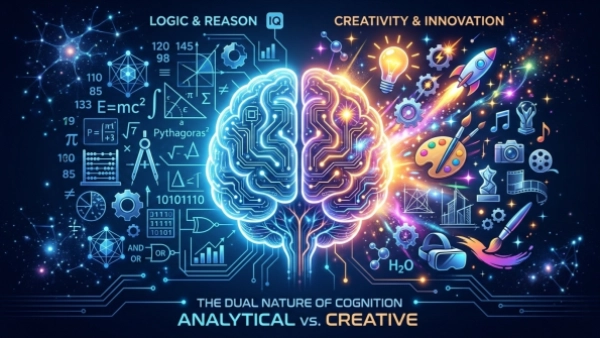
Many people assume that a high IQ automatically leads to success in life. The idea seems logical: if someone is highly intelligent, they should perform better in school, earn more money, and achieve more recognition. However, decades of research in psychology and sociology show that the relationship between IQ and success is much more complex.
A high IQ can certainly provide advantages, but it does not guarantee success. Factors such as personality, emotional intelligence, opportunity, persistence, and social skills often play just as important a role.
What IQ Actually Measures
An IQ (Intelligence Quotient) score is designed to measure certain cognitive abilities. These typically include:
- Logical reasoning
- Pattern recognition
- Problem-solving ability
- Working memory
- Verbal comprehension
Modern intelligence tests such as the Stanford–Binet Intelligence Scales and the Wechsler Adult Intelligence Scale are widely used by psychologists to assess these skills.
However, these tests focus mainly on analytical and academic abilities. They do not fully measure creativity, emotional understanding, motivation, or real-world decision-making—qualities that strongly influence success.
The Correlation Between IQ and Achievement
Research consistently finds a moderate correlation between IQ and academic achievement. Individuals with higher IQ scores often perform better in school because education systems emphasize the same kinds of analytical and verbal skills that IQ tests measure.
In careers that rely heavily on complex problem-solving—such as engineering, mathematics, or scientific research—higher IQ can also be an advantage.
But the correlation weakens when examining long-term life outcomes such as:
- Career advancement
- Leadership success
- Personal fulfillment
- Entrepreneurial achievement
Many individuals with average IQs build highly successful careers, while some with very high IQ scores struggle to achieve their goals.
The Role of Non-Cognitive Traits
Psychologists increasingly emphasize the importance of non-cognitive traits in predicting success. These include qualities like perseverance, self-discipline, and resilience.
One of the most influential studies on this topic was conducted by Angela Duckworth, who introduced the concept of grit—the combination of passion and perseverance toward long-term goals.
Her research suggests that individuals who consistently work toward their goals, even in the face of failure, often outperform those who rely mainly on raw intelligence.
Emotional Intelligence Matters Too
Another key factor is emotional intelligence, a concept popularized by psychologist Daniel Goleman.
Emotional intelligence refers to abilities such as:
- Understanding emotions in oneself and others
- Managing stress and conflict
- Building strong relationships
- Communicating effectively
In many workplaces, these skills are essential for teamwork, leadership, and collaboration. Someone with exceptional cognitive intelligence but poor emotional skills may struggle in social environments that require cooperation and empathy.
Opportunity and Environment
Success is also heavily influenced by environmental factors. Access to quality education, supportive mentors, stable family environments, and economic opportunities can significantly affect a person’s trajectory.
For example, a highly intelligent individual growing up in a disadvantaged environment may face barriers that prevent them from reaching their full potential. Meanwhile, someone with average intelligence but strong support systems may have more opportunities to succeed.
Creativity and Innovation
Many groundbreaking achievements come not only from intelligence but from creativity and unconventional thinking. Innovators often challenge existing ideas rather than simply solving established problems.
Creative thinking involves skills that IQ tests do not fully measure, such as imagination, curiosity, and the willingness to experiment with new approaches.
Some of the world’s most influential innovators combined intelligence with creativity, persistence, and vision rather than relying solely on cognitive ability.
The Importance of Motivation and Work Ethic
Motivation and consistent effort can significantly outweigh differences in IQ over time. People who are highly motivated tend to:
- Practice skills longer
- Learn from mistakes
- Adapt to challenges
- Continue improving over time
This sustained effort often leads to mastery and achievement, even if someone begins with only average cognitive ability.
What the Research Ultimately Shows
The evidence from decades of psychological research leads to a clear conclusion: IQ is only one factor among many that contribute to success.
A high IQ can make learning easier and problem-solving faster, but success typically requires a combination of:
- Persistence
- Emotional intelligence
- Creativity
- Opportunity
- Social skills
- Hard work
In other words, intelligence may open doors, but other qualities determine how far someone walks through them.
Final Thoughts
The belief that a high IQ guarantees success is a widespread myth. Intelligence can provide a valuable advantage, but it is far from the only ingredient in achievement.
True success tends to emerge from a complex mix of abilities, personality traits, experiences, and opportunities. Understanding this broader picture helps explain why people with very different levels of measured intelligence can all achieve meaningful success in their own ways.