IQ scores often spark fascination—especially when associated with famous innovators, scientists, and leaders. Lists claiming precise IQ numbers for well-known figures circulate widely online, but many of these claims lack reliable evidence.
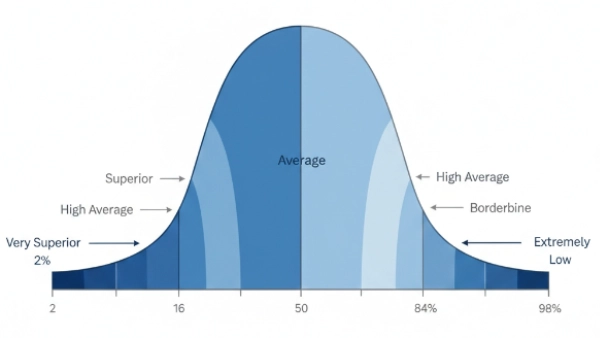
This article explores what is actually known, what is estimated, and why IQ alone never explains greatness. To understand what these scores actually represent, start with our IQ score chart and range guide before reading on.
Understanding IQ Claims About Famous People
Before examining specific individuals, it’s essential to understand an important limitation:
Most famous people never took a modern, standardized IQ test.
As a result, many reported IQ scores are:
- Retrospective estimates
- Based on academic achievement or observed reasoning ability
- Inferred from biographies or early test data
- Sometimes exaggerated or entirely fabricated
Psychologists generally agree that assigning exact IQ scores to historical figures is speculative. These numbers should be viewed as approximations, not facts. For a full breakdown of people with some of the highest verified IQ scores, the picture is more nuanced than most lists suggest.
Albert Einstein — Intelligence Beyond Measurement
Albert Einstein is often cited as the ultimate example of genius, frequently assigned IQ scores ranging from 160 to 190.
What We Know
- Einstein never took a modern IQ test
- As a child, he reportedly spoke later than average
- He struggled with rigid schooling but excelled in conceptual thinking
- His work revolutionized physics, not through speed, but through deep abstraction
Estimated IQ Range
Most psychologists estimate Einstein’s IQ to be around 160, based on:
- Exceptional abstract reasoning
- Groundbreaking theoretical insight
- Unprecedented contributions to science
Key Insight
Einstein's intelligence was not about rapid calculation—it was about conceptual imagination, persistence, and the courage to challenge assumptions. This connects to a broader question: why genius is not the same as having a high IQ.
Elon Musk — Applied Intelligence and Systems Thinking
Elon Musk is frequently associated with estimated IQ scores between 150 and 160, though no official score has been published.
Evidence-Based Indicators
- Early mastery of programming and physics concepts
- Admission to elite academic institutions
- Ability to reason across engineering, economics, and design
- Long-term planning at extreme scale
What Sets Him Apart
Musk’s intelligence is often described as systems-level reasoning—the ability to:
- Break complex problems into first principles
- Rebuild solutions from the ground up
- Apply logic across unrelated domains
Key Insight
His success highlights that applied intelligence, combined with risk tolerance and persistence, can be more impactful than raw test scores. For more on this topic, read what research actually shows about high IQ and success.
Other Famous Figures Commonly Associated With High IQ
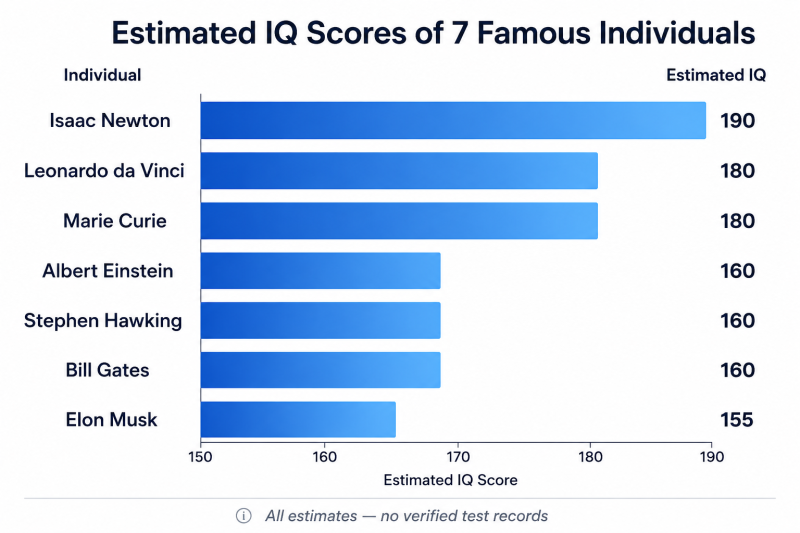
| Person | Field | Estimated IQ | Reliability |
| Isaac Newton | Physics / Mathematics | ~190 | Retrospective estimate |
| Leonardo da Vinci | Art / Engineering / Science | ~180 | Retrospective estimate |
| Marie Curie | Physics / Chemistry | ~180 | Retrospective estimate |
| Albert Einstein | Theoretical Physics | ~160 | Retrospective estimate |
| Stephen Hawking | Cosmology | ~160 | Self-reported (disputed) |
| Bill Gates | Technology / Business | ~160 | Academic records inference |
| Elon Musk | Engineering / Business | 150–160 | Unverified estimate |
⚠️ All figures are estimates only. None were derived from verified standardized IQ tests. See our IQ score chart to understand what these ranges mean.
Many historical and modern figures are frequently cited in discussions about intelligence. In most cases, exact IQ scores are unknown, as standardized IQ testing either did not exist or was never administered. The figures below are associated with estimated ranges, inferred from documented achievements, reasoning ability, and academic performance—not from verified test records.
These examples are useful not as rankings, but as illustrations of how intelligence can manifest in very different ways.
Isaac Newton
Estimated IQ: ~190
Isaac Newton is widely regarded as one of the most influential scientists in human history. He co-invented calculus, formulated the laws of motion, and developed the theory of universal gravitation—often working in isolation for years at a time.
Newton’s intelligence was characterized by:
- Extraordinary capacity for abstract mathematical reasoning
- Intense concentration and prolonged solitary focus
- Willingness to rethink fundamental assumptions about nature
His cognitive strength was not merely speed, but depth—the ability to hold complex systems in mind and refine them over long periods. Newton’s example shows how extreme focus and intellectual persistence can amplify raw ability into lasting impact.
Leonardo da Vinci
Estimated IQ: ~180
Leonardo da Vinci represents one of the clearest examples of cross-domain intelligence. He excelled simultaneously as an artist, engineer, anatomist, inventor, and scientific observer—an extremely rare cognitive profile.
Key traits of da Vinci’s intelligence included:
- Exceptional visual–spatial reasoning
- Deep curiosity across unrelated disciplines
- Ability to connect art, mechanics, biology, and physics
- Relentless observation of real-world detail
Rather than specializing narrowly, da Vinci demonstrated how intelligence can flourish through interdisciplinary thinking. His legacy suggests that curiosity and pattern recognition across domains can rival formal academic brilliance.
Marie Curie
Estimated IQ: ~180
Marie Curie was the first person to win two Nobel Prizes in different scientific fields—physics and chemistry—a feat unmatched to this day. Her work laid the foundation for modern research into radioactivity.
Curie’s intelligence was marked by:
- Strong analytical and experimental reasoning
- Exceptional perseverance under physical, social, and institutional hardship
- Ability to work rigorously with abstract scientific concepts
Her life illustrates that intelligence alone is not enough—resilience, discipline, and moral commitment play equally vital roles in meaningful achievement.
Stephen Hawking
Estimated IQ: ~160
Stephen Hawking made groundbreaking contributions to cosmology, black hole theory, and theoretical physics—much of it while living with severe physical limitations.
Notably, Hawking himself dismissed the importance of IQ, once remarking that people who boast about IQ are “losers.” His work depended less on calculation speed and more on:
- Deep conceptual abstraction
- Long-range theoretical reasoning
- Ability to simplify complex ideas into elegant models
Hawking's career demonstrates that clarity of thought and imagination can matter more than raw numerical performance. This is closely related to the difference between high IQ and being a genius — a distinction that is often misunderstood.
Bill Gates
Estimated IQ: ~160
Bill Gates reportedly scored extremely high on standardized exams as a teenager and demonstrated exceptional reasoning ability from a young age. His success, however, reflects more than test performance.
Gates’s strengths include:
- Logical and structured thinking
- Strategic foresight in complex systems
- Rapid learning and information synthesis
- Ability to translate abstract ideas into practical solutions
His career highlights how intelligence becomes most powerful when combined with execution, timing, and long-term vision.
Do High IQ Scores Guarantee Success?
The short answer is no.
While higher IQ scores often correlate with academic performance and certain technical skills, they do not guarantee:
- Creativity or originality
- Leadership ability
- Emotional intelligence
- Motivation or self-discipline
- Ethical judgment
- Happiness or life satisfaction
Many individuals with average IQ scores achieve extraordinary success through persistence, adaptability, emotional awareness, and social intelligence. Our article on how intelligence is measured in modern IQ tests explains why standardized scores capture only part of the cognitive picture.
Why Famous Geniuses Often Downplay IQ
Interestingly, many individuals widely considered “geniuses” have minimized the importance of IQ scores.
Common reasons include:
- IQ measures how you think, not what you create
- Creativity and insight are poorly captured by standardized tests
- Real-world problems are ambiguous, emotional, and nonlinear
- Obsession with scores can discourage curiosity and growth
High achievers tend to focus on learning, experimentation, and problem-solving, not numerical rankings.
Intelligence Is Multifaceted, Not Singular
Modern psychology recognizes that intelligence is not a single trait, but a collection of abilities, including:
- Logical–mathematical reasoning
- Verbal and linguistic intelligence
- Spatial visualization
- Emotional intelligence
- Creative intelligence
- Practical and adaptive intelligence
Famous individuals typically excel in specific combinations, rather than scoring uniformly high across all areas. For a broader perspective on the many dimensions of intelligence, read what truly defines human intelligence beyond IQ scores.
The Real Lesson From Famous Minds
Rather than asking, “What was their IQ?”, a more meaningful question is:
How did they use their abilities differently from others?
Across history, exceptional individuals tend to share:
- Intense curiosity
- Willingness to question authority and norms
- Long-term focus on difficult problems
- Deep, sometimes obsessive interest in their domain
- The courage to think independently and persist through failure
These traits often matter as much as—or more than—raw cognitive ability. If you're curious about where your own reasoning sits, our IQ score chart can help you contextualise your result, and Mensa standards show what exceptional performance looks like in formal terms.
Final Thoughts: IQ as Context, Not Destiny
IQ scores can provide insight into certain cognitive strengths, but they are not a blueprint for greatness.
The stories of Einstein, Musk, and other famous minds remind us that:
- Intelligence expresses itself in many forms
- Effort, creativity, and environment shape outcomes
- What you do with your mind matters more than how it is measured
Curious how your own reasoning compares? Take our free 18-minute IQ exam and see where you stand. Then use our IQ score chart to put your result in perspective — no famous name required.