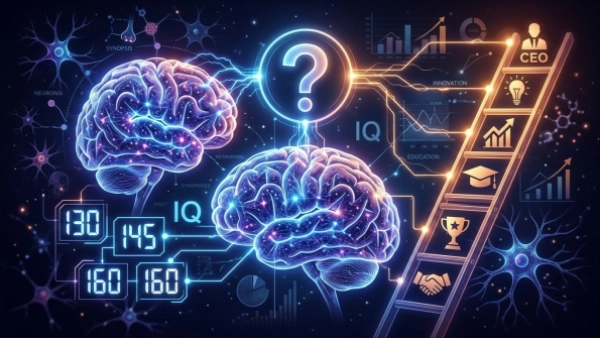
Many people assume that having a very high IQ automatically makes someone a genius. While IQ tests measure certain aspects of intelligence—such as logical reasoning, memory, and problem-solving—genius is a much broader concept. Throughout history, individuals considered geniuses have demonstrated extraordinary creativity, originality, and impact that goes far beyond what an intelligence test can measure.
Understanding the difference between genius and high IQ helps clarify how human intelligence truly works.
What a High IQ Actually Measures
IQ, or Intelligence Quotient, is a standardized score used to compare cognitive abilities across individuals. Most modern IQ tests evaluate specific mental skills, including:
- Logical reasoning
- Pattern recognition
- Working memory
- Verbal comprehension
- Processing speed
These skills are useful indicators of analytical thinking ability. IQ scores are standardized so the average score is 100.
Psychologists use statistical methods to determine how far a person's score deviates from the average population.
z = (x - μ) / σ
Scores above 130 are typically considered gifted, while scores above 160 are extremely rare.
However, these scores only measure certain cognitive abilities—they do not fully capture human creativity or innovation.
What Makes Someone a Genius
A genius is often defined not simply by intelligence but by exceptional originality and transformative impact. Many individuals recognized as geniuses changed the way people understand science, art, mathematics, or philosophy.
For example, Albert Einstein revolutionized physics with his theory of relativity, fundamentally changing our understanding of space, time, and gravity.
Similarly, Leonardo da Vinci was not only a painter but also an inventor, scientist, and engineer whose ideas were centuries ahead of his time.
These individuals demonstrated creativity, curiosity, and visionary thinking that cannot be measured by an IQ test alone.
Creativity vs. Analytical Intelligence
One of the biggest differences between genius and high IQ lies in creativity.
High IQ individuals often excel at solving existing problems efficiently. Geniuses, however, frequently do something different—they create entirely new ways of thinking.
For instance, Nikola Tesla imagined technologies that did not yet exist, including wireless power transmission and advanced electrical systems. His imaginative thinking extended far beyond traditional analytical reasoning.
Creative insight, imagination, and the ability to connect unrelated ideas are key components of genius.
Persistence and Passion
Another factor that separates genius from high IQ is extraordinary dedication.
Many famous innovators spent years—or even decades—pursuing their ideas despite skepticism or failure. Genius often involves:
- Deep curiosity
- Long-term focus
- Willingness to challenge established ideas
- Persistence in the face of obstacles
For example, Thomas Edison conducted thousands of experiments before successfully developing the practical electric light bulb. His achievements were driven by relentless experimentation rather than IQ alone.
Emotional and Social Intelligence
High IQ tests primarily measure analytical thinking, but many geniuses possess strong emotional or social intelligence as well.
These abilities help individuals communicate ideas, collaborate with others, and inspire change.
For instance, Steve Jobs combined technological insight with remarkable vision and leadership, transforming industries such as personal computing and mobile technology.
His success involved creativity, intuition, and an ability to understand human needs—not just raw intellectual power.
Why High IQ Does Not Guarantee Genius
While many geniuses likely have above-average intelligence, a high IQ alone does not guarantee groundbreaking achievements.
Several reasons explain this:
- Creativity is not directly measured by IQ tests.
- Motivation and passion vary greatly between individuals.
- Environmental opportunities influence intellectual development.
- Genius often requires interdisciplinary thinking.
Some people may score extremely high on IQ tests but never produce innovative work, while others with moderate scores create transformative ideas.
Modern Views of Intelligence
Today, psychologists increasingly recognize that intelligence is multidimensional. Theories such as multiple intelligences and emotional intelligence emphasize that human abilities extend far beyond traditional cognitive tests.
Intellectual success often results from a combination of:
- Analytical reasoning
- Creativity
- Curiosity
- Emotional understanding
- Persistence
This broader perspective helps explain why genius cannot be reduced to a single numerical score.
Conclusion
Although IQ tests are useful tools for measuring certain cognitive abilities, they do not fully define genius. A high IQ reflects strong analytical skills, but genius involves something more—originality, creativity, vision, and lasting impact.
History shows that the individuals we call geniuses—such as Albert Einstein, Leonardo da Vinci, and Nikola Tesla—were not simply intelligent. They possessed a rare ability to imagine new possibilities and reshape the world with their ideas.
In the end, genius is not just about how well someone solves problems—it is about how they change the way humanity thinks about them.