An IQ score is one of the most widely recognized ways of measuring human cognitive ability. The term IQ stands for Intelligence Quotient, and it represents a standardized estimate of how an individual’s reasoning abilities compare with those of the general population.
Although many people treat IQ as a simple number that defines intelligence, the reality is more nuanced. IQ scores are derived from carefully designed psychological tests and statistical methods that compare an individual's performance to large groups of people of the same age.
Understanding how IQ scores are calculated can help clarify what these numbers actually mean—and what they do not.
What an IQ Score Measures
An IQ score reflects performance across several types of cognitive tasks. Modern intelligence tests aim to measure abilities that are strongly related to general reasoning ability, often called general intelligence or the g factor.
This concept was first proposed by psychologist Charles Spearman, who suggested that many different mental abilities share a common underlying factor.
Most modern IQ tests assess a combination of the following skills:
- Logical reasoning
- Pattern recognition
- Verbal comprehension
- Working memory
- Spatial reasoning
- Processing speed
These abilities are measured through a series of structured questions designed to evaluate how individuals think and solve problems rather than what they have memorized.
Two of the most widely used intelligence tests are the Stanford–Binet Intelligence Scales and the Wechsler Adult Intelligence Scale.
The Basic Idea Behind IQ Scores
IQ scores are designed to compare an individual's performance to that of a large, representative sample of the population.
In modern IQ testing:
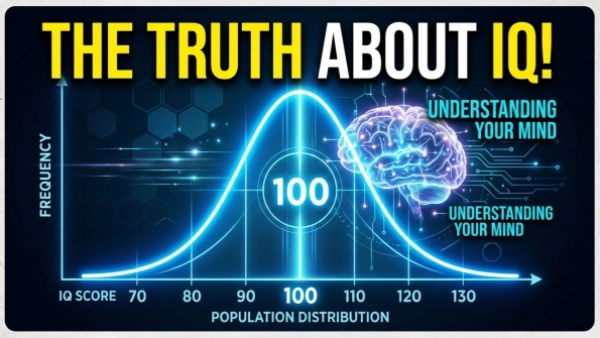
- The average IQ score is set at 100
- Most people fall within a predictable range around that average
- Scores are distributed according to a statistical pattern known as a normal distribution
This means IQ scores are not determined by how many questions someone answers correctly alone. Instead, they are calculated based on how a person's performance compares with others.
Understanding the Normal Distribution
IQ scores follow a bell-shaped statistical curve called a normal distribution. In this distribution:
- The average score is 100
- Most people cluster near the center
- Very high and very low scores are increasingly rare
Psychologists use a statistical value called the standard deviation (SD) to describe how scores spread around the average.
Most modern IQ tests use:
- Mean (average): 100
- Standard deviation: 15
This statistical model determines how common or rare different scores are.
To visualize the relationship between IQ scores and distance from the average, psychologists often refer to the concept of a standard score (z-score):
z = (x - μ) / σ
In this formula:
- x represents an individual's score
- μ is the population average (100)
- σ is the standard deviation (usually 15)
The result shows how many standard deviations a score lies above or below the average.
Typical IQ Score Ranges
Because IQ scores follow a normal distribution, psychologists can estimate how common different scores are.
| IQ Score | Approximate Percentile | Population Frequency |
| 100 | 50th percentile | Average |
| 115 | 84th percentile | Above average |
| 130 | 98th percentile | Top 2% |
| 145 | 99.9th percentile | Extremely rare |
This is why many high-IQ societies, such as Mensa, require scores at or above the 98th percentile for membership.
How Raw Test Scores Become IQ Scores
When someone takes an intelligence test, the process involves several stages.
1. Raw Score
First, the individual receives a raw score based on the number of questions answered correctly.
However, raw scores alone are not very meaningful because test difficulty varies between assessments.
2. Age Standardization
Next, the raw score is compared with the performance of people in the same age group.
This step ensures that IQ scores reflect cognitive ability relative to developmental expectations.
For example:
- A 10-year-old and a 30-year-old are evaluated against their respective age groups.
- The scoring system adjusts results to maintain fairness.
3. Statistical Scaling
After age comparison, the results are converted into the standard IQ scale with:
- Mean = 100
- Standard deviation = 15
This step ensures that scores from different versions of the test remain comparable.
Why Different Tests Can Produce Similar IQ Scores
Although multiple IQ tests exist, they all rely on similar statistical methods.
For example:
- The Stanford–Binet Intelligence Scales
- The Wechsler Adult Intelligence Scale
- The Wechsler Intelligence Scale for Children
Each uses large normative samples to calibrate scores so that the average remains 100.
This standardization allows psychologists to compare results across different tests.
What an IQ Score Does Not Measure
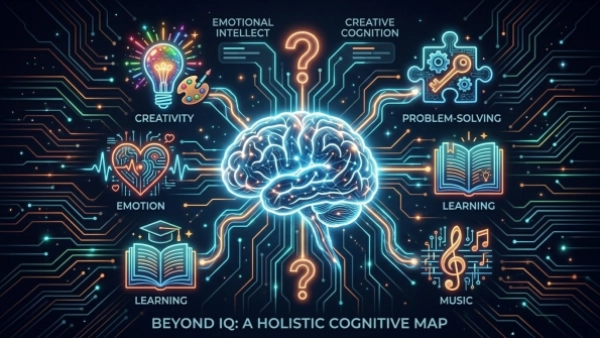
Despite their usefulness, IQ scores do not represent the full range of human intelligence.
Most IQ tests do not directly measure:
- Creativity
- Emotional intelligence
- Social skills
- Motivation and persistence
- Practical or hands-on problem solving
Psychologists increasingly recognize that intelligence is multidimensional and cannot be fully captured by a single number.
Are IQ Scores Fixed for Life?
IQ scores tend to remain relatively stable over time, particularly after adolescence. However, they can change due to factors such as:
- Education
- Health and nutrition
- Cognitive stimulation
- Life experiences
In other words, while cognitive ability has strong biological components, it is also influenced by environment and development.
Final Thoughts
An IQ score is not simply the number of correct answers on a test. It is a statistical comparison that shows how an individual's reasoning abilities relate to the broader population.
By using standardized tests, age comparisons, and statistical scaling, psychologists can estimate where someone falls within the distribution of cognitive performance.
However, intelligence is complex and multifaceted. IQ tests provide valuable insights into reasoning ability, but they represent only one piece of the much larger puzzle of human intelligence.