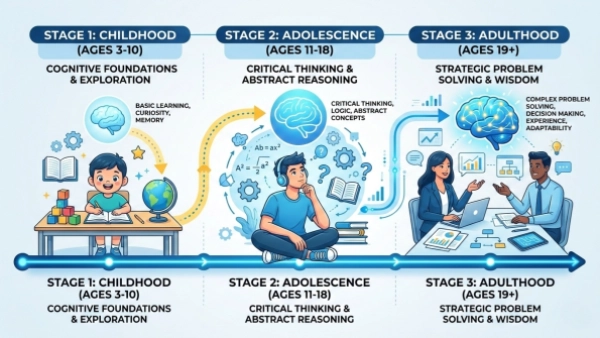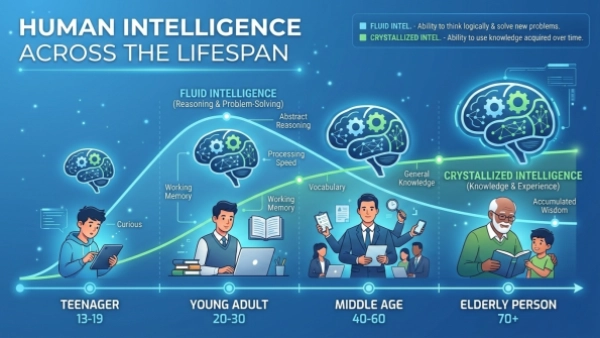
IQ scores are often discussed as a measure of intelligence, but many people misunderstand what these numbers actually mean. Seeing a specific score—whether high, average, or below average—can lead to assumptions about a person's abilities that are not always accurate.
Interpreting an IQ score correctly requires understanding how the score is calculated, what it measures, and what its limitations are. When viewed in the proper context, an IQ score can provide useful insights into cognitive abilities without defining a person’s full intellectual potential.
What an IQ Score Represents
An IQ score, or Intelligence Quotient, is a standardized measure designed to estimate certain cognitive abilities. Modern IQ tests evaluate skills such as:
- Logical reasoning
- Pattern recognition
- Working memory
- Spatial reasoning
- Verbal comprehension
- Processing speed
The results are compared to the performance of a large reference population. This comparison allows psychologists to determine where an individual’s score falls relative to others.
Most modern IQ tests are designed so that the average score is 100.
Understanding the IQ Distribution
IQ scores follow a statistical pattern known as a normal distribution, often illustrated as a bell-shaped curve. This means most people score close to the average, while fewer individuals score extremely high or extremely low.
The relationship between a raw score and its standardized value is described using the z-score formula:
z = (x - μ) / σ
In this formula:
- x represents the individual’s score
- μ (mu) represents the average score of the population
- σ (sigma) represents the standard deviation
IQ tests are typically designed with a standard deviation of 15, which determines how scores are distributed around the average.
Common IQ Score Ranges
Although interpretations may vary slightly across different tests, IQ scores are commonly categorized into approximate ranges:
- 130 and above: Very superior intelligence
- 120–129: Superior intelligence
- 110–119: High average
- 90–109: Average range
- 80–89: Low average
- 70–79: Borderline range
- Below 70: May indicate significant cognitive difficulties
It is important to remember that these categories describe statistical groupings, not fixed labels for a person’s abilities.
What Your IQ Score Can Tell You
An IQ score can provide insights into certain cognitive strengths, particularly in areas like reasoning, problem-solving, and pattern recognition.
For example, individuals with higher IQ scores often demonstrate:
- Faster learning of complex concepts
- Strong analytical thinking
- Greater ability to identify patterns and relationships
In educational or professional settings, these skills may contribute to success in fields that require intensive problem-solving or abstract thinking.
What Your IQ Score Cannot Tell You
Despite its usefulness, an IQ score does not measure many important aspects of intelligence.
IQ tests generally do not capture abilities such as:
- Creativity
- Emotional intelligence
- Social skills
- Motivation and perseverance
- Practical problem-solving in everyday life
A person may have a moderate IQ score but still excel in leadership, artistic creativity, entrepreneurship, or interpersonal communication.
In other words, IQ measures a narrow set of cognitive abilities, not the full range of human intelligence.
Why Context Matters
Several factors can influence IQ test performance, including:
- Educational background
- Cultural experiences
- Language proficiency
- Test anxiety
- Health and fatigue
Because of these variables, psychologists rarely rely on a single IQ score to make major decisions. Instead, IQ results are often combined with other assessments, interviews, and observations.
IQ Scores Can Change
Although IQ scores tend to remain relatively stable over time, they are not completely fixed. Changes in environment, education, and mental stimulation can influence cognitive development.
Activities that support cognitive growth include:
- Continuous learning
- Challenging mental tasks
- Reading and problem-solving
- Healthy lifestyle habits
These activities help maintain and strengthen cognitive abilities throughout life.
The Bigger Picture of Intelligence
Perhaps the most important thing to remember is that an IQ score is only one piece of a much larger puzzle. Intelligence is complex and multidimensional, shaped by both biological and environmental factors.
Success in life depends on many qualities beyond cognitive reasoning, including determination, curiosity, adaptability, and social understanding.
Conclusion
Interpreting an IQ score correctly requires understanding what the number actually represents. IQ tests measure certain cognitive abilities related to reasoning and problem-solving, but they do not capture the full range of human intelligence.
Rather than viewing an IQ score as a fixed label, it should be seen as one indicator among many that help describe how people think and learn. With the right perspective, IQ results can be informative without limiting how we understand human potential.