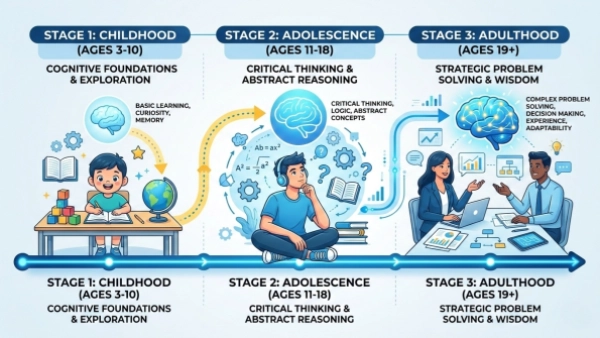
Many people assume that intelligence reaches its highest point at a specific age and then gradually declines. However, modern research shows that intelligence does not peak at a single moment in life. Instead, different cognitive abilities reach their peak at different ages.
Understanding how intelligence changes across the lifespan helps explain why younger individuals may excel at quick problem-solving while older adults often demonstrate deeper knowledge and better judgment.
Intelligence Is Not a Single Ability
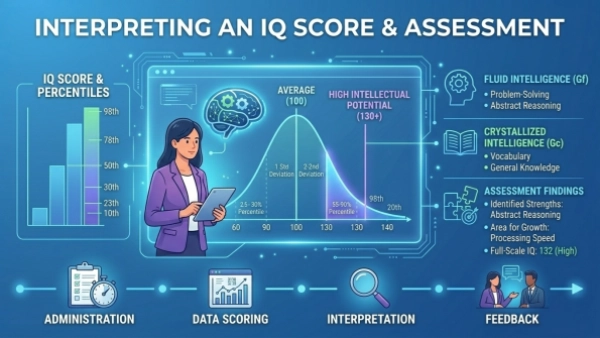
Psychologists have long recognized that intelligence is made up of multiple components. Two important categories are:
- Fluid intelligence – the ability to solve new problems, think logically, and recognize patterns without relying on prior knowledge.
- Crystallized intelligence – the knowledge and skills accumulated through education and experience.
Because these abilities develop differently, they also peak at different stages of life.
When Fluid Intelligence Peaks
Fluid intelligence tends to reach its highest level in early adulthood, typically during the late teens to the late 20s.
This type of intelligence is closely related to:
- Processing speed
- Working memory
- Abstract reasoning
- Problem-solving ability
Young adults often perform very well in tasks that require quick thinking and mental flexibility, such as solving unfamiliar puzzles or analyzing new information.
After the late 20s or early 30s, fluid intelligence may gradually decline, mainly because the brain’s processing speed slows slightly over time. However, the decline is usually slow and varies significantly between individuals.
When Crystallized Intelligence Peaks
Crystallized intelligence follows a very different pattern. Instead of peaking early, it continues to grow throughout adulthood.
This type of intelligence includes:
- Vocabulary
- General knowledge
- Professional expertise
- Cultural understanding
Many studies suggest that crystallized intelligence may peak in the 40s, 50s, or even later, depending on how actively a person continues learning and gaining experience.
This is why experienced professionals often outperform younger individuals in fields that require deep knowledge and long-term expertise.
Cognitive Abilities Peak at Different Ages
Research has shown that specific mental abilities reach their highest performance at different stages of life. For example:
- Processing speed: often peaks in the late teens or early 20s
- Short-term memory: usually strongest in the mid-20s
- Emotional intelligence: tends to improve into middle adulthood
- Vocabulary and knowledge: may peak in the 50s or 60s
These differences show that intelligence evolves throughout life rather than reaching a single peak.
The Role of Brain Development
The brain continues developing well into early adulthood. The prefrontal cortex, which controls planning, decision-making, and impulse control, matures fully in the mid-20s.
As people age, their brains become more efficient at integrating knowledge and experiences. Even though some cognitive processes slow slightly, the ability to make informed decisions often improves.
This combination of knowledge and perspective contributes to what many psychologists describe as wisdom.
Factors That Influence Cognitive Aging
Although general trends exist, the age at which intelligence peaks can vary widely depending on several factors, including:
- Education level
- Mental stimulation
- Physical health
- Social engagement
- Lifestyle habits
People who continue challenging their minds through reading, learning new skills, and engaging in complex activities often maintain strong cognitive abilities for longer.
Regular physical exercise, healthy sleep patterns, and good nutrition also support brain health.
Intelligence Can Be Maintained Throughout Life
While some cognitive abilities naturally change with age, research shows that the brain remains adaptable throughout life. This adaptability is known as neuroplasticity.
Activities that help maintain cognitive performance include:
- Lifelong learning
- Solving puzzles and strategy games
- Learning new languages or skills
- Maintaining social relationships
- Staying physically active
These habits help strengthen neural connections and support long-term cognitive health.
Conclusion
Intelligence does not peak at a single age. Instead, different mental abilities reach their highest performance at different stages of life. Fluid intelligence tends to peak in early adulthood, while crystallized intelligence often continues growing well into middle and later adulthood.
Rather than declining sharply with age, intelligence evolves. As people gain knowledge, experience, and perspective, they often develop deeper understanding and better judgment. In this way, intellectual growth can continue throughout an entire lifetime.