IQ tests are among the most widely used psychological assessments for measuring cognitive ability. However, these tests are not created randomly or based on simple question lists. Instead, they are carefully designed through years of psychological research, statistical analysis, and testing on large populations.
The goal of this process is to ensure that IQ tests measure cognitive abilities accurately, consistently, and fairly across different groups of people. Understanding how IQ tests are designed and standardized helps explain why these assessments are considered reliable tools in psychology and education.
The Purpose of IQ Test Design
The primary goal of an IQ test is to measure aspects of general cognitive ability, often called general intelligence. Test designers aim to create tasks that evaluate reasoning, memory, language understanding, and problem-solving in a structured and objective way.
To achieve this, psychologists develop questions that:
- Measure specific cognitive skills
- Avoid cultural or educational bias as much as possible
- Produce consistent results across different populations
- Allow meaningful comparison between individuals
The design process requires careful planning to ensure that each test item contributes to an accurate measurement of intelligence.
Identifying the Cognitive Domains to Measure
Modern IQ tests typically assess several core areas of cognition. These domains represent different mental processes that together contribute to general intelligence.
Common domains included in IQ assessments are:
- Verbal comprehension – understanding and reasoning with language
- Logical reasoning – identifying patterns and solving abstract problems
- Working memory – holding and manipulating information mentally
- Processing speed – quickly analyzing and responding to information
- Visual-spatial reasoning – understanding shapes, patterns, and spatial relationships
Test designers create specific tasks for each domain to ensure a broad evaluation of cognitive functioning.
Developing Test Items
Once the cognitive domains are defined, researchers begin creating potential test questions, known as items. These items are designed to vary in difficulty and measure the targeted abilities effectively.
Examples of item types include:
- Pattern recognition puzzles
- Vocabulary or analogy questions
- Memory tasks involving sequences of numbers or symbols
- Visual puzzles requiring mental rotation or shape matching
Each item must be clear, measurable, and capable of distinguishing between different levels of ability.
Pilot Testing and Data Collection
Before an IQ test is officially released, it undergoes extensive pilot testing. Large groups of participants from different backgrounds take the test under controlled conditions.
Researchers collect detailed data on how people respond to each item. This information helps determine:
- Which questions are too easy or too difficult
- Whether items measure the intended cognitive ability
- How well each question differentiates between levels of performance
Questions that do not perform well statistically are revised or removed.
Statistical Analysis and Item Selection
After pilot testing, psychologists use statistical techniques to analyze the results. The goal is to identify which items contribute most effectively to measuring intelligence.
Key factors considered during this stage include:
- Item difficulty – how many participants answer correctly
- Item discrimination – how well the item separates high and low performers
- Reliability – whether results remain consistent over repeated testing
Only the most reliable and informative items are included in the final version of the test.
The Process of Standardization
Once the final set of items is selected, the test undergoes standardization. This step ensures that scores can be meaningfully compared across individuals.
Standardization involves administering the test to a large and representative sample of the population. Participants are selected to reflect diversity in age, education, gender, ethnicity, and geographic background.
The data collected from this sample forms the norm group, which becomes the reference point for interpreting all future scores.
Creating the Score Distribution
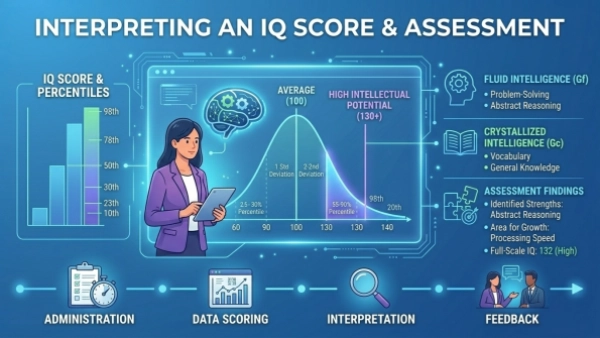
Using data from the norm group, psychologists establish the statistical distribution of scores. IQ tests are designed so that results follow a normal distribution, often called a bell curve.
This means:
- The average score is set to 100
- The standard deviation is typically 15
- Most scores fall within a predictable range around the average
The statistical relationship between individual performance and the population average can be described using a standard score calculation.
z = (x - μ) / σ
This formula represents the z-score, which indicates how far a person’s performance is from the population mean. IQ scores are derived from similar statistical transformations that convert raw test performance into standardized values.
Age Norms and Fair Comparisons
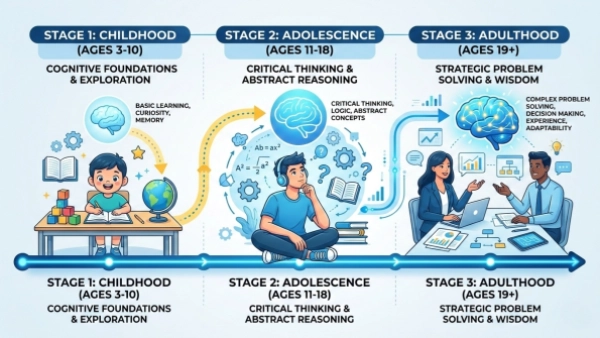
One of the most important aspects of IQ test standardization is age norming. Cognitive abilities change throughout the lifespan, especially during childhood and adolescence.
To account for these differences, test scores are compared only with individuals in the same age group.
For example:
- A 9-year-old is compared with other 9-year-olds
- A 30-year-old is compared with other adults
This ensures that IQ scores reflect relative cognitive performance rather than simple differences in experience or development.
Ensuring Reliability and Validity
For an IQ test to be useful, it must meet two key scientific standards.
Reliability
Reliability refers to the consistency of test results. A reliable IQ test should produce similar scores if a person takes the test again under similar conditions.
Researchers evaluate reliability using repeated testing and statistical analysis.
Validity
Validity refers to whether the test actually measures what it claims to measure—in this case, cognitive ability.
Psychologists test validity by examining how well IQ scores relate to other indicators of intellectual performance, such as academic achievement and problem-solving ability.
Continuous Revision of IQ Tests
IQ tests are not permanent or fixed tools. Over time, populations change due to factors such as improved education, nutrition, and access to information.
Because of these shifts, test developers periodically update IQ tests through a process called restandardization. This involves collecting new norm data and adjusting scoring to maintain accuracy.
Without these updates, IQ scores could gradually drift upward due to what researchers call the Flynn Effect, a long-term rise in average test performance.
Final Thoughts
Designing and standardizing an IQ test is a complex process that combines psychology, statistics, and large-scale data analysis. Researchers carefully develop test items, evaluate their effectiveness, and establish norms based on representative populations.
Through these steps, IQ tests become structured tools that allow psychologists and educators to compare cognitive performance in a consistent and scientifically grounded way. While no test can fully capture the complexity of human intelligence, standardized IQ assessments provide valuable insight into how individuals think, reason and solve problems.