IQ scores are widely used to estimate cognitive ability, but many people misunderstand what these scores truly represent. An IQ test does not measure all forms of intelligence, nor does it determine a person’s full intellectual potential. Instead, IQ tests focus on specific mental processes related to reasoning, problem-solving, and information processing.
Understanding what an IQ score actually measures helps clarify both the value and the limitations of intelligence testing.
The Concept of General Intelligence
Most modern IQ tests are designed to estimate a psychological construct known as general intelligence, often referred to as g. This concept suggests that different cognitive abilities are interconnected and that individuals who perform well in one type of mental task often perform well in others.
General intelligence reflects the brain’s ability to:
- Understand complex ideas
- Learn from experience
- Adapt to new situations
- Solve unfamiliar problems
- Process information efficiently
While IQ tests do not capture every aspect of intelligence, they attempt to measure core cognitive abilities that contribute to these skills.
Key Cognitive Abilities Measured by IQ Tests
Most standardized intelligence tests assess several fundamental cognitive domains. These domains combine to produce an overall IQ score.
Logical and Abstract Reasoning
Reasoning is one of the most important components measured by IQ tests. This ability involves identifying patterns, relationships, and rules in unfamiliar information.
Typical tasks may include:
- Pattern completion problems
- Analogies and relationships between objects
- Logical sequences of shapes or numbers
These tasks evaluate how effectively a person can analyze new information and reach logical conclusions.
Working Memory
Working memory refers to the ability to temporarily hold and manipulate information in the mind. This skill is essential for complex thinking, problem-solving, and learning.
Examples of working memory tasks include:
- Remembering and repeating number sequences
- Solving mental arithmetic problems
- Reordering information in memory
Strong working memory allows individuals to manage multiple pieces of information simultaneously while solving problems.
Verbal Comprehension
Verbal comprehension measures how well a person understands language and uses words to reason and communicate ideas.
This domain often includes tasks such as:
- Defining vocabulary words
- Explaining similarities between concepts
- Understanding verbal analogies
Verbal abilities are closely related to education, reading habits, and exposure to language throughout life.
Processing Speed
Processing speed reflects how quickly the brain can interpret and respond to information. It is an important factor in tasks that require rapid visual scanning, decision-making, or pattern recognition.
Processing speed tasks may involve:
- Matching symbols with numbers
- Identifying patterns under time pressure
- Completing simple visual tasks quickly and accurately
Although speed is only one aspect of intelligence, it influences how efficiently someone can perform many cognitive tasks.
Visual-Spatial Reasoning
Visual-spatial reasoning refers to the ability to understand and manipulate visual information in space.
Typical assessments include:
- Identifying how shapes fit together
- Rotating objects mentally
- Completing visual puzzles or block designs
This ability plays an important role in fields such as engineering, architecture, and design.
How These Abilities Combine into an IQ Score
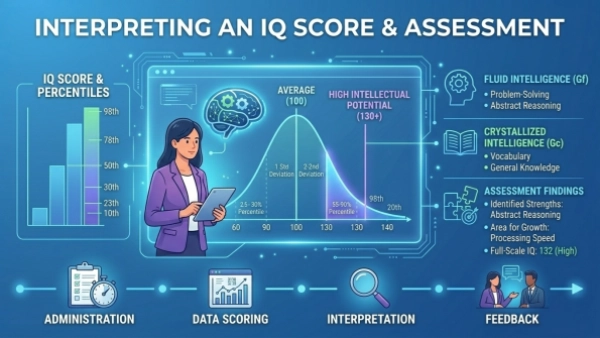
IQ tests measure performance across several cognitive domains. The results from these individual sections are combined to produce an overall score representing general cognitive functioning.
Because each ability contributes differently, the final IQ score reflects a composite estimate rather than a single skill. Two people may have identical IQ scores but show different strengths—for example, one might excel in verbal reasoning while another performs better in visual-spatial tasks.
What IQ Tests Do Not Measure
Although IQ tests measure several important cognitive abilities, they do not capture every form of intelligence.
Important abilities not directly measured include:
- Creativity and artistic thinking
- Emotional intelligence
- Social awareness and interpersonal skills
- Practical problem-solving in everyday life
- Motivation and persistence
These qualities can strongly influence success and life outcomes, even though they are not included in traditional IQ scores.
Environmental and Educational Influences
IQ test performance is shaped not only by cognitive ability but also by environmental factors.
Important influences include:
- Quality of education
- Early childhood development
- Cultural background and language exposure
- Access to learning opportunities
- Familiarity with test formats
Because of these influences, IQ scores should be interpreted as estimates of cognitive performance within a particular context, rather than absolute measures of intelligence.
Why Psychologists Use IQ Tests
Despite their limitations, IQ tests remain useful tools in psychology, education, and research. They can help identify cognitive strengths and challenges, support educational planning, and contribute to research on learning and brain development.
IQ assessments are commonly used for:
- Educational evaluation and learning support
- Cognitive research
- Identifying giftedness
- Understanding learning difficulties
When used carefully and interpreted by professionals, IQ tests provide valuable insight into how individuals process information and solve problems.
Final Thoughts
An IQ score measures several core cognitive abilities, including reasoning, memory, language comprehension, processing speed, and visual-spatial thinking. Together, these abilities provide an estimate of general intelligence and how efficiently a person processes complex information.
However, intelligence is far more complex than a single number. Creativity, emotional awareness, practical judgment, and life experience all contribute to how people think and adapt to the world. For this reason, IQ scores are best viewed as one useful indicator of cognitive ability rather than a complete measure of human intelligence.