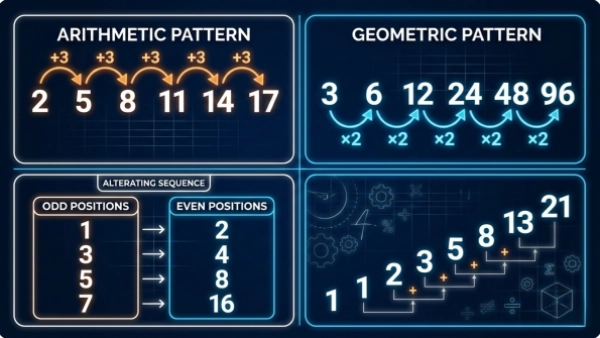
Most number series questions look simple on the surface. Add 3. Multiply by 2. Alternate between two rules.
But in higher-level IQ tests—especially those used in competitive exams, executive assessments, or high-range intelligence screenings—the patterns become more abstract. Instead of basic arithmetic progressions, you may encounter recursive sequences, prime-based logic, factorial growth, or nested multi-layer rules.
This guide breaks down the most important advanced numerical patterns, explains how they work, and shows you how to recognize them quickly under pressure. Before diving in, make sure you're familiar with the core numerical pattern types — this article builds directly on those foundations.
Why Advanced Patterns Matter
In easier number series questions, the objective is straightforward: Can you detect a basic arithmetic or geometric rule? Add 4. Multiply by 3. Alternate between two operations. These questions test pattern awareness at a surface level.
However, in high-difficulty IQ tests—such as executive aptitude exams, advanced cognitive assessments, or elite-level screening tests—the purpose shifts dramatically.
The goal is no longer to check whether you can perform simple arithmetic.
Instead, test designers want to measure:
- Abstract reasoning — Can you identify structure beneath apparent randomness?
- Fluid intelligence — Can you solve novel problems without relying on memorized formulas?
- Cognitive flexibility — Can you abandon a wrong hypothesis quickly and pivot?
- Working memory under load — Can you track multiple relationships at once?
Advanced number series often look chaotic at first glance. The numbers may grow quickly, shift unpredictably, or combine multiple rules. This initial confusion is intentional. The sequence is designed to disrupt automatic thinking.
The key difference between average and high scorers is not mathematical knowledge. It’s structural recognition.
High scorers don’t calculate faster—they recognize patterns earlier. They see relationships across terms rather than between isolated numbers. They test hypotheses efficiently and discard weak ones quickly.
Advanced patterns reward mental discipline, not advanced math. To understand what's happening cognitively when you recognize patterns, read our article on the science of pattern recognition and how your brain solves number series.
For context on how fluid intelligence works during pattern recognition, see our science-based article on whether abstract reasoning can be improved.
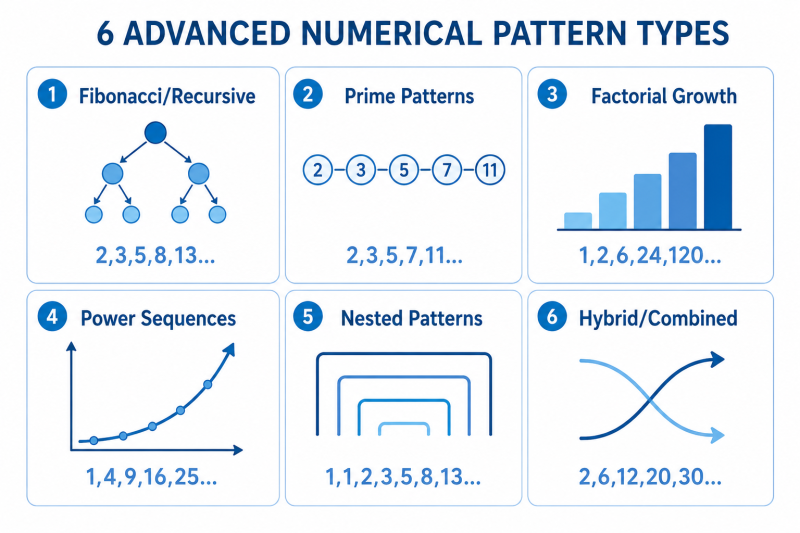
1. Fibonacci and Recursive Sequences
The Classic Fibonacci Pattern
Example:
2, 3, 5, 8, 13, ?
Each term equals the sum of the previous two:
- 2 + 3 = 5
- 3 + 5 = 8
- 5 + 8 = 13
Next term:
8 + 13 = 21
This follows a recursive rule:
aₙ = aₙ₋₁ + aₙ₋₂
Recursive sequences are fundamentally different from arithmetic or geometric ones. Instead of depending on a fixed operation, each term depends on previous terms. That dependency increases cognitive load because you must track relationships across multiple positions.
In difficult IQ tests, recursive structures are powerful because they require relational thinking rather than step-by-step calculation.
Variations You Might See
High-level tests rarely use a pure Fibonacci sequence. That would be too recognizable. Instead, they modify it in subtle ways:
- Start with unusual seed numbers (e.g., 4, 7, 11, 18, 29…)
- Add a constant: aₙ = aₙ₋₁ + aₙ₋₂ + 1
- Alternate between addition and subtraction
- Multiply instead of add
- Insert a positional modifier
Example:
1, 2, 4, 7, 11, ?
Look at differences:
+1, +2, +3, +4
This is not Fibonacci directly, but it shows second-order growth. The rate of change increases by 1 each step. That accelerating structure is closely related to recursive thinking.
More advanced example:
3, 4, 8, 15, 27, ?
Check relationships across three terms:
- 4 + 3 = 7 (not 8)
- But 8 = 3 + 4 + 1
- 15 = 4 + 8 + 3
- 27 = 8 + 15 + 4
Now we see a recursive pattern plus a shifting modifier. These layered rules are common in harder assessments.
Recognition Strategy for Recursive Patterns
If differences are not constant, ask:
- Is each term related to the two before it?
- Does the sequence accelerate steadily?
- Do the differences themselves form a pattern?
- Does subtracting earlier terms reveal consistency?
Recursive patterns often reveal themselves only after examining relationships across three consecutive terms. When growth feels smooth but not linear, suspect recursion.
2. Prime Number Sequences
Prime numbers are a favorite tool in advanced IQ tests because they appear irregular. There is no simple formula for predicting the next prime without checking divisibility. That unpredictability creates cognitive tension.
Example 1: Pure Prime Sequence
2, 3, 5, 7, 11, 13, ?
Next prime: 17
This is straightforward—but in high-level tests, it rarely stays that simple.
Example 2: Position-Based Prime Pattern
3, 5, 11, 17, 29, ?
At first glance, these look like random primes.
Now analyze positions:
- 3 → 2nd prime
- 5 → 3rd prime
- 11 → 5th prime
- 17 → 7th prime
Now look at those positions: 2, 3, 5, 7
Those are consecutive prime numbers.
This suggests a deeper structure: the sequence may be selecting prime numbers at prime positions.
This layered logic is characteristic of advanced tests.
Prime + Arithmetic Hybrid
Example:
5, 8, 13, 20, 29, ?
Differences:
3, 5, 7, 9
Those are consecutive odd numbers.
Next difference = 11
29 + 11 = 40
But notice something subtle:
3, 5, 7 are prime numbers.
Sometimes primes are embedded indirectly—within differences, positions, or increments.
This creates what feels like randomness but is actually structured logic.
Recognition Strategy for Prime-Based Patterns
If numbers feel irregular:
- Check whether they are prime.
- Look at prime positions.
- Analyze gaps between terms.
- Examine whether differences follow a prime pattern.
- Check whether prime indices are involved.
Irregular spacing often signals prime involvement. When numbers don’t behave “smoothly,” suspect primes.
3. Factorial Growth Patterns
Factorials grow extremely fast:
- 1! = 1
- 2! = 2
- 3! = 6
- 4! = 24
- 5! = 120
- 6! = 720
Because factorials escalate rapidly, they’re often used to create dramatic growth that overwhelms casual pattern detection.
Basic Factorial Example
1, 2, 6, 24, 120, ?
Next: 720
That’s 6!
Modified Factorial Patterns
More advanced versions disguise the factorial:
2, 3, 8, 27, 124, ?
Look carefully:
- 1! + 1 = 2
- 2! + 1 = 3
- 3! + 2 = 8
- 4! + 3 = 27
- 5! + 4 = 124
Pattern:
n! + (n − 1)
This hybrid structure forces you to recognize factorial growth and then adjust for an additive modifier.
Recognition Strategy for Factorials
If numbers grow explosively:
- Compare them to nearby factorial values.
- Divide by increasing integers.
- Check whether dividing by 2, 3, 4, 5 produces clean results.
- Ask whether the numbers are “almost” factorials.
Rapid acceleration is the primary clue. If geometric growth feels too slow to explain the increase, factorials may be involved.
4. Power and Exponential Position Patterns
Sometimes the sequence depends entirely on position.
Perfect Squares
1, 4, 9, 16, 25, ?
Rule: n²
Next: 36
Cubes
1, 8, 27, 64, ?
Rule: n³
Next: 125
Mixed Power Patterns
2, 5, 10, 17, 26, ?
Differences:
3, 5, 7, 9
Those are consecutive odd numbers.
The sequence equals:
n² + 1
Position-based logic is common in advanced tests because it rewards abstraction. You must step back and think: What is the formula for the nth term?
When first differences increase linearly, suspect a quadratic expression.
5. Nested (Multi-Layer) Patterns
Nested patterns require analyzing multiple levels of change.
Example:
1, 3, 6, 10, 15, ?
Differences:
2, 3, 4, 5
Second differences:
+1, +1, +1
Constant second difference signals a quadratic pattern.
This sequence is the triangular number formula:
n(n + 1)/2
Nested sequences require you to analyze:
- First differences
- Second differences
- Sometimes third differences
If the second difference is constant, the sequence likely follows a quadratic polynomial.
If the third difference is constant, the sequence may follow a cubic structure.
These are among the most cognitively demanding types because they require layered analysis.
6. Hybrid and Combined Structures
The most difficult IQ number series combine two independent ideas.
Example:
2, 5, 7, 12, 19, 31, ?
Split by position:
Odd positions:
2, 7, 19, ?
Even positions:
5, 12, 31
Now analyze each subsequence separately.
Hard problems often require segmentation before analysis.
These questions measure cognitive flexibility—the ability to drop one interpretation and try another without emotional attachment.
A Systematic Approach to Advanced Sequences
When facing a difficult number series:
Step 1: Check Differences
If constant → arithmetic
If increasing → check second differences
Step 2: Check Ratios
If constant → geometric
Step 3: Check Position
Do values resemble n², n³, n!?
Step 4: Check Recursive Relationships
Is each term derived from the previous two?
Step 5: Check for Alternation
Split odd and even positions
The biggest mistake in advanced problems is assuming complexity too early. Always eliminate simpler explanations first.
Common Traps in Advanced Patterns
- Near-Fibonacci illusion – Appears recursive but fails consistency check
- Fake exponential growth – Large jumps caused by addition, not multiplication
- Prime distraction – Numbers look prime-heavy but follow another rule
- Partial rule correctness – Rule works for first three terms but collapses later
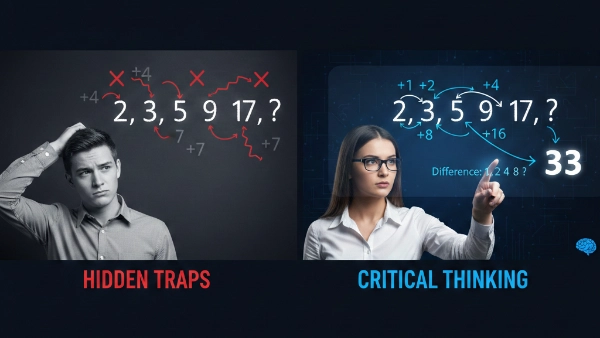
A valid rule must explain every transition in the sequence — not just the beginning. For a detailed guide to all the deliberate traps test designers use in number series questions, read hidden traps in number series questions: think like a test designer.
How to Train for Advanced Numerical Patterns
Mastery requires deliberate exposure.
To improve:
- Practice recursive sequences intentionally.
- Memorize reference sequences (primes under 50, factorials up to 7!).
- Work with second-difference tables regularly.
- Solve mixed-difficulty sets under time pressure.
- Review mistakes and identify which assumption failed.
Advanced pattern recognition improves through structural familiarity. The more patterns you've seen, the faster your brain detects similarities. To build this familiarity quickly, work through our 50+ number series practice questions with step-by-step solutions — they cover a range of difficulty levels including the advanced types discussed in this article.
Over time, what once looked chaotic begins to look predictable.
And that shift—from confusion to clarity—is exactly what high-level IQ tests are designed to measure.
Final Thoughts
Advanced numerical patterns are not about complex math. They are about layered logic. When you learn to think recursively, recognize structural growth, analyze differences systematically, and separate overlapping rules, even the most intimidating sequences become manageable.
At higher levels, number series stop being arithmetic exercises. They become tests of abstraction, discipline, and mental flexibility. To complement this skill with speed, read our high-speed strategy guide for solving number series in under 20 seconds. And to benchmark your numerical reasoning against real test questions, try our free IQ exam.