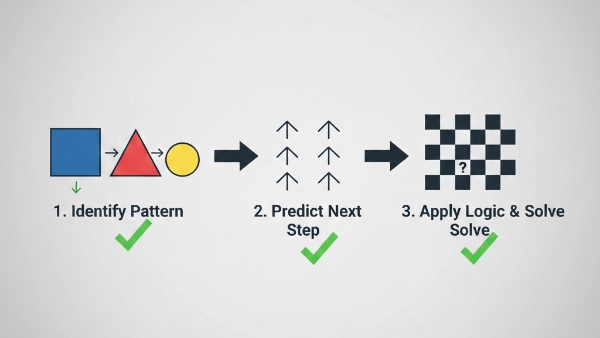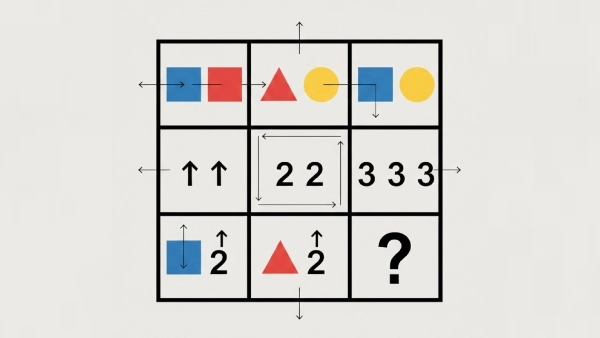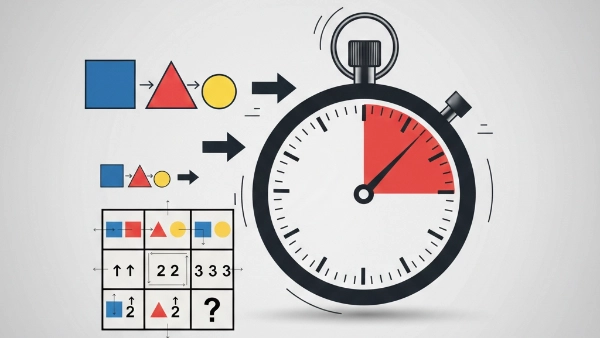
Abstract reasoning is often described as a core component of intelligence—the ability to recognize patterns, understand relationships, and solve unfamiliar problems without relying on language or prior knowledge. Because of its strong connection to IQ testing, many people wonder: Is abstract reasoning fixed, or can it actually be improved?
The short answer from science is yes, abstract reasoning can improve, but with important limitations. Understanding how and why it improves helps set realistic expectations and guides effective practice. Before diving into the science, make sure you understand what abstract reasoning questions actually test — the distinction matters when evaluating what "improvement" really means.
What Science Says About Abstract Reasoning
Abstract reasoning is closely linked to what psychologists call fluid intelligence—the capacity to solve new problems independently of learned knowledge. For a long time, fluid intelligence was believed to be largely fixed after adolescence.
Modern research paints a more nuanced picture.
Studies in cognitive psychology and neuroscience show that:
- Abstract reasoning ability has a stable baseline influenced by genetics
- Performance can improve meaningfully with targeted training
- Improvements are strongest in tasks similar to those practiced
This means abstract reasoning is not infinitely malleable, but it is also not static.
What Actually Improves: Ability vs Performance
One of the most misunderstood aspects of abstract reasoning is the difference between underlying cognitive ability and observable test performance. These two are related, but they are not the same.
Underlying ability refers to relatively stable traits such as processing capacity, working memory limits, and baseline pattern-detection efficiency. These are influenced by genetics and long-term development.
Performance, on the other hand, reflects how effectively that ability is used in a specific context—especially under time pressure.
Training primarily improves performance by strengthening how efficiently you apply your existing capacity.
In practice, training tends to improve:
- Speed of pattern recognition, reducing the time needed to notice relevant changes
- Accuracy under time pressure, minimizing rushed errors
- Familiarity with common rule types, so fewer mental resources are spent on discovery
- Efficiency of problem-solving strategies, allowing faster elimination of wrong options
These gains translate directly into higher abstract reasoning scores, even when fundamental intelligence remains largely unchanged.
From a real-world perspective, this distinction matters far more than philosophical debates about whether intelligence itself can change. Tests measure performance—not theoretical potential.
Why Practice Works for Abstract Reasoning
Abstract reasoning tests may look endlessly varied, but they rely on a small and repetitive set of logical principles. Rotation, symmetry, counting, alternation, progression, and rule combination appear across nearly all major test providers. For a full breakdown of these principles, see our guide on the most common abstract reasoning patterns you must know.
Practice works because it reduces novelty.
With repetition, your brain:
- Recognizes familiar structures more quickly
- Stops re-solving the same logic from scratch
- Learns which hypotheses are worth testing first
As a result, practice improves performance by:
- Reducing cognitive load, freeing mental resources for harder rules
- Automating pattern recognition, making it feel instinctive rather than analytical
- Shortening hypothesis-testing time, so you discard wrong rules faster
- Preventing common mistakes under pressure, such as ignoring number-based rules
This is why trained individuals often outperform untrained individuals with similar baseline ability—especially in timed environments.
Brain Plasticity and Pattern Learning
Neuroscience supports the idea that repeated exposure changes how the brain processes information.
Abstract reasoning training consistently engages:
- Visual-spatial processing networks, responsible for shape and position analysis
- Working memory, used to hold multiple transformations in mind
- Attentional control, needed to focus on relevant features and ignore noise
- Rule-learning mechanisms, which help detect regularities
With practice, these systems become more efficient and coordinated. Signals travel faster, irrelevant features are filtered out earlier, and correct rules are identified with less effort.
This does not mean the brain becomes “smarter” in a general sense. Instead, it becomes better calibrated for abstract reasoning tasks, much like an athlete becomes efficient at a specific movement pattern.
What Improvement Looks Like in Real Terms
Improvement in abstract reasoning is usually subtle but meaningful, not dramatic or sudden.
It is typically:
- Gradual rather than instant
- Measured in consistency and confidence
- Most visible under timed conditions
Common real-world signs of improvement include:
- Recognizing the governing rule within seconds instead of minutes
- Making fewer back-and-forth visual comparisons
- Eliminating incorrect answers earlier and more decisively
- Feeling mentally fresher near the end of a test
These changes significantly affect outcomes, even if they feel modest subjectively.
Limits of Improvement: What Training Cannot Do
Scientific evidence is clear that training has limits.
Practice cannot:
- Transform abstract reasoning ability indefinitely
- Erase individual differences in baseline cognitive capacity
- Replace general constraints like working memory limits or processing speed
Someone with extensive training may outperform others on tests, but very large differences in baseline ability usually persist over the long term.
This does not make training ineffective—it simply means expectations should be realistic.
What Type of Training Works Best
Research consistently shows that specific, structured training is far more effective than general “brain training” games.
Effective abstract reasoning training includes:
- Practice questions closely resembling real test items
- Explicit instruction in common pattern categories
- Step-by-step problem-solving frameworks
- Timed practice to simulate test conditions
- Careful review of incorrect answers
Unstructured puzzle-solving or casual games may be enjoyable, but they produce much weaker and less transferable gains. For a structured approach to timed practice specifically, read our abstract reasoning practice tips for timed tests. And for the step-by-step method that supports all of these, see how to solve abstract reasoning questions step by step.
Does Improvement Transfer to Other Skills?
Transfer depends heavily on similarity.
Strong transfer is seen to:
- Other abstract reasoning tests
- Nonverbal IQ assessments
- Visual aptitude and matrix reasoning tasks
Limited transfer occurs to:
- Verbal reasoning
- Numerical reasoning
- Academic knowledge or subject-based learning
Abstract reasoning training improves what it directly trains—and little beyond that. This also explains why, if you want to improve numerical pattern recognition or verbal reasoning alongside abstract reasoning, each skill benefits most from its own targeted practice.
Age and Improvement
Improvement is possible at nearly any adult age.
Research suggests:
- Younger learners often improve faster
- Older adults may require more repetition
- Motivation, consistency, and strategy matter more than age
There is no strong evidence that adults lose the ability to improve abstract reasoning performance.
Practical Takeaway
So, can abstract reasoning be improved?
Yes—but not magically, and not without limits.
Science shows that abstract reasoning performance improves through:
- Repeated exposure
- Pattern familiarity
- Strategic problem-solving
- Timed, structured practice
Training does not rewrite intelligence. It sharpens how intelligence is expressed, especially in high-pressure test environments. That distinction is exactly why preparation works — and why it matters. To see what common errors trip up even well-prepared candidates, read beginner mistakes in abstract reasoning and how to avoid them.
Final Thoughts
Abstract reasoning sits at the intersection of innate ability and learned efficiency. While genetics influence your starting point, practice determines how effectively you use that ability under real-world conditions.
For exams, hiring tests, and IQ assessments, improvement is not only possible — it is expected for those who prepare properly. The best way to experience this improvement firsthand is to practice with a real timed assessment — try our free IQ exam and see where you stand today.