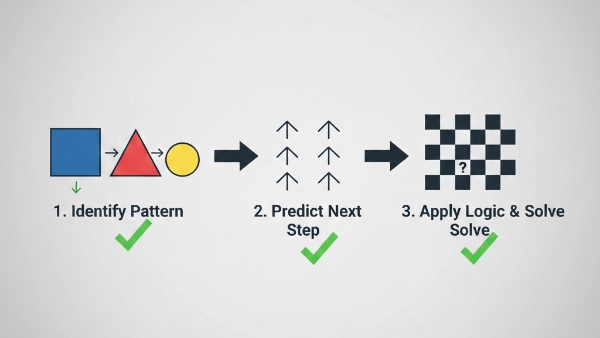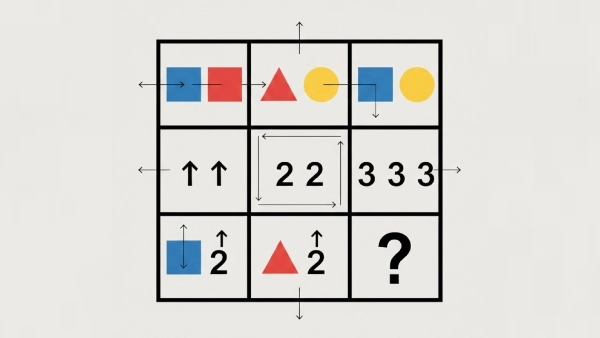
Abstract reasoning tests often feel intimidating to beginners. The questions look unfamiliar, the rules are hidden, and time pressure makes everything worse. Most poor results, however, are not caused by low ability—they come from predictable beginner mistakes.
The good news is that these mistakes are easy to fix once you recognize them. This article breaks down the most common errors beginners make in abstract reasoning tests and shows you how to avoid them.

Mistake 1: Jumping to an Answer Too Quickly
Many beginners rush to choose an answer as soon as they notice any pattern. While this feels efficient, it is one of the most common causes of wrong answers. The first visible pattern is often only part of the rule, not the complete logic behind the sequence or matrix.
Abstract reasoning questions are designed to reward careful verification, not fast guesses.
Why it happens
- Anxiety caused by time pressure
- Fear of running out of time
- Overconfidence after spotting an obvious change
How to avoid it
Pause for a few seconds before committing. Ask yourself whether the rule you identified explains every image, not just the first two. If the rule fails even once, discard it immediately and keep analyzing.
Mistake 2: Ignoring What Stays the Same
Beginners tend to focus almost entirely on change—movement, rotation, or transformation—while overlooking elements that remain constant. In abstract reasoning, what stays the same is often just as important as what changes.
Constant features frequently act as constraints that limit the correct answer.
Why it happens
- Visual overload from complex diagrams
- Habit of chasing movement and transformation
- Lack of a structured observation method
How to avoid it
Always ask two questions in parallel:
- What changes?
- What stays the same?
Elements that remain constant often help you eliminate answer choices quickly and prevent overcomplicated interpretations.
Mistake 3: Overcomplicating Simple Patterns
Many abstract reasoning questions are intentionally designed to look difficult. Beginners often assume that complex visuals must require complex logic.
In reality, test designers often hide very simple rules inside visually busy patterns.
Why it happens
- Intimidation by complex images
- Belief that tests reward clever or tricky logic
- Limited exposure to common pattern types
How to avoid it
Test simple rules first: rotation, counting, alternation, symmetry, and position shifts. If a simple rule explains the entire pattern cleanly, it is almost always the correct one. For a reference guide to all major rule types, see the most common abstract reasoning patterns you must know.
Mistake 4: Failing to Count Elements
Beginners often treat abstract reasoning as purely visual and forget that many questions rely on numbers rather than appearance.
Counting errors are especially common in harder-looking questions.
Why it happens
- Overreliance on visual impressions
- Ignoring numerical relationships
How to avoid it
When visual logic feels unclear or inconsistent, switch strategies and start counting. Count shapes, lines, sides, dots, or filled elements. Many confusing patterns become obvious once you focus on numbers.
Mistake 5: Trying to Analyze Everything at Once
Abstract reasoning problems often change multiple features simultaneously. Beginners frequently try to track all of them at the same time, which leads to confusion and mental overload.
Why it happens
- No clear step-by-step approach
- Cognitive overload from complex visuals
How to avoid it
Break the problem down and analyze one feature at a time:
- Shape
- Number
- Position
- Orientation
- Color or shading
Once you lock in one clear rule, move on to the next feature. This structured approach prevents overwhelm. For the full step-by-step method, read how to solve abstract reasoning questions step by step.
Mistake 6: Forgetting to Check for Multiple Rules
As questions increase in difficulty, they often include more than one rule. Beginners may stop analyzing as soon as they find a rule that explains most of the pattern.
Partial explanations are a common trap.
Why it happens
- Relief after identifying the first rule
- Limited experience with advanced questions
How to avoid it
If your rule explains most but not all images, assume there is a second rule. Advanced questions reward layered analysis, not shortcuts. This is especially true in 3×3 matrix reasoning questions, where two rules often operate simultaneously across rows and columns.
Mistake 7: Guessing Without Eliminating Options
Under time pressure, beginners sometimes guess randomly instead of using elimination. This dramatically reduces accuracy.
Why it happens
- Panic during timed tests
- Poor time management
- Lack of elimination practice
How to avoid it
Even when uncertain, eliminate options that:
- Violate the identified rule
- Introduce new elements not present in the pattern
- Break symmetry, number progression, or orientation
Systematic elimination often leads to the correct answer even without full certainty.
Mistake 8: Spending Too Long on One Question
Beginners often fixate on one difficult question, sacrificing time that could be used to solve several easier ones.
Why it happens
- Perfectionism
- Fear of skipping questions
How to avoid it
Set a time limit per question — typically 30–40 seconds. If no clear rule emerges, move on and return later if time allows. Time management is a skill, not a weakness. Our guide on abstract reasoning practice tips for timed tests covers this in depth.
Mistake 9: Practicing Without Reviewing Mistakes
Doing large numbers of practice questions without reviewing errors is one of the most inefficient study habits.
Why it happens
- Emphasis on quantity over quality
- Impatience
How to avoid it
After each practice session:
- Review every incorrect answer
- Identify the missed or misunderstood rule
- Classify the mistake (counting, rotation, overcomplication, etc.)
Mistakes are the fastest and most reliable teachers in abstract reasoning.
Mistake 10: Expecting Instant Improvement
Beginners often become discouraged when progress feels slow. This leads some to give up too early.
Why it happens
- Unrealistic expectations
- Comparing themselves to experienced test-takers
How to avoid it
Understand that abstract reasoning improves gradually. Speed, confidence, and accuracy develop through repeated exposure and structured practice — not overnight breakthroughs. The science behind this is explained clearly in our article on whether abstract reasoning can genuinely be improved.
Final Thoughts
Abstract reasoning is not about being naturally “good at puzzles.” It is about learning how to think systematically under pressure. Most beginner mistakes come from lack of structure, not lack of intelligence.
By recognizing these common errors and correcting them early, beginners can dramatically improve performance and confidence in a short amount of time. The next step is to apply what you've learned — go back to the abstract reasoning guide for a complete overview of all skills and strategies.
Ready to test yourself and see which mistakes you still make? Take our free 18-minute IQ exam — the immediate feedback will show you exactly where to focus next.