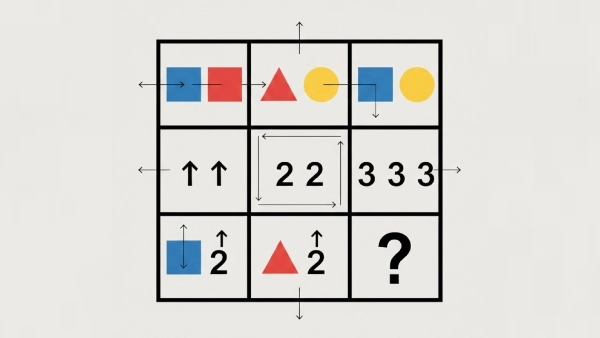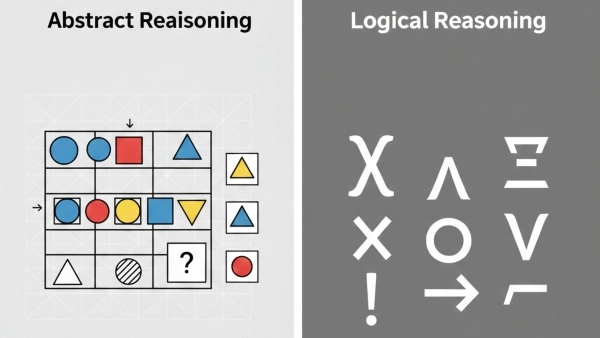
Abstract reasoning questions are designed to test how well you can identify patterns, rules, and logical relationships in unfamiliar information. At first, these questions may seem confusing or overwhelming, especially because they rely on shapes and symbols rather than words or numbers. However, with a structured approach, abstract reasoning problems become far more manageable.
This step-by-step guide shows you exactly how to approach abstract reasoning questions efficiently and accurately. If you're not yet familiar with what these questions look like, start with what abstract reasoning questions are in IQ tests before reading on.
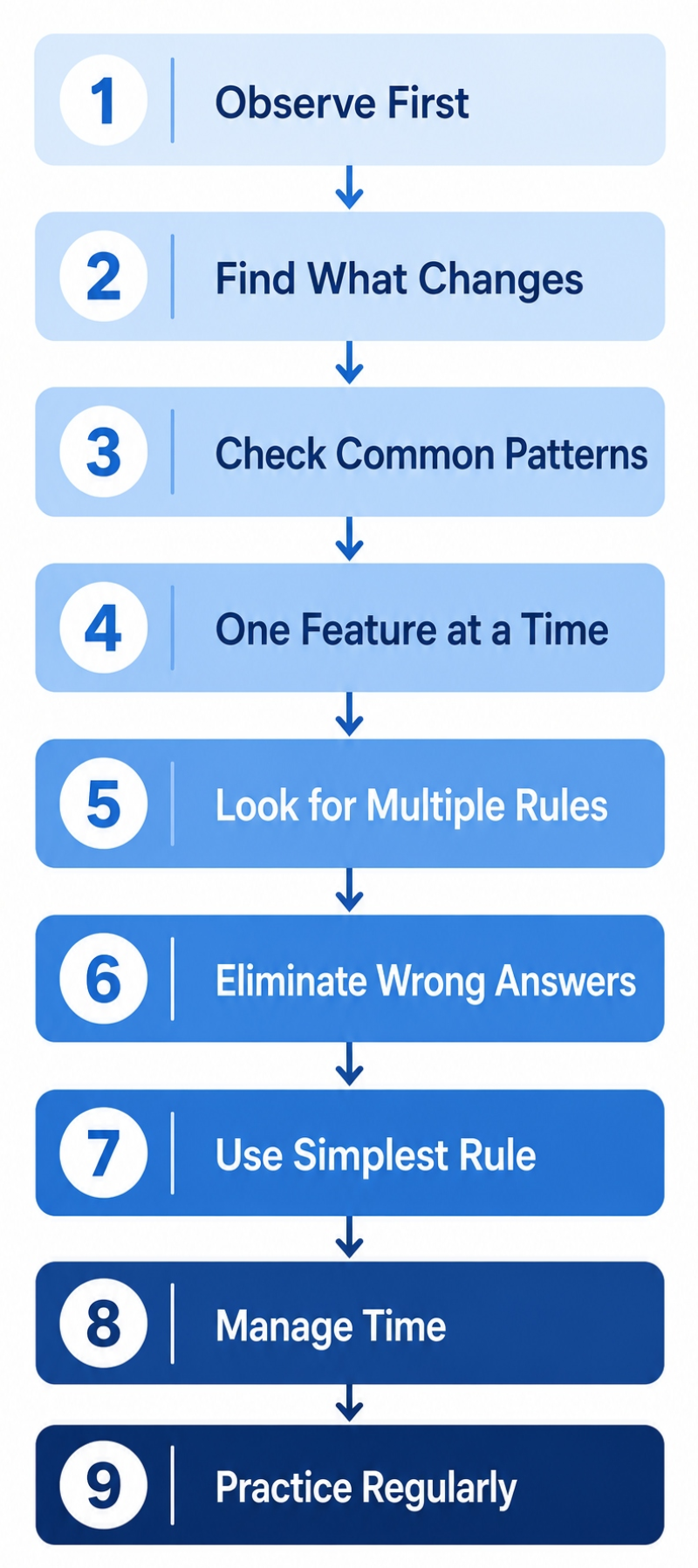
Step 1: Observe Before You Analyze
Before trying to solve an abstract reasoning question, pause and observe the entire set of images carefully. This short moment of observation is crucial, because rushing into analysis often leads to incorrect assumptions.
At this stage, you are not trying to solve the problem. You are simply getting familiar with what you are looking at.
Ask yourself:
- How many images are presented in total?
- Is the structure a sequence, a group of choices, or a matrix with rows and columns?
- Do any shapes, symbols, or visual elements repeat across the images?
Pay attention to the overall layout. A sequence usually implies progression, while a matrix often suggests relationships across rows and columns. By understanding the structure early, you avoid applying the wrong type of logic later.
Your goal in this step is orientation, not solution. A clear overview sets the foundation for accurate reasoning.
Step 2: Identify What Changes and What Stays the Same
Abstract reasoning questions are built entirely on contrast. Some elements change from one image to the next, while others remain constant.
Compare the images carefully and make a mental list of:
- Which features change (such as shape, color, position, number, or orientation)
- Which features stay the same throughout the sequence or grid
Constant elements are often distractions. Once you recognize what does not change, you can safely ignore it and focus your attention on the variables that actually drive the pattern.
This step narrows the problem and prevents unnecessary mental clutter.
Step 3: Look for the Most Common Pattern Types First
Most abstract reasoning questions reuse the same logical patterns again and again. Successful test-takers do not invent new rules for every question—they check for familiar ones first.
Start by testing the most common pattern types:
- Pattern progression (rotation, movement, or size change)
- Number or count-based rules
- Alternating patterns
- Symmetry or reflection
- Shape addition or subtraction
- Color and shading changes
If one of these patterns fits the images cleanly, you have likely found the correct rule. Testing common patterns first saves time and reduces cognitive overload, especially under exam pressure. For a full breakdown of each pattern type with examples, see our guide on the most common abstract reasoning patterns you must know.
Step 4: Analyze One Feature at a Time
One of the biggest mistakes in abstract reasoning is trying to understand everything at once. When multiple features change, this approach quickly becomes overwhelming.
Instead, isolate each feature and analyze it independently:
- First, focus only on shape
- Then, look at number or quantity
- Next, examine position or movement
- Finally, analyze color or shading
If a feature follows a clear and consistent rule, lock that rule in mentally before moving on. This step-by-step isolation makes complex questions manageable and prevents confusion.
Step 5: Check for Multiple Rules
As difficulty increases, many abstract reasoning questions use more than one rule at the same time. This is where careful analysis becomes essential.
For example:
- Shapes may rotate while colors alternate
- The number of elements may increase while positions shift
- One rule may apply across rows, while another applies down columns
If a single rule explains only part of the pattern, do not abandon it. Instead, assume a second rule is operating simultaneously and continue analyzing the remaining features. Multiple-rule questions are especially common in matrix reasoning grids, where rows and columns each carry their own independent logic.
Multiple-rule questions reward patience and structured thinking.
Step 6: Eliminate Wrong Answer Choices Systematically
Once you understand the rule or rules, apply them to the answer choices logically rather than intuitively.
Eliminate any option that:
- Clearly breaks the identified pattern
- Follows the rule partially but fails on one key detail
- Introduces new elements that do not appear in the original images
This process of elimination is safer and more reliable than guessing. Even if you are not completely certain, eliminating incorrect options significantly increases your chances of choosing the correct answer.
Step 7: Use the Simplest Valid Rule
Abstract reasoning tests are designed to test logical thinking, not creativity. If two possible rules seem to work, the simpler one is almost always correct.
A valid rule should:
- Explain all images without exceptions
- Apply consistently across the entire problem
- Require no unnecessary assumptions
Avoid overthinking. The correct answer usually feels clean and logical once the rule is identified.
Step 8: Manage Time Without Rushing
Time pressure is a key part of abstract reasoning tests, but rushing often leads to careless errors.
Use practical time-management strategies:
- If you cannot identify a rule within 30–40 seconds, move on
- Mark difficult questions and return to them later
- Do not force a solution when the pattern is unclear
Efficiency comes from structure and discipline, not speed alone. Staying calm often saves more time than rushing. For more detail on how to handle time pressure specifically, read our guide on abstract reasoning practice tips for timed tests.
Step 9: Practice Pattern Recognition Regularly
Abstract reasoning is a skill that improves with exposure. The more patterns you recognize, the faster your brain identifies them during real tests.
Effective practice includes:
- Reviewing incorrect answers to understand why they were wrong
- Grouping practice questions by pattern type
- Practicing under timed conditions to simulate test pressure
Over time, patterns that once seemed confusing become familiar and predictable. Research confirms this — read the science-backed answer to whether abstract reasoning can genuinely be improved with deliberate practice.
Common Mistakes to Avoid
Even strong candidates make avoidable errors. Be especially careful to avoid:
- Focusing on irrelevant visual details
- Ignoring simple numerical rules
- Forgetting to check for symmetry or alternation
- Overcomplicating patterns unnecessarily
- Guessing without eliminating incorrect options
Awareness of these mistakes helps you stay disciplined and accurate under pressure. For a detailed breakdown of the errors that trip up beginners most often, read beginner mistakes in abstract reasoning and how to avoid them.
Final Thoughts
Abstract reasoning questions are not about intelligence alone—they are about method. By approaching each problem step by step, analyzing one feature at a time, and testing common pattern types first, you can solve these questions more accurately and with less stress.
With consistent practice and a structured strategy, abstract reasoning stops being abstract and starts becoming logical. The next step is to apply what you've learned — explore how abstract reasoning differs from logical reasoning, then test your skills directly on our free IQ exam.