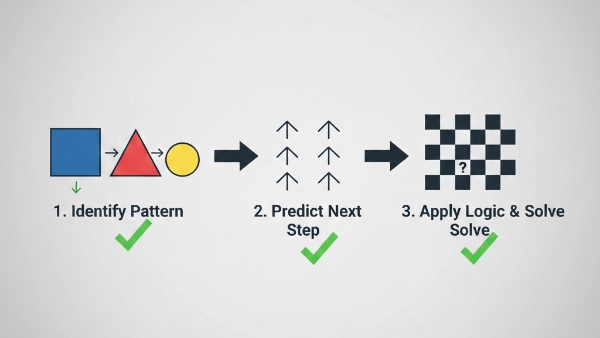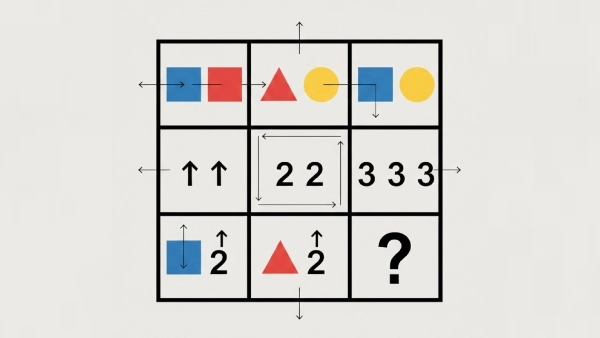
Abstract reasoning and logical reasoning are often mentioned together in IQ tests, aptitude exams, and hiring assessments. Because both involve problem-solving and pattern recognition, many people assume they are the same skill. In reality, they measure different aspects of thinking and require different mental approaches.
Understanding the difference can help you prepare more effectively for tests and recognize which skill is being evaluated. For a deeper understanding of abstract reasoning specifically, start with our guide on what abstract reasoning questions are in IQ tests.
What Is Abstract Reasoning?
Abstract reasoning measures your ability to identify patterns, relationships, and rules using nonverbal information. Most abstract reasoning questions rely on shapes, symbols, diagrams, or images rather than words or numbers.
You are typically asked to:
- Identify what comes next in a visual sequence
- Complete a pattern or matrix
- Find the odd one out
- Determine the rule governing a set of figures
The key characteristic of abstract reasoning is that the rules are unknown and must be discovered. You are not given definitions, formulas, or instructions. You must infer the logic by observing how elements change.
Abstract reasoning focuses heavily on:
- Pattern recognition
- Visual-spatial thinking
- Learning new rules quickly
- Adapting to unfamiliar problems
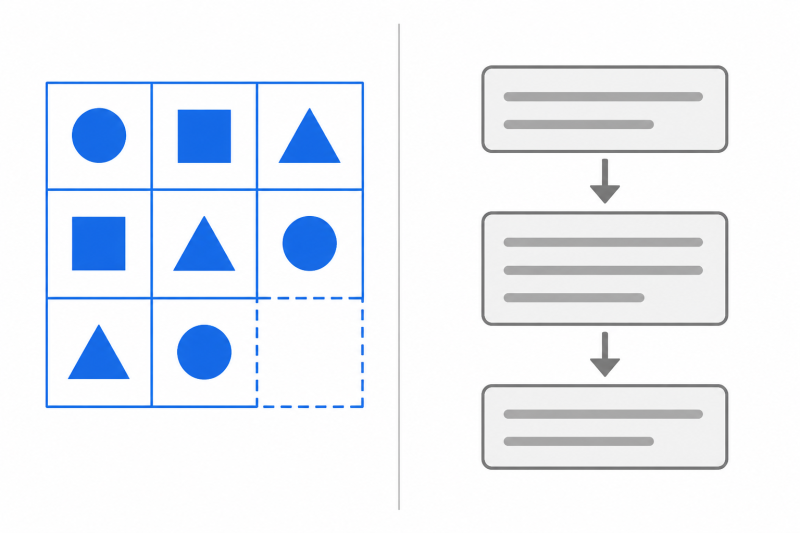
What Is Logical Reasoning?
Logical reasoning evaluates how well you can apply explicit rules or statements to reach a valid conclusion. These questions are often verbal or numerical and are based on structured logic.
Typical logical reasoning tasks include:
- Evaluating arguments
- Identifying assumptions
- Drawing conclusions from premises
- Detecting contradictions or inconsistencies
Unlike abstract reasoning, logical reasoning usually provides you with clear information upfront. Your task is to apply logic correctly rather than discover the rule itself.
Logical reasoning emphasizes:
- Deductive and inductive thinking
- Understanding cause-and-effect relationships
- Following structured arguments
- Evaluating truth and validity
Key Differences Between Abstract and Logical Reasoning
Although abstract reasoning and logical reasoning are both used to assess problem-solving ability, they operate in fundamentally different ways. Understanding these differences helps clarify why people often perform unevenly across the two—and why tests deliberately separate them.
1. Type of Information Used
Abstract reasoning works primarily with visual and symbolic information. Questions are built around shapes, patterns, diagrams, symbols, or spatial relationships. Language is usually minimal or completely absent.
This design forces you to rely on perception and pattern recognition rather than reading comprehension or factual knowledge. You are solving the problem by seeing relationships, not by interpreting text.
Logical reasoning, by contrast, relies on verbal statements, numerical information, or written arguments. You must read carefully, understand meanings, and interpret how statements relate to one another.
Because of this difference:
- Abstract reasoning minimizes language dependency
- Logical reasoning depends heavily on comprehension and precision
This also explains why abstract reasoning is often considered more accessible across languages and cultures.
2. Rule Discovery vs Rule Application
One of the most important distinctions lies in how rules are handled.
In abstract reasoning, the rule is hidden. You are not told what to do. Instead, you must infer the rule by observing how shapes or symbols change across a sequence or matrix. The challenge lies in discovering what the system is before you can solve it.
In logical reasoning, the rules or premises are given explicitly. You are told the conditions, facts, or assumptions. Your task is to apply them correctly and consistently to reach a valid conclusion.
In simple terms:
- Abstract reasoning asks: “What is the rule?”
- Logical reasoning asks: “Given the rule, what follows?”
This difference is central to how each skill is tested and practiced. To see how this plays out in real questions, read our step-by-step guide to solving abstract reasoning questions.
3. Learning Speed vs Logical Accuracy
Abstract reasoning strongly emphasizes how quickly you can learn something new. Every question introduces a mini-system with its own logic, and success depends on how rapidly you can detect that logic.
This makes abstract reasoning a good predictor of learning potential in unfamiliar situations.
Logical reasoning emphasizes accuracy within a known framework. The rules are stable, but the challenge is avoiding mistakes, faulty assumptions, or invalid conclusions.
As a result:
- Abstract reasoning rewards adaptability and speed of insight
- Logical reasoning rewards careful analysis and precision
It is common for someone to be strong in one area and weaker in the other, even though both reflect intelligence. If you want to build your abstract reasoning speed specifically, see our practice tips for timed abstract reasoning tests.
4. Visual Thinking vs Verbal Thinking
Abstract reasoning relies heavily on visual-spatial processing. You must mentally rotate shapes, track positions, notice symmetry, and recognize visual transformations.
Logical reasoning relies more on verbal and conceptual processing. You must follow chains of reasoning, understand qualifiers, and evaluate how ideas connect.
Because abstract reasoning does not depend on vocabulary or cultural references, it is often seen as more culturally neutral. Logical reasoning, while still fair, can be influenced by language proficiency and familiarity with formal argument structures.
5. Common Test Formats
Abstract reasoning most often appears in:
- IQ tests
- Nonverbal intelligence assessments
- Visual aptitude tests
- Leadership and potential evaluations
These tests aim to measure raw cognitive flexibility rather than learned knowledge.
Logical reasoning commonly appears in:
- Verbal reasoning tests
- Law school and graduate admissions exams
- Critical thinking assessments
- Argument analysis tests
These formats emphasize structured thinking and decision-making based on explicit information.
Why Tests Use Both Types of Reasoning
Modern assessments include both abstract and logical reasoning because they measure complementary cognitive strengths.
Abstract reasoning predicts:
- How quickly someone adapts to new systems
- Ability to handle novel or ambiguous problems
- Learning potential in complex environments
Logical reasoning predicts:
- Quality and consistency of decision-making
- Ability to analyze structured information
- Accuracy in evaluating arguments and evidence
Together, they provide a more complete and balanced picture of overall cognitive ability. To understand the broader framework of what IQ tests measure across all domains, read our IQ basics 101 guide.
Which One Is More Important?
Neither type of reasoning is universally more important. Their value depends on the context.
Abstract reasoning is especially valuable in:
- Technical and analytical roles
- Jobs involving complex systems or rapid change
- Situations requiring fast learning without instruction
Logical reasoning is critical in:
- Law, policy, and academic research
- Roles involving evaluation and judgment
- Tasks that require clear justification and explanation
High-level problem solvers typically develop both skills and know when to rely on each.
Can You Improve Both Skills?
Yes—but improvement requires different training approaches.
To improve abstract reasoning:
- Practice visual pattern recognition regularly
- Learn common nonverbal rule categories
- Train under timed conditions to build speed
For the most effective starting point, see the most common abstract reasoning patterns you must know and read whether abstract reasoning can genuinely be improved with practice.
To improve logical reasoning:
- Practice analyzing arguments and conclusions
- Study common logical fallacies
- Work through structured reasoning problems step by step
General problem-solving practice helps, but targeted training is far more effective. Our verbal intelligence guide covers the logical reasoning side of cognitive testing in detail.
Final Insight
Abstract reasoning and logical reasoning are not interchangeable skills. One focuses on discovering hidden patterns without instructions, while the other focuses on applying known rules with precision. Understanding their differences allows you to prepare smarter, perform better on tests, and develop a more well-rounded thinking style.
To put both skills to the test at once, try our free IQ exam — which includes abstract, numerical, and spatial reasoning questions in a single 18-minute session.