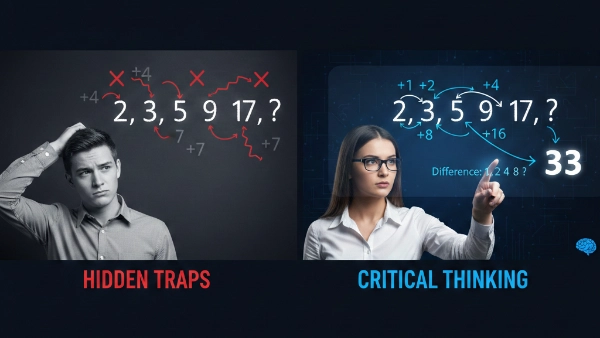
You study the rules.
You practice regularly.
Yet somehow, number series questions still trip you up.
If that sounds familiar, the issue is rarely intelligence. It’s almost always diagnostic errors under time pressure.
Number series problems are structured. Predictable. Classifiable.
But small thinking mistakes compound quickly.
Let’s break down the real reasons you keep getting them wrong—and how to fix each one systematically.
1. You Start Calculating Before Diagnosing
The Mistake
You see:
4, 7, 13, 25, ?
Your brain immediately goes into action mode.
You subtract:
+3, +6, +12…
Not constant.
You try division.
Doesn’t work.
You test random operations.
Time disappears.
Confidence drops.
The question suddenly feels “hard.”
What’s Actually Happening
You skipped the most important step: structural diagnosis.
You began testing operations without asking strategic questions:
- Is this linear?
- Is it alternating?
- Are differences doubling?
- Is this second-order?
- Is it hybrid?
When you subtract:
3 → 6 → 12
You notice something subtle but powerful:
The differences are doubling.
That means the structure is not linear—but it is still highly organized.
Next difference = 24
25 + 24 = 49
The pattern was clean.
You just approached it reactively instead of analytically.
Why This Happens Psychologically
Under time pressure, your brain prefers action over observation.
Doing feels productive.
Pausing feels risky.
But in number series, premature computation is the fastest way to waste time.
The Fix: The 5-Second Diagnostic Rule
Before touching your calculator brain, force yourself to scan:
- Check subtraction.
- Check division.
- Check alternation.
- Check second differences.
- Check simple doubling patterns.
No guessing.
No committing early.
Diagnosis first. Calculation second.
This alone can cut your error rate dramatically.
2. You Ignore Alternating Patterns
The Mistake
You treat every sequence as a single stream.
Example:
2, 5, 4, 7, 6, 9, ?
You subtract straight across:
+3, -1, +3, -1…
It looks inconsistent.
Your brain labels it as “messy.”
So you assume it’s complex.
The Reality
This sequence is actually simple.
Split by position:
- Odd positions: 2, 4, 6
- Even positions: 5, 7, 9
Each follows +2.
The next odd term is 8.
The problem was never difficult.
It was misframed.
Why Alternation Is So Common
Alternating patterns are popular in IQ tests because they:
- Create artificial chaos
- Reward structural thinking
- Punish linear assumptions
Your brain naturally wants a single rule.
Alternation violates that expectation.
The Fix
When differences look chaotic:
Immediately split into:
- Odd positions
- Even positions
If still unclear, test:
- Every third term
- Grouped patterns (A, B, C repeating)
The moment you split structure correctly, confusion disappears.
3. You Stop at “Almost” Geometric
The Mistake
Sequence:
5, 11, 23, 47, ?
You divide:
- 11 ÷ 5 ≈ 2.2
- 23 ÷ 11 ≈ 2.09
- 47 ÷ 23 ≈ 2.04
Not constant.
So you conclude:
“Not geometric.”
And you move on.
The Hidden Rule
×2 + 1
- 5 × 2 + 1 = 11
- 11 × 2 + 1 = 23
- 23 × 2 + 1 = 47
Next:
47 × 2 + 1 = 95
Why This Trap Works
The ratios are close to 2.
That’s intentional.
Test designers design hybrid patterns to look “almost geometric” so you abandon the correct path too early.
The Fix
If ratios look close but not exact:
Test:
Multiply → then add/subtract a constant.
Hybrid multiply-add patterns are extremely common at medium difficulty.
Whenever you see:
- Differences roughly doubling
- Ratios near a constant
- Fast growth but slight deviation
Suspect hybrid structure.
4. You Don’t Check Second Differences
The Mistake
Sequence:
1, 4, 9, 16, 25, ?
You subtract:
+3, +5, +7, +9
Not constant.
You conclude:
“Not arithmetic.”
You move on.
The Hidden Structure
The differences themselves follow a pattern:
+3, +5, +7, +9
These increase by +2.
Second differences:
+2, +2, +2
This is a square sequence.
Next difference = +11
25 + 11 = 36
Why Second-Order Patterns Are Missed
Your brain expects the rule at the first level.
When it’s not there, you assume irregularity.
But many IQ questions are second-order arithmetic.
The Fix
If first differences are not constant but look structured:
Always compute second differences.
Many “advanced-looking” sequences are simply quadratic patterns.
One extra layer often solves everything.
5. You Rush and Miscalculate Early
The Mistake
Sequence:
6, 13, 27, 55, ?
Correct differences:
+7, +14, +28
But under pressure, you calculate:
13 → 27 as +13 instead of +14.
Now your structure collapses.
You search for complex explanations to fix your arithmetic mistake.
Why This Happens
Cognitive overload reduces accuracy before it reduces reasoning.
Small subtraction errors distort entire patterns.
The Fix
- Write differences clearly.
- Avoid large mental jumps.
- Double-check the first two differences before committing.
Accuracy first. Speed later.
Fast and wrong is slower than steady and correct.
6. You Panic When Growth Looks Explosive
Sequence:
1, 2, 6, 24, 120, ?
The numbers grow rapidly.
Your brain says:
“This is too big. Too complex.”
But it’s just factorial growth:
- 1!
- 2!
- 3!
- 4!
- 5!
Next:
6! = 720
Why Explosive Growth Feels Intimidating
Large numbers trigger cognitive stress.
You assume advanced math is required.
But most explosive sequences are:
- Factorials
- Powers (squares, cubes)
- Doubling patterns
The Fix
Memorize:
- Squares up to 15²
- Cubes up to 10³
- Factorials up to 6!
Recognition eliminates intimidation.
Familiarity reduces cognitive load dramatically.
7. You Assume Complexity Too Early
Sequence:
10, 20, 30, 40, ?
Some test-takers immediately search for hybrid or second-order logic.
But it’s simply +10.
Why This Happens
After practicing harder problems, your brain expects complexity.
You overanalyze easy questions.
This wastes time.
The Fix
Always test the simplest explanation first.
Occam’s Razor applies.
If subtraction works cleanly, stop searching.
Complex patterns are less common than simple ones.
8. You Don’t Classify the Pattern Type
Most number series fall into predictable families:
- Arithmetic
- Geometric
- Second-order
- Alternating
- Recursive
- Hybrid multiply-add
- Position-based
- Square/cube growth
- Factorial growth
If you don’t label the category, you test operations blindly.
The Fix
When you see a sequence, ask:
Which structural family does this resemble?
Classification reduces randomness.
Once labeled, solving becomes mechanical.
9. You Guess Before Completing the Checklist
You think:
“It looks like doubling.”
But you haven’t verified consistency.
High scorers never guess early.
They complete a systematic scan:
- Constant difference?
- Constant ratio?
- Alternation?
- Second differences?
- Recursive addition?
- Hybrid multiply-add?
Only after confirmation do they commit.
Discipline beats intuition.
10. You Practice Randomly Instead of Strategically
Solving 100 mixed problems won’t fix blind spots.
If you consistently miss alternating patterns, you need targeted alternation drills.
If you miss second-order patterns, you need layered difference practice.
The Fix
After every mistake, ask:
- What pattern type did I miss?
- At what stage did I misdiagnose?
- Did I rush?
- Did I skip alternation?
- Did I avoid second differences?
Reflection builds recognition speed faster than repetition alone.
A High-Speed Correction Framework
To stop getting number series wrong, follow this:
Step 1: Diagnose (5 seconds)
- Linear?
- Alternating?
- Second-order?
- Hybrid?
- Recursive?
Step 2: Verify (10 seconds)
Ensure the rule works for at least three transitions.
Step 3: Project
Extend confidently.
- No guessing.
- No rushing.
- No skipping structural layers.
Final Insight
Most number series errors are not knowledge problems.
They are:
- Diagnostic mistakes
- Pattern blindness
- Rushing
- Structural misclassification
When you slow down just enough to diagnose properly, the majority of “hard” sequences become straightforward.
Elite performance isn’t about faster thinking.
It’s about structured thinking under pressure.