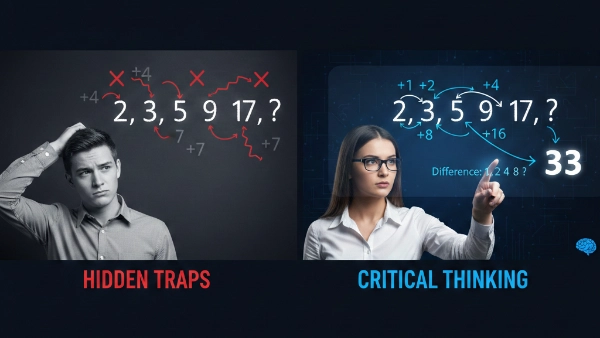
Most people approach number sequence problems as pattern-guessing exercises.
Strong test-takers approach them as structured mathematical systems.
Behind nearly every number series question—whether in IQ tests, aptitude exams, or competitive assessments—there is a small set of mathematical principles at work:
- Recursive definitions
- Polynomial behavior
- Exponential growth
- Logical or positional structures
Once you understand the mathematics underneath, number sequences stop feeling random. They become predictable systems with identifiable rules.
This article breaks down the core mathematical foundations behind number sequences and shows how to recognize them efficiently.
1. Recursive Rules: When Each Term Depends on the Previous
A recursive sequence is defined by dependency.
Instead of being generated by plugging a number into a single global formula, each term is built from one or more earlier terms. The rule is local rather than global.
When analyzing recursive sequences, you shift your mindset. Instead of asking:
“What is the overall formula for the nth term?”
You ask:
“How is this term constructed from the one (or two) before it?”
That subtle shift changes how you approach the entire problem.
Basic Recursive Form
The simplest recursive sequence looks like this:
an = an - 1 + c
This means each term equals the previous term plus a constant.
Example:
3, 7, 11, 15, 19
Each term adds 4.
Even though this is also an arithmetic (linear) sequence, it is technically recursive because every term depends directly on the previous one.
In fact, all arithmetic sequences can be written recursively:
a1 = 3
an = an - 1 + 4
Understanding this helps you see that recursion is not exotic—it is foundational.
Fibonacci-Type Recursion
A more advanced recursive structure uses two previous terms:
an = an - 1 + an - 2
Example:
1, 1, 2, 3, 5, 8, 13
Each term equals the sum of the two before it.
This structure introduces layered dependency. Growth now compounds because each term carries forward accumulated structure.
In IQ and aptitude tests, Fibonacci-style recursion is often disguised.
Example:
2, 3, 5, 8, 13, ?
If you only check differences:
1, 2, 3, 5
You may not immediately see a simple pattern.
But if you check term relationships:
- 2 + 3 = 5
- 3 + 5 = 8
- 5 + 8 = 13
The logic becomes clear.
Recursive questions reward structural awareness rather than mechanical subtraction.
Extended Recursive Patterns
Many medium-to-difficult problems combine recursion with transformation.
For example:
an = 2an - 1 + 1
Sequence:
2, 5, 11, 23, 47
Each term doubles the previous term and adds 1.
At first glance, this resembles a geometric sequence. But pure geometric growth would be:
2, 4, 8, 16, 32
Here, something extra is happening.
Recursive structures often take the form:
- Multiply then add
- Add then multiply
- Combine two previous terms and adjust
Example:
an = an -1 + n
These patterns are common in IQ tests because they look familiar but contain subtle variation.
Why Recursive Structures Matter
Recursive rules:
- Explain many “multiply + add” and “grow + adjust” patterns
- Appear frequently in medium-to-hard aptitude questions
- Require you to analyze relationships between terms
The key question to ask whenever growth depends on earlier numbers is:
“Is this term built from the one before it?”
If the answer is yes, test for recursion before jumping to polynomial differences.
2. Polynomial Sequences: The Logic of Differences
Many aptitude test sequences are not recursive—they are polynomial.
Polynomial sequences follow a predictable mathematical property:
- Constant first differences → degree 1 (linear)
- Constant second differences → degree 2 (quadratic)
- Constant third differences → degree 3 (cubic)
This structure is not arbitrary. It comes directly from calculus and algebra.
Taking differences reduces the degree of a polynomial by one each time.
That is why the difference method works so reliably.
Linear Sequences (Degree 1)
Example:
5, 9, 13, 17, 21
First differences:
4, 4, 4, 4
Constant first differences indicate a linear relationship.
General form:
an = 4n + 1
In tests, you do not need to derive the full formula.
You only need to recognize the structural behavior.
Quadratic Sequences (Degree 2)
Example:
2, 6, 12, 20, 30
First differences:
4, 6, 8, 10
Second differences:
2, 2, 2
Constant second differences signal quadratic growth.
General form:
an = an2 + bn + c
The sequence grows faster than linear, but not explosively.
Quadratic growth produces steady acceleration.
Recognizing this prevents you from misclassifying it as exponential.
Cubic Sequences (Degree 3)
If third differences are constant, the pattern is cubic.
These are less common but appear in higher-difficulty exams.
The structure:
- First differences → not constant
- Second differences → not constant
- Third differences → constant
Understanding this hierarchy allows you to stop guessing.
Why Polynomial Logic Is Powerful
The difference method works because:
- Each difference step lowers the polynomial degree by one.
- Eventually, you reach a constant level.
Degree 2 → first difference becomes linear
Degree 1 → second difference becomes constant
Once you understand the mathematics, you stop seeing “mysterious” second-difference problems.
You see predictable algebra.
3. Exponential and Geometric Growth
Not all sequences are additive. Some grow multiplicatively.
Example:
3, 6, 12, 24, 48
Each term multiplies by 2.
General form:
an = a1 . rn - 1
Where:
- r is the common ratio.
Exponential growth behaves very differently from polynomial growth.
Polynomial growth increases steadily.
Exponential growth accelerates rapidly.
In timed exams, if numbers grow dramatically, always test division before subtraction.
Why Ratios Matter
When you divide consecutive terms and see a constant result, you have geometric growth.
If you only check differences, you may misinterpret explosive growth as “increasing differences.”
The key distinction:
Additive growth → smooth acceleration
Multiplicative growth → explosive scaling
Recognizing this quickly saves time.
4. Factorials and Super-Exponential Growth
Example:
1, 2, 6, 24, 120
This follows:
an = n!
Factorial growth increases faster than exponential growth.
The ratio between consecutive terms increases each time:
- 1 → 2 (×2)
- 2 → 6 (×3)
- 6 → 24 (×4)
- 24 → 120 (×5)
These sequences are rare but highly recognizable once you understand their behavior.
When numbers escalate extremely quickly, test factorial logic before overcomplicating the analysis.
5. Logical and Positional Structures
Not every sequence is purely algebraic.
Many IQ problems rely on structure rather than formula.
Alternating Sequences
Example:
2, 5, 4, 7, 6, 9
Odd positions:
2, 4, 6
Even positions:
5, 7, 9
Two independent linear sequences are interwoven.
This is not polynomial.
It is positional logic.
Position-Based Rules
Example:
1, 4, 9, 8, 25, 12, 49, ?
Odd terms:
1, 9, 25, 49 → perfect squares
Even terms:
4, 8, 12 → increase by 4
The rule depends on index position, not overall growth behavior.
Why Logical Structures Appear in IQ Tests
Because they test flexibility.
If you assume every sequence is algebraic, you will miss interwoven structures.
High-level problem solvers ask:
“Is this value-driven or position-driven?”
That question alone prevents many mistakes.
6. Hybrid Structures: Where Mathematics Meets Logic
Advanced sequences combine multiple mechanisms:
Recursion + multiplication
Alternation + second differences
Position-based rules + polynomial growth
Example:
2, 4, 7, 11, 16, 22
Differences:
2, 3, 4, 5, 6
Here, the underlying structure is linear growth inside the differences.
Hybrid problems reward systematic breakdown:
- Check first differences
- Check ratios
- Check positional splits
- Check recursion
This structured order reduces chaos.
7. Why Understanding the Mathematics Changes Everything
Most students memorize pattern categories.
Top performers understand the mechanics behind them.
They understand:
- Why constant second differences imply quadratic structure
- Why recursive rules create compound growth
- Why exponential growth outpaces polynomial growth
- Why alternating structures defeat linear assumptions
When you understand the mathematics:
- You diagnose patterns faster
- You avoid unnecessary trial-and-error
- You reduce cognitive overload
- You remain calm under time pressure
Number sequence problems are not puzzles based on luck.
They are miniature mathematical systems governed by consistent rules.
And once you recognize the governing rule, the answer becomes inevitable rather than uncertain.
Final Insight
Every number sequence question falls into one of a few structural categories:
- Recursive
- Polynomial
- Exponential
- Factorial
- Logical/Positional
- Hybrid combinations
Your job is not to calculate blindly.
Your job is to classify the structure.
Because once the structure is identified, the answer becomes mechanical.
Mathematics turns confusion into order.
And structure is always easier to solve than randomness.