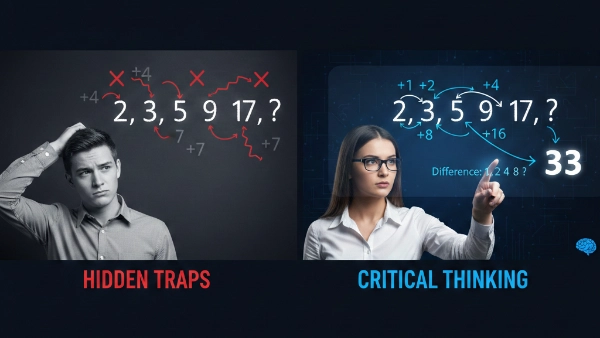
IQ tests are not just about intelligence—they are about pattern detection under pressure. Among all question formats, number series problems often feel familiar. But how do they compare to other common IQ question types? And more importantly, how should your solving strategy change?
This guide breaks down the structural differences between number series and other major IQ categories—so you can adapt your thinking instead of using one rigid approach for every problem.
What Makes Number Series Unique?
Number series questions present a sequence of numbers and ask you to determine the next term (or occasionally a missing term in the middle).
Example:
3, 6, 12, 24, ?
At their core, number series measure:
- Logical sequencing
- Pattern recognition
- Working memory
- Analytical speed
They rely heavily on quantitative structure—you must detect relationships like:
- Constant differences
- Constant ratios
- Alternating arithmetic patterns
- Recursive additions
- Hybrid multiplication + addition
Unlike many other IQ question types, number series are procedural. Once the pattern is identified, the solution is mechanical.
That makes classification your most powerful tool.
How Number Series Differ from Verbal Analogies
At first glance, number series and verbal analogies may both seem like “pattern recognition” tasks. But they operate on entirely different cognitive systems.
Verbal Analogy Example
Bird : Nest :: Bee : ?
The correct answer is Hive.
Here, the relationship is conceptual. A nest is the home of a bird. A hive is the home of a bee. The task is not computational—it is relational.
You are not calculating anything. You are mapping a relationship from one pair to another.
Core Structural Differences
| Number Series | Verbal Analogies |
| Quantitative | Conceptual |
| Operation-based | Relationship-based |
| Sequential logic | Parallel relational logic |
| Structured growth | Semantic symmetry |
Why This Matters
In number series, each term evolves from the previous one. There is directional movement.
In verbal analogies, both pairs must mirror the same abstract relationship. There is structural symmetry.
You are not extending a sequence.
You are balancing a relationship.
Strategy Shift
In Number Series:
- Test operations systematically.
- Check subtraction, division, alternation, recursion.
- Move step by step.
In Verbal Analogies:
Identify the relationship category first:
- Function (Knife : Cut)
- Part–whole (Wheel : Car)
- Cause–effect (Rain : Flood)
- Category (Rose : Flower)
- Location (Bird : Nest)
Then replicate that relationship exactly.
There is no subtraction or division in analogies. Instead, you must detect abstract relational symmetry.
Applying arithmetic thinking to analogies wastes time.
Applying conceptual thinking to arithmetic sequences creates confusion.
The key difference is this:
- Number series = How does it change?
- Analogies = How are they related?
Number Series vs Logical Sequences (Non-Numerical)
Logical sequences often replace numbers with shapes or symbols:
▲ ■ ▲ ■ ▲ ?
These questions look simpler—but they test a different skill.
They focus on visual alternation and transformation, not numerical change.
Structural Differences
Number series rely on mathematical progression.
Logical symbol sequences rely on:
- Alternation (A-B-A-B)
- Rotation (90°, 180°)
- Reflection (mirror flips)
- Shape transformation (triangle → square → pentagon)
- Pattern cycling
The brain processes these visually, not computationally.
Strategy Shift
For Number Series:
- Compute differences.
- Test ratios.
- Look for layered arithmetic structure.
For Symbol Sequences:
- Track position carefully.
- Observe directional changes.
- Identify cycles.
- Check for symmetry or rotation patterns.
In both cases, you are analyzing structure—but:
- One is numerical.
- The other is spatial.
Sequential arithmetic logic does not automatically translate into visual pattern recognition.
Number Series vs Matrix Reasoning
Matrix reasoning problems (often presented as 3×3 grids) require identifying patterns across rows and columns simultaneously.
Example structure:
- A → B
- C → ?
You must determine the rule governing A and B, then apply it to C.
Structural Differences
Number Series:
- Linear progression.
- One-dimensional.
- Time-based flow (left to right).
- Each term depends on prior terms.
Matrix Reasoning:
- Multi-directional.
- Patterns exist horizontally AND vertically.
- Sometimes diagonally.
- Often layered (shape + shading + rotation).
In matrix questions, the brain must process multiple pattern streams simultaneously.
In number series, the brain processes one evolving stream.
Strategy Shift
In Number Series:
Analyze step-by-step progression.
Ask:
What changes from term to term?
In Matrices:
Compare:
- Row 1 pattern
- Row 2 pattern
- Column 1 pattern
- Column 2 pattern
Look for intersections.
Matrix questions demand parallel pattern processing.
Number series demand sequential pattern tracking.
That distinction explains why some students excel in one but struggle in the other.
Number Series vs Classification Questions
Classification questions ask which item does not belong.
Example:
2, 3, 5, 7, 9
Here, 9 breaks the prime number pattern.
Structural Differences
Number Series:
- You extend the rule forward.
- You predict continuation.
Classification:
- You identify the hidden rule.
- Then detect violation.
One is about growth.
The other is about consistency.
Strategy Shift
For number series:
- Project forward logically.
- Assume internal coherence.
For classification:
- Identify rule.
- Test each element against it.
- Look for structural inconsistency.
Classification is about rule recognition.
Number series is about rule extension.
Number Series vs Word Problems
Word-based IQ math problems introduce narrative context.
Example:
“A machine doubles output every hour. If it starts with 5 units…”
Now you must:
- Extract the quantitative rule.
- Convert language into numbers.
- Apply the pattern.
Structural Differences
Number Series:
- Pure structure.
- No language interference.
- Immediate computational focus.
Word Problems:
- Require language decoding.
- Increase cognitive load.
- May include irrelevant details.
Many mistakes occur because test-takers skip the translation phase.
They jump into computation without clarifying the rule.
Strategy Shift
Number series → Direct computation.
Word problems → Translate first, compute second.
The strongest performers pause briefly to rewrite the structure in numerical form.
Only then do they calculate.
Cognitive Demands: What Each Type Tests
Understanding cognitive load helps you shift mental gears quickly.
Number Series Tests:
- Pattern recognition speed
- Analytical flexibility
- Working memory
- Sequential reasoning
Verbal Questions Test:
- Semantic mapping
- Conceptual reasoning
- Vocabulary depth
- Abstraction ability
Spatial/Matrix Questions Test:
- Visual processing
- Multi-layer pattern tracking
- Mental rotation
- Simultaneous rule comparison
Classification Tests:
- Rule abstraction
- Error detection
- Consistency evaluation
Each question type activates different neural processing pathways.
Treating them identically reduces efficiency.
Why People Struggle Switching Between Types
Many test-takers make one critical mistake:
They apply the same thinking style to every problem.
Examples:
- Trying arithmetic logic in a spatial matrix.
- Overcomplicating a simple arithmetic series.
- Ignoring alternation in favor of linear thinking.
- Forcing conceptual reasoning onto mechanical sequences.
Each question type requires a different diagnostic lens.
Failure to switch lenses creates unnecessary difficulty.
Strategic Adaptation: A Universal Framework
Before solving any IQ question, pause for 3–5 seconds and ask:
- Is this numerical, verbal, or visual?
- Is the structure linear or multi-dimensional?
- Am I extending a rule or identifying a violation?
- Does this require computation or abstraction?
- Is the rule likely simple or layered?
This micro-classification prevents cognitive misalignment.
Diagnosis first. Execution second.
Speed Comparison Under Time Pressure
Under strict timing conditions:
- Arithmetic number series are often solved fastest.
- Hybrid or recursive series require moderate time.
- Matrix reasoning consumes the most cognitive bandwidth.
- Verbal analogies depend heavily on vocabulary familiarity.
- Classification questions are fast once rule is spotted.
Smart Time Allocation Strategy
- Solve obvious arithmetic series immediately.
- Flag complex hybrid patterns for second pass.
- Reserve mental energy for matrix reasoning.
- Avoid getting trapped in overanalysis.
Efficiency beats intensity.
Common Mistakes When Transitioning
- Overcomputing simple arithmetic sequences.
- Ignoring alternating structures.
- Failing to split positions in chaotic sequences.
- Treating matrix reasoning like linear progression.
- Guessing before systematic testing.
- Forgetting to check second-order differences.
Top performers do not just solve.
They diagnose structure before committing cognitive effort.
Why Number Series Often Feel Harder Than They Are
Number series trigger anxiety because:
- Numbers appear abstract.
- Growth patterns look unpredictable.
- Early mistakes compound.
- Time pressure amplifies uncertainty.
But most sequences fall into fewer than ten structural categories:
- Arithmetic
- Geometric
- Second-order
- Alternating
- Recursive
- Hybrid multiply-add
- Position-based
- Square/cube growth
- Factorial growth
Once you internalize these categories, ambiguity collapses into familiarity.
What feels chaotic becomes classifiable.
Final Insight: Think Like a Pattern Analyst
IQ tests are not testing memorization.
They are testing your ability to recognize structural change.
Number series are:
- Linear
- Operation-driven
- Highly classifiable
Other IQ types may be:
- Conceptual
- Visual
- Multi-directional
When you understand the structural differences, you stop reacting emotionally and start solving strategically.
The key isn’t intelligence.
It’s adaptability.
Shift your mental model to match the question type—and your solving speed and accuracy will rise across the entire test.