Verbal IQ tests measure far more than vocabulary. They assess reasoning, pattern recognition, comprehension, logical precision, and the ability to interpret language accurately under time pressure.
Many test-takers assume verbal sections are “easy” because they involve words rather than numbers. In reality, verbal IQ questions are designed to expose subtle weaknesses in reasoning.
Below are the most common mistakes people make on verbal IQ tests—and practical strategies to avoid them.
1. Focusing on Words Instead of Relationships
This mistake appears most often in analogy questions.
Example:
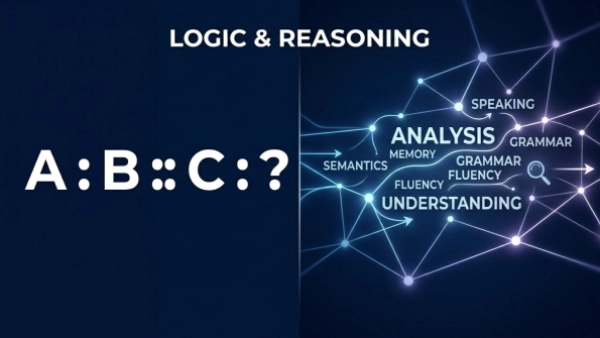
A : B :: C : ?
Many people look for a word that feels related to C.
Strong test-takers look for the exact relationship between A and B.
The Mistake:
Choosing answers based on surface similarity.
The Fix:
Always define the relationship precisely before looking at answer choices.
Instead of asking:
“Which word connects to C?”
Ask:
“What exactly is the relationship between A and B?”
Then replicate that structure.
Precision beats intuition.
2. Ignoring Direction in Analogies
Order matters.
Example:
Predator : Prey
The predator hunts the prey.
If reversed:
Prey : Predator
Now the relationship changes.
The Mistake:
Selecting an answer that reverses the relationship.
The Fix:
Create a sentence bridge:
“A predator hunts prey.”
Plug in your answer choice:
“Does X hunt Y?”
If the direction shifts, the answer is wrong.
3. Choosing Answers That “Sound Right”
Verbal IQ distractors are designed to feel familiar.
The Mistake:
Selecting answers because they seem close in meaning.
The Fix:
Demand structural accuracy.
If the question tests synonyms, the match must be equivalent in tone, intensity, and context—not just vaguely similar.
“Angry” and “furious” are not always interchangeable. Degree matters.
4. Misreading the Question Stem
Many incorrect answers happen before reasoning even begins.
The Mistake:
Missing key qualifiers like:
- “Most likely”
- “Must be true”
- “Cannot be true”
- “Only if”
- “Except”
Each phrase changes the logic requirement.
The Fix:
Slow down. Underline logical operators mentally.
“Must be true” requires certainty.
“Most likely” allows probability.
Tiny wording shifts create entirely different logical demands.
5. Confusing Correlation with Causation
This appears in reading comprehension and argument analysis.
Example:
Ice cream sales rise when crime increases.
Conclusion:
Ice cream causes crime.
The Mistake:
Assuming temporal or statistical association implies cause.
The Fix:
Ask:
- Is there evidence of a direct mechanism?
- Could a third variable explain both?
Logical discipline prevents false cause errors.
6. Overcomplicating Simple Questions
High verbal scorers sometimes sabotage themselves by overthinking.
The Mistake:
Searching for hidden complexity in straightforward items.
The Fix:
First, test the simplest explanation.
If the relationship fits cleanly and precisely, it is often correct.
Complex reasoning is valuable—but not when unnecessary.
7. Rushing Without Structural Analysis
Time pressure leads to impulsive answering.
The Mistake:
Reading quickly and relying on instinct.
The Fix:
Train accuracy before speed.
Practice defining:
- Conclusion
- Premises
- Assumptions
- Relationship type
Speed develops naturally after structural recognition becomes automatic.
8. Weak Vocabulary Depth (Not Just Breadth)
Memorizing definitions is not enough.
The Mistake:
Knowing a word’s general meaning but not its nuance.
Example:
“Frugal” vs. “Miserly”
Both relate to money-saving, but one has positive connotations, the other negative.
The Fix:
Study:
- Connotation
- Intensity
- Contextual usage
- Word roots
Depth prevents subtle traps.
9. Failing to Identify Hidden Assumptions
Argument-based questions often rely on unstated premises.
Example:
“This company is growing quickly, so it must be well managed.”
Hidden assumption:
Growth indicates effective management.
The Mistake:
Accepting conclusions without testing underlying assumptions.
The Fix:
Ask:
What must be true for this reasoning to hold?
Exposing assumptions strengthens evaluation.
10. Neglecting Process of Elimination
Verbal IQ is often about ruling out flawed options.
The Mistake:
Looking only for the correct answer instead of eliminating incorrect ones.
The Fix:
Systematically eliminate:
- Reversed relationships
- Different categories
- Wrong degrees
- Logical fallacies
- Extreme wording
When three answers are clearly wrong, the remaining one becomes logically stronger.
11. Letting Emotion Influence Reasoning
Some passages include emotionally charged language.
The Mistake:
Reacting to tone instead of structure.
The Fix:
Separate emotional content from logical form.
Ask:
- What is the conclusion?
- What evidence supports it?
- Does the reasoning follow?
Emotion can amplify persuasion—but it cannot repair flawed logic.
12. Misinterpreting Conditional Statements
Conditional logic is a common weakness.
Example:
“If A, then B.”
This does NOT mean:
“If B, then A.”
The Mistake:
Affirming the consequent or denying the antecedent.
The Fix:
Memorize core structures:
- If A → B
- Not B → Not A
- (Valid contrapositive)
Understanding conditional flow prevents common deduction errors.
How to Avoid These Mistakes Long-Term
Avoiding mistakes is not about memorizing tricks. It requires structured cognitive training.
1. Practice Active Analysis
After each question, ask:
- Why is this correct?
- Why are the others wrong?
Understanding distractors accelerates improvement.
2. Build Vocabulary in Context
Read complex materials:
- Analytical journalism
- Academic essays
- Philosophy
- Scientific writing
Context builds nuance.
3. Train Logical Structure
Regularly practice:
- Analogies
- Argument breakdowns
- Deductive reasoning
- Inference under ambiguity
Structure becomes automatic with repetition.
4. Slow Down to Speed Up
Accuracy first.
Efficiency second.
Rushed intuition produces preventable errors.
What High Performers Do Differently
Strong verbal IQ test-takers:
- Define relationships explicitly.
- Think in structure, not emotion.
- Eliminate distractors methodically.
- Recognize fallacies quickly.
- Notice subtle wording shifts.
- Prioritize precision over familiarity.
They do not rely on “feeling smart.”
They rely on disciplined reasoning.
Final Insight
Most mistakes on verbal IQ tests are not due to low intelligence. They are due to:
- Imprecision
- Overconfidence
- Rushing
- Surface-level analysis
Verbal reasoning rewards patience, structure, and clarity.
When you train yourself to analyze relationships carefully, define terms precisely, and evaluate logic systematically, your performance improves—not just on tests, but in real-world thinking.
Verbal IQ is not only about knowing words.
It is about thinking clearly through language.