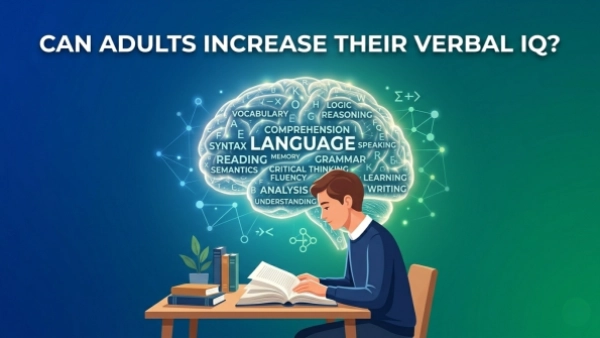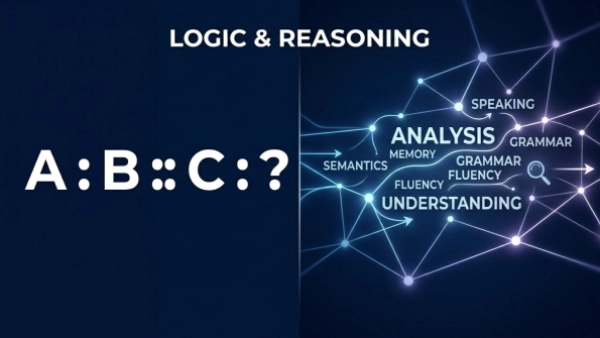
Verbal reasoning tests your ability to understand language, identify relationships, analyze arguments, detect assumptions, and interpret meaning precisely. Below are 50 challenging questions across multiple categories, each followed by a clear explanation.
Part I: Verbal Analogies (1–10)
1. Architect : Blueprint :: Chef : ?
A. Kitchen
B. Recipe
C. Stove
D. Restaurant
Answer: B. Recipe
Explanation: An architect creates or uses a blueprint. A chef creates or uses a recipe. The relationship is professional to planning document.
2. Fragile : Delicate :: Robust : ?
A. Weak
B. Strong
C. Gentle
D. Minor
Answer: B. Strong
Explanation: Fragile and delicate are synonyms. Robust and strong are synonyms.
3. Seed : Tree :: Larva : ?
A. Insect
B. Cocoon
C. Egg
D. Wing
Answer: A. Insect
Explanation: A seed develops into a tree. A larva develops into an insect. The relationship is developmental stage.
4. Skeptic : Doubt :: Optimist : ?
A. Fear
B. Hope
C. Confusion
D. Regret
Answer: B. Hope
Explanation: A skeptic is characterized by doubt. An optimist is characterized by hope.
5. Paint : Brush :: Ink : ?
A. Paper
B. Pen
C. Writer
D. Desk
Answer: B. Pen
Explanation: Paint is applied using a brush. Ink is applied using a pen.
6. Glacier : Ice :: Volcano : ?
A. Lava
B. Smoke
C. Rock
D. Ash
Answer: A. Lava
Explanation: A glacier consists of ice. A volcano produces lava.
7. Generous : Stingy :: Transparent : ?
A. Clear
B. Hidden
C. Visible
D. Honest
Answer: B. Hidden
Explanation: Generous and stingy are opposites. Transparent and hidden are opposites.
8. Author : Novel :: Composer : ?
A. Orchestra
B. Symphony
C. Piano
D. Concert
Answer: B. Symphony
Explanation: An author writes a novel. A composer writes a symphony.
9. Benevolent : Kind :: Malevolent : ?
A. Evil
B. Angry
C. Sad
D. Hostile
Answer: A. Evil
Explanation: Benevolent means kind. Malevolent means evil.
10. Fragment : Whole :: Detail : ?
A. Overview
B. Small
C. Close
D. Focus
Answer: A. Overview
Explanation: A fragment is part of a whole. A detail is part of an overview.
Part II: Logical Deduction (11–20)
11. All poets are imaginative. Some imaginative people are introverted. Can we conclude that some poets are introverted?
Answer: No.
Explanation: The premises do not guarantee overlap between poets and introverted individuals.
12. If all engineers are logical and Maria is an engineer, what must be true?
Answer: Maria is logical.
Explanation: This is a valid deductive structure.
13. No reptiles are warm-blooded. All snakes are reptiles. What follows?
Answer: No snakes are warm-blooded.
Explanation: Classic syllogism.
14. Some artists are musicians. All musicians are creative. What can we conclude?
Answer: Some artists are creative.
Explanation: The overlapping group inherits the trait.
15. If it rains, the ground gets wet. The ground is wet. Did it rain?
Answer: Not necessarily.
Explanation: This is affirming the consequent. Other causes are possible.
16. All mammals breathe air. Dolphins are mammals. Conclusion?
Answer: Dolphins breathe air.
Explanation: Valid deduction.
17. Some books are novels. No novels are textbooks. Conclusion?
Answer: Some books are not textbooks.
Explanation: The novels subset cannot be textbooks.
18. If sales increase, profits rise. Profits did not rise. What follows?
Answer: Sales did not increase.
Explanation: Modus tollens.
19. All citizens pay taxes. Some taxpayers are retirees. What follows?
Answer: Some citizens may be retirees.
Explanation: Possible but not guaranteed.
20. If the alarm sounds, there is smoke. There is no smoke. Conclusion?
Answer: The alarm did not sound.
Explanation: Valid contrapositive reasoning.
Part III: Reading Comprehension (21–30)
21. What is the main idea?
Answer: Innovation increases efficiency but also complexity.
22. What is implied?
Answer: Progress may require adaptation.
23. Which word best replaces "demands"?
A. Requests
B. Requires
C. Suggests
D. Ignores
Answer: B
24. Tone?
Answer: Balanced and analytical.
25. What assumption is present?
Answer: That complexity accompanies innovation.
26. What logical implication follows from the passage?
A. Automation eliminates the need for human workers.
B. Automation may increase the need for specialized skills.
C. Innovation always simplifies work.
D. Efficiency reduces expertise requirements.
Answer: B
Explanation:
The passage states that automation “shifts cognitive demands toward higher-order monitoring and decision-making.” This implies the need for more advanced skills, not fewer. Option A overgeneralizes. Options C and D contradict the passage. The correct answer reflects the logical consequence of increased complexity.
27. Which word best describes the author’s attitude toward innovation?
A. Hostile
B. Uncritical
C. Nuanced
D. Dismissive
Answer: C
Explanation:
The author acknowledges both benefits (efficiency) and drawbacks (complexity). This balanced perspective indicates a nuanced tone. It is neither hostile nor blindly supportive.
28. What can be reasonably inferred about future workplaces?
A. They will require no training.
B. They will demand different types of training.
C. They will eliminate cognitive tasks.
D. They will reduce decision-making responsibilities.
Answer: B
Explanation:
If automation shifts tasks toward higher-order monitoring and decision-making, then training must adapt accordingly. The inference follows logically from the structural relationship in the passage.
29. The phrase “higher-order monitoring” most nearly means:
A. Physical supervision
B. Routine inspection
C. Complex oversight
D. Mechanical repair
Answer: C
Explanation:
“Higher-order” suggests advanced or complex thinking. “Monitoring” suggests oversight. Together, the phrase implies complex cognitive supervision, not routine physical tasks.
30. Which assumption underlies the argument?
A. Efficiency is always beneficial.
B. Complexity requires adaptation.
C. Technology is harmful.
D. Expertise is declining.
Answer: B
Explanation:
The passage assumes that increased complexity demands new forms of expertise—meaning adaptation is necessary. Without this assumption, the argument’s structure would weaken.
Part IV: Argument Analysis (31–40)
31. “This phone is expensive, so it must be better.”
Flaw: Price does not guarantee quality.
32. “Everyone I know prefers remote work. Therefore, remote work is superior.”
Flaw: Anecdotal evidence.
33. “We cannot reduce taxes and increase spending simultaneously.”
Flaw: Possible false dilemma.
34. Identify the assumption:
“Online education is flexible, so it is more effective.”
Answer: Flexibility leads to effectiveness.
35. Circular Reasoning
Argument:
“This policy is effective because it works.”
What is the flaw?
A. False cause
B. Circular reasoning
C. Straw man
D. Hasty generalization
Answer: B. Circular reasoning
Explanation:
The statement restates the conclusion (“effective”) as its own justification (“it works”) without offering independent evidence. No new support is provided. The premise and conclusion are logically identical. The reasoning goes in a circle rather than moving forward.
36. Straw Man
Argument:
“People who support environmental regulations want to shut down all businesses and destroy the economy.”
What is the flaw?
A. False dilemma
B. Ad hominem
C. Straw man
D. Slippery slope
Answer: C. Straw man
Explanation:
The argument exaggerates and distorts the opposing position. Supporting environmental regulation does not logically mean wanting to shut down all businesses. The original claim is misrepresented to make it easier to attack. The structure attacks a weakened version rather than the real argument.
37. Hasty Generalization
Argument:
“I met two rude tourists from that country. People from that country are impolite.”
What is the flaw?
A. Hasty generalization
B. False cause
C. Circular reasoning
D. Appeal to authority
Answer: A. Hasty generalization
Explanation:
The conclusion about an entire group is drawn from an extremely small and unrepresentative sample. Two individuals cannot justify a universal claim. The reasoning lacks sufficient evidence for the scope of the conclusion.
38. False Cause (Post Hoc)
Argument:
“After the new mayor took office, crime rates increased. Therefore, the mayor caused the increase in crime.”
What is the flaw?
A. Straw man
B. False cause
C. False analogy
D. Equivocation
Answer: B. False cause
Explanation:
The argument assumes causation based solely on temporal sequence. Just because one event follows another does not mean it caused it. Other factors may explain the increase. The structure confuses correlation with causation.
39. False Dilemma
Argument:
“Either we ban social media entirely, or society will collapse.”
What is the flaw?
A. False dilemma
B. Circular reasoning
C. Ad hominem
D. Red herring
Answer: A. False dilemma
Explanation:
The argument presents only two extreme options while ignoring alternative solutions (regulation, moderation, education, etc.). The structure artificially limits possibilities to force a dramatic conclusion.
40. Slippery Slope
Argument:
“If we allow students to redo one assignment, soon they’ll expect to redo every test, and eventually academic standards will disappear.”
What is the flaw?
A. Hasty generalization
B. Slippery slope
C. False cause
D. Appeal to emotion
Answer: B. Slippery slope
Explanation:
The argument assumes a chain of increasingly extreme consequences without evidence that such progression is inevitable. It predicts drastic outcomes without demonstrating necessary causal steps. The reasoning moves from a minor action to catastrophic results without logical support.
Part V: Advanced Vocabulary & Logic (41–50)
41. Choose the word closest in meaning to “Ephemeral.”
A. Eternal
B. Temporary
C. Strong
D. Hidden
Answer: B
42. Antonym of “Meticulous”?
Answer: Careless.
43. Complete the analogy:
Obscure : Clear :: Complicated : ?
Answer: Simple.
44. Sentence Completion
Although the scientist’s theory was initially dismissed as _______, subsequent evidence revealed it to be remarkably _______.
A. trivial / flawed
B. controversial / accurate
C. obvious / simplistic
D. complex / misleading
Answer: B
Explanation:
The sentence signals contrast (“Although” ... “subsequent evidence revealed”). The theory was first dismissed negatively, then proven correct. “Controversial / accurate” maintains logical contrast and structural coherence.
45. Inference Under Ambiguity
Statement:
“Several board members expressed concerns about the merger, but none voted against it.”
What can be logically concluded?
A. All members supported the merger.
B. Concerns did not prevent approval.
C. The merger was unpopular.
D. The board was divided evenly.
Answer: B
Explanation:
The key structural fact: concerns were expressed, yet no votes opposed it. This means approval occurred despite reservations. Option A overreaches. C and D lack support.
46. Multi-Step Logical Reasoning
All strategic decisions require data analysis.
Some business leaders rely on intuition.
No intuition-based decisions involve data analysis.
What must be true?
A. Some business leaders do not make strategic decisions.
B. All business leaders avoid data analysis.
C. Strategic decisions are intuitive.
D. Intuition improves strategy.
Answer: A
Explanation:
If strategic decisions require data analysis, and intuition-based decisions involve no data analysis, then intuition-based decisions cannot be strategic. Therefore, leaders who rely on intuition cannot be making strategic decisions in those instances. This requires multi-step structural comparison.
47. Subtle Vocabulary Distinction
Which word best completes the sentence?
“The CEO’s apology was so _______ that it failed to address the substantive issues raised.”
A. candid
B. perfunctory
C. sincere
D. transparent
Answer: B
Explanation:
“Perfunctory” means done superficially or without genuine engagement. The sentence implies the apology lacked depth. The other options suggest honesty or openness, which contradict the criticism implied.
48. Logical Consistency
If a policy is equitable, it treats similar cases similarly.
This policy treats similar cases differently.
Conclusion?
A. The policy is efficient.
B. The policy is equitable.
C. The policy is not equitable.
D. The policy is popular.
Answer: C
Explanation:
The reasoning follows direct negation of definition. If equitable means treating similar cases similarly, and this policy does not, then it fails the definition.
49. Structural Analogy (Advanced)
Prototype : Innovation :: Precedent : ?
A. Law
B. Tradition
C. Judgment
D. History
Answer: A
Explanation:
A prototype serves as a model for innovation. A precedent serves as a model for law or legal decisions. The structural relationship is foundational example guiding future development.
50. Precision in Logical Language
Statement:
“Only managers can approve budgets.”
Which conclusion is logically valid?
A. All managers approve budgets.
B. Some managers approve budgets.
C. Anyone who approves budgets is a manager.
D. Managers are the only employees.
Answer: C
Explanation:
“Only managers can approve budgets” means: If someone approves a budget, then that person is a manager. It does not guarantee that all managers approve budgets. Precision in conditional logic is critical.
Final Thoughts
Challenging verbal reasoning questions are not about memorization. They require:
- Pattern recognition
- Logical structure awareness
- Vocabulary precision
- Careful elimination of distractors
Mastery comes from deliberate practice, reviewing mistakes, and understanding why an answer is correct—not just selecting it.
If you'd like, I can generate another 50 at a higher difficulty level focused purely on analogies, logical deduction, or reading comprehension.