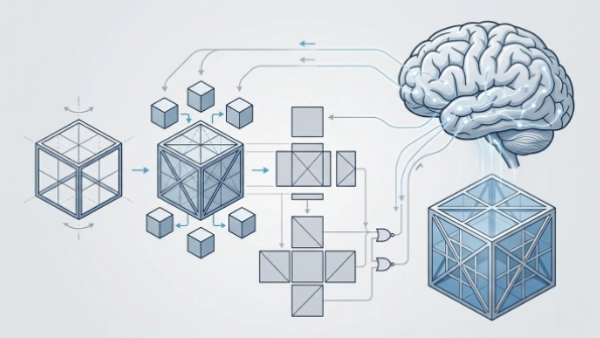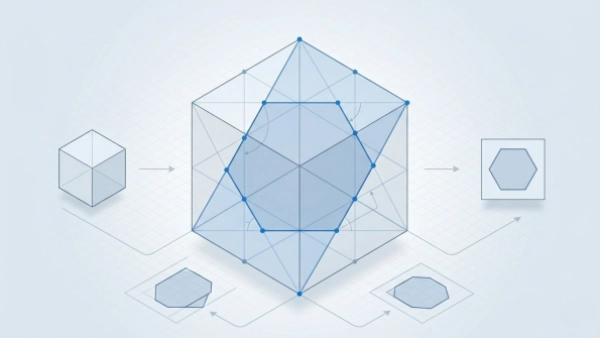
Mental rotation is one of the most fundamental skills in spatial intelligence. It allows you to turn objects in your mind, predict how they will look from new angles, and recognize structure despite changes in orientation.
This ability plays a central role in engineering, architecture, physics, surgery, mechanical design, aviation, and technical problem-solving. It also appears frequently in cognitive assessments and aptitude tests.
Yet for many people, mental rotation feels unstable and unreliable.
The good news: it is trainable. And like any skill, progress follows stages—from beginner confusion to advanced control.
This guide walks you through that progression step by step. Before diving into the stages, it helps to understand how the brain processes 3D space — the neural systems behind mental rotation explain why each stage of training works the way it does.
What Mental Rotation Really Is
Mental rotation is not vague imagination or casual daydreaming. It is a disciplined cognitive operation. When you rotate an object mentally, you are performing a controlled internal transformation governed by structural constraints.
The process follows a clear sequence:
- You construct a stable mental representation of an object.
- You apply a rotational change along a defined axis.
- You preserve structural relationships throughout the movement.
- You evaluate the transformed result against the target condition.
The critical word is preserve.
During a true rotation:
- Faces remain connected to the same neighboring faces.
- Edges retain their length and relationships.
- Proportions do not stretch or compress.
- Orientation changes, but structure does not.
If faces detach, proportions warp, or relationships shift incorrectly, the mental image has not rotated—it has collapsed and reassembled incorrectly.
This distinction explains why many people think they are rotating an object when they are actually reconstructing fragments of it. Mental rotation is continuous structural transformation, not reconstruction from memory.
At higher levels, it begins to feel less like imagination and more like controlled internal perception.
Stage 1: Beginner — Stabilizing the Image
At the beginner stage, instability is the dominant challenge.
Common experiences include:
- The object blurs midway through rotation.
- Faces disappear, duplicate, or swap positions incorrectly.
- The image “resets” suddenly.
- Confusion arises about whether the object moved or the viewer moved.
These reactions are normal. The brain is learning to coordinate visual working memory with spatial transformation. At this stage, cognitive load exceeds control.
The Real Goal of Stage 1
The objective is not speed.
It is stability.
A slow but stable rotation is far more valuable than a fast, distorted one. Precision precedes efficiency.
Why Instability Happens
Working memory can only hold a limited number of spatial elements simultaneously. When beginners attempt complex rotations, too many variables change at once. The brain loses structural coherence. This is the root cause behind most spatial logic failures — read more about why most people fail spatial logic questions for a complete breakdown of all the common mistakes.
Think of it like trying to spin a delicate model in the air without securing its joints. Without reinforcement, pieces separate.
Stability training reinforces those joints.
Beginner Techniques
1. Use Simple Shapes First
Start with:
- A cube with one marked face
- A rectangular prism
- A simple pyramid
Avoid composite or irregular objects initially. Every added feature increases working memory demand.
The brain needs repetition with minimal variables before complexity can be introduced safely.
2. Rotate in 90° Steps
Do not attempt full 180° or 270° turns immediately. Large rotations require maintaining multiple intermediate states simultaneously.
Instead:
- Rotate 90°. Pause. Stabilize.
- Rotate another 90°. Pause again.
Discrete steps prevent collapse.
Over time, the pauses become shorter and smoother.
3. Track One Feature Only
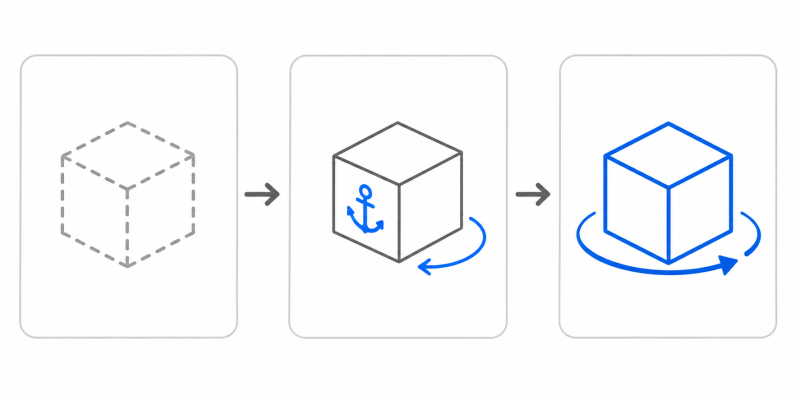
Rather than monitoring the entire object, select a single anchor:
- A colored face
- A distinct corner
- A specific edge
Follow only that feature during rotation. Once its path is clear, reconstruct surrounding relationships.
Selective tracking reduces overload.
4. Anchor Orientation
Define a consistent reference:
- “This face is the top.”
- “This edge is facing forward.”
Keep viewpoint constant unless explicitly practicing perspective shifts.
Most beginner confusion comes from unintentionally rotating both the object and the viewer.
At this stage, accuracy matters more than speed. Stability builds neural coordination. Speed emerges naturally once structure holds.
Stage 2: Intermediate — Controlling Transformations
When basic rotations remain stable, the next challenge is control under complexity.
At this level, individuals can rotate simple objects reliably, but difficulties arise when:
- Rotations compound across multiple axes
- Time pressure increases
- Distractor options resemble correct answers
- Adjacency relationships become harder to track
The issue is no longer collapse—it is precision.
The Goal of Stage 2
Maintain structural integrity while increasing transformation complexity.
This stage strengthens executive control over imagery.
Intermediate Techniques
1. Practice Multi-Axis Rotations
Introduce compound transformations:
- Rotate 90° horizontally.
- Then tilt 90° vertically.
- Then rotate backward.
Each axis shift forces recalibration of orientation mapping.
This improves coordination between spatial memory and transformation logic.
2. Train Invariant Awareness
After each movement, verify structural constants:
- Which faces are still adjacent?
- Did any relationship change that should not have?
- Is left–right consistency preserved?
Consciously checking invariants prevents subtle drift.
Over time, this becomes automatic.
3. Differentiate Rotation vs Reflection
Intermediate learners often misclassify mirrored versions as rotated ones.
Train deliberately:
- Compare a rotated cube to its mirror image.
- Identify what exactly reversed.
Reflections invert orientation relationships. Rotations do not.
Developing this sensitivity dramatically improves test performance.
4. Use Elimination Strategically
At this stage, logical reasoning complements visualization.
Instead of fully rotating every option:
- Remove answers that violate adjacency.
- Eliminate mirrored options when only rotation occurred.
- Discard structurally impossible configurations.
Visualization becomes more efficient when supported by logical filtering. Intermediate mastery means reliability — even when complexity increases. For a full elimination-based approach to spatial problems, read our step-by-step framework for solving 3D spatial problems.
Stage 3: Advanced — Fluid Dynamic Visualization
At the advanced stage, mental rotation becomes smooth and continuous.
Instead of discrete jumps, the object rotates fluidly. The structure feels solid. Orientation changes without distortion.
You no longer consciously track every edge; the entire structure moves coherently.
Advanced spatial thinkers can:
- Rotate irregular polyhedra
- Manipulate composite multi-block systems
- Combine rotation with folding or cutting
- Maintain clarity under strict time limits
- Switch between object-centered and viewer-centered perspectives
The Goal of Stage 3
Reduce cognitive strain while increasing complexity and speed.
Rotation transitions from effortful computation to controlled perception.
Advanced Techniques
1. Continuous Rotation Practice
Imagine smooth rotational motion rather than incremental shifts.
Observe:
- How faces gradually move out of view
- How hidden faces reappear
- How edges align during movement
Continuous motion strengthens dynamic stability.
2. Increase Structural Complexity
Introduce:
- Interlocking block structures
- Asymmetrical objects
- Mechanical assemblies
Complexity forces integration of multiple relational constraints simultaneously.
3. Combine Operations
Add folding, slicing, or perspective shifts mid-rotation.
For example:
- Rotate an object.
- Then imagine slicing it diagonally.
- Predict the cross-section.
Compound tasks simulate real-world spatial reasoning demands. For focused practice on the cross-section component specifically, see how to solve cross-section problems systematically.
4. Time-Constrained Drills
Gradually reduce allowed time while preserving accuracy.
Speed should emerge from stability—not from rushed guessing.
At this stage, rotation feels less like problem-solving and more like mental manipulation of a solid object in space.
The Most Common Bottlenecks
Cognitive Overload
Even advanced learners regress when object complexity exceeds working memory capacity.
Solution:
Simplify temporarily. Reintroduce stepwise control. Build complexity gradually.
Perspective Confusion
Rotating yourself instead of the object creates orientation errors.
Solution:
Fix viewpoint unless explicitly practicing perspective change.
Structural Drift
Small adjacency errors accumulate across compound rotations.
Solution:
Periodically reset and verify invariants.
A Practical Daily Practice Structure (15–20 Minutes)
For consistent improvement:
- 5 minutes: Basic single-axis cube rotations
- 5 minutes: Multi-axis compound rotations
- 5 minutes: Mixed spatial problems with elimination
- Optional 5 minutes: Timed advanced challenges
Consistency builds neural efficiency. Intensity is secondary. Within three to four weeks, most learners experience measurable gains in stability and speed. To follow a complete structured programme, see our 30-day spatial reasoning training plan.
Why Mental Rotation Feels So Difficult Initially
Reading and arithmetic receive years of structured training. Mental rotation rarely does.
As a result:
- The brain has capacity but lacks procedure.
- Imagery exists but lacks control.
This mismatch produces frustration:
- “I should be able to do this.”
- “Why does it keep flipping incorrectly?”
The issue is not intelligence.
It is unstructured processing.
Once structure is introduced—anchors, invariants, sequential control—improvement accelerates.
Mental Rotation in Professional Contexts
Advanced spatial control supports:
- Engineering design and prototyping
- Architecture and structural planning
- Surgical procedure planning
- Robotics and mechanical modeling
- Physics simulations
- Aviation and navigation
In these fields, errors are practical, not theoretical. Misjudging orientation can affect safety, efficiency, and cost.
Developing strong rotation skills increases confidence in high-stakes environments.
Signs You’re Improving
Progress may appear subtle, but indicators include:
- Reduced image collapse
- Faster identification of mirrored distractors
- Clearer awareness of adjacency
- Improved performance under time pressure
- Greater mental “solidity” during transformation
The shift from chaotic imagery to controlled rotation is unmistakable.
At first, you struggle to hold the object together.
Later, you guide it deliberately.
Eventually, you rotate it as smoothly as turning it in your hand.
That progression—from instability to fluidity—is the path to mastering mental rotation.
Final Insight
Mental rotation is not a talent reserved for a few. It is a cognitive system built through stages: Stability → Control → Fluidity.
Beginners struggle because they try to move too fast. Intermediates struggle because they skip structural checks. Advanced performers succeed because they combine imagery with invariants and sequence control. To understand how mental rotation fits within the broader picture of spatial intelligence, read about spatial intelligence vs logical and verbal intelligence.
Mastery is not about seeing everything instantly. It is about rotating deliberately, preserving structure, and refining control until transformation feels natural. And that progression is available to anyone willing to train.
When you feel ready to test your mental rotation skills under real time pressure, try our free 18-minute IQ exam — spatial and abstract reasoning questions included.