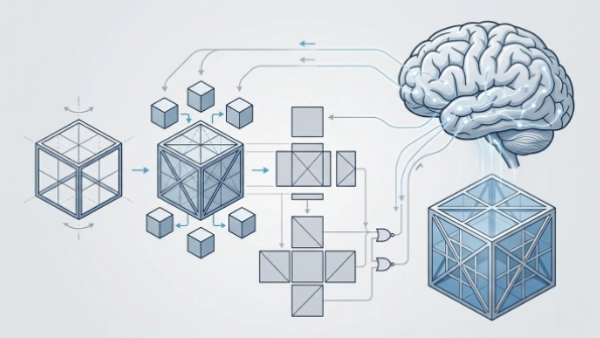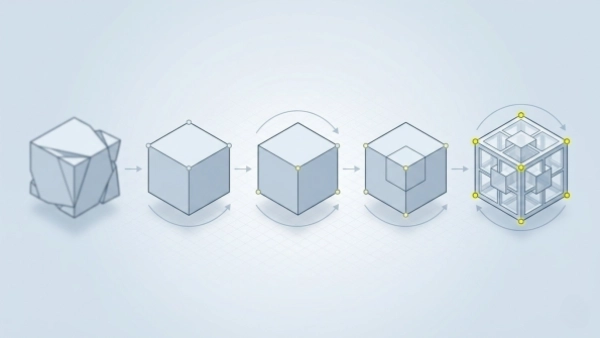
Spatial reasoning is not a fixed talent. It is a trainable cognitive skill built through repeated exposure to rotation, transformation, constraint tracking, and structural visualization.
The key to improvement is not intensity.
It is structured progression.
This 30-day plan gradually increases complexity, moving from basic mental rotation to dynamic, multi-step spatial reasoning. Each session takes about 15–25 minutes. Consistency matters more than duration.
How the Plan Works
This 30-day program is designed around progressive cognitive overload. You are not simply repeating the same task for a month. You are gradually increasing the demands placed on your spatial working memory, transformation accuracy, and structural reasoning.
The program develops five core components:
1. Mental Rotation
The ability to turn objects in your mind while preserving orientation and structure.
2. Perspective Shifting
The ability to imagine the same environment or object from different viewpoints without losing relational accuracy.
3. Cross-Section Reasoning
The ability to understand how planes intersect solids and predict resulting shapes logically.
4. Dynamic Spatial Updating
The ability to continuously track movement, rotation, or position changes in real time.
5. Constraint-Based Construction
The ability to reason within structural limits—understanding what is possible and impossible before testing.
Each week builds directly on the previous one. Week 1 stabilizes internal imagery. Week 2 introduces geometric constraints. Week 3 adds motion and sequential transformations. Week 4 applies everything to real-world tasks.
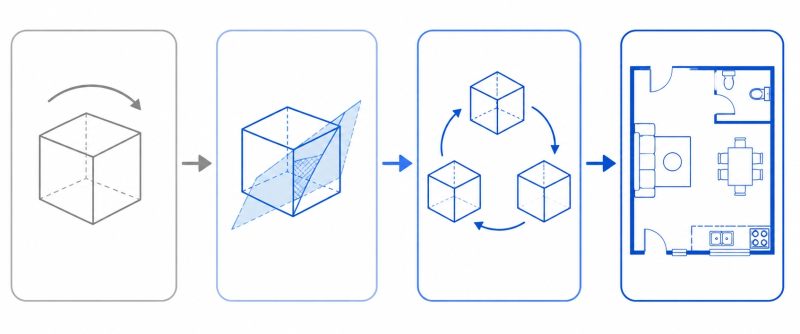
If your mental images are unstable in Week 1, adding complexity will only reinforce confusion. Precision first. Complexity second.
Week 1: Stabilizing Mental Rotation (Days 1–7)
Goal: Strengthen Single-Axis Rotation and Image Clarity
This week focuses on control. You are training clarity and stability—not speed or difficulty.
Many people believe they “can’t visualize.” In reality, their images are unstable and collapse under manipulation. Week 1 fixes that foundation.
Daily Exercise 1: Object Rotation (5–10 Minutes)
Choose one simple object:
- A cube
- A book
- A mug
- Your phone
Keep the object physically nearby at first if needed.
Mentally rotate it:
- 90° left
- 90° right
- 180°
- Upside down
Now add structure:
Pick one anchor point—a corner, logo, scratch mark, or edge.
Track that anchor continuously during rotation.
Do not allow:
- The image to blur
- Edges to distort
- Orientation to jump suddenly
If destabilization occurs, slow down the rotation. Smooth motion builds control.
By Day 5–7, you should notice reduced effort and clearer object boundaries. For a deeper breakdown of what's happening cognitively during this stage, read mastering mental rotation from beginner to advanced — it covers exactly the progression from instability to control.
Daily Exercise 2: Perspective Shifting (5–10 Minutes)
Choose a familiar environment—a desk, room, or hallway.
Imagine viewing it from:
- The doorway
- The ceiling
- Behind you
- Floor level
Important rule:
Focus on spatial relationships, not decorative details.
Track:
- Relative distances
- Object height differences
- Pathways
- Occlusion (what blocks what)
Perspective shifting trains viewpoint flexibility. This prevents rigid, single-angle visualization.
Weekly Challenge (Day 7)
Combine two transformations:
Example:
- Rotate 90° left
- Then flip vertically
Track final orientation precisely.
If you cannot maintain clarity, return to slower, simpler rotation and rebuild stability.
Week 2: Introducing Structural Constraints (Days 8–14)
Goal: Move from Free Rotation to Rule-Based Reasoning
In Week 1, you manipulated objects freely.
In Week 2, you must respect geometry.
Spatial reasoning becomes more powerful when governed by constraints.
Daily Exercise 1: Cross-Section Visualization (10 Minutes)
Imagine slicing:
- A cube diagonally
- A cylinder horizontally
- A cone vertically
Do not jump immediately to the final image.
Instead, ask:
- How many edges does the plane intersect?
- Are the intersections straight or curved?
- Does symmetry remain intact?
- Which faces are involved?
Count intersection points first.
Then build the shape logically.
This prevents guessing and trains structural deduction. For the full systematic method behind cross-section reasoning, see how to solve cross-section problems systematically.
Daily Exercise 2: 2D to 3D Translation (5–10 Minutes)
Draw simple 2D shapes:
- A square
- A triangle
- A basic floor plan
Then imagine extruding them upward into 3D volumes.
Alternatively:
Choose a simple object and sketch three orthographic views:
- Front
- Side
- Top
Converting between representations strengthens projection reasoning and structural mapping.
Weekly Challenge
Visualize a cube cut by a diagonal plane passing through exactly three edges.
Before imagining the full shape, determine:
- How many vertices does the cross-section have?
- What geometric constraints apply?
Then construct it mentally.
The goal is structured deduction—not fast guessing.
Week 3: Dynamic Spatial Updating (Days 15–21)
Goal: Add Motion and Multi-Step Transformations
Now your internal models must remain stable while moving.
Static visualization is simpler.
Dynamic updating increases cognitive demand significantly.
Daily Exercise 1: Sequential Rotations (10 Minutes)
Choose a cube or rectangular prism.
Apply three transformations in sequence:
- Rotate 90° left
- Flip vertically
- Rotate 180°
Track orientation continuously.
If you lose track:
- Reset
- Slow down
- Reduce to two transformations
Then rebuild complexity.
Sequential transformation strengthens working memory endurance. If you find this stage particularly difficult, the root causes are usually the same as those covered in why most people fail spatial logic questions — understanding those failure patterns helps you correct them faster.
Daily Exercise 2: Motion Simulation (5–10 Minutes)
Mentally simulate:
- A door swinging open
- A gear rotating and engaging another
- A drawer sliding outward
- A drone tilting, yawing, and pitching
Track:
- Direction
- Speed
- Spatial relationships
If overwhelmed, simplify the system first.
Motion multiplies demand because orientation changes constantly.
Weekly Challenge
Imagine walking through your home in reverse order, room by room.
Maintain:
- Correct orientation
- Relative distances
- Accurate layout
This trains allocentric spatial reasoning—the ability to maintain spatial maps independent of current viewpoint.
Week 4: Applied Spatial Reasoning (Days 22–30)
Goal: Integrate All Components into Real-World Tasks
This week emphasizes transfer. You are no longer practicing isolated drills. You are applying spatial logic to life contexts.
Day 22–23: Furniture Reconfiguration
Sketch a room layout.
Mentally rearrange furniture before moving anything.
Predict:
- Traffic flow
- Light distribution
- Clearance
- Visual balance
Then test physically.
Compare outcome with prediction.
Discrepancy equals growth opportunity.
Day 24–25: Navigation Awareness
Travel somewhere familiar.
Before checking navigation:
- Predict next turn
- Identify cardinal direction
- Estimate remaining distance
After arrival, sketch the route from memory.
Navigation strengthens dynamic updating and spatial mapping simultaneously.
Day 26–27: Digital or Physical Construction
Use:
- A simple 3D modeling tool
- A construction-based sandbox
- A physical model kit
Before placing pieces:
- Predict orientation
- Predict intersections
- Predict collision or fit
Digital feedback loops accelerate calibration.
Day 28–29: Complex Cross-Section Reasoning
Visualize slicing:
- A cube through four faces
- A cylinder diagonally
- A pyramid below the apex
Count intersection points first.
Then construct the shape step by step along the cutting plane.
Avoid guessing.
Day 30: Integration Test (No Time Pressure)
Combine everything:
- Mentally rotate a cube twice.
- Slice it diagonally.
- Imagine extruding the cross-section upward.
- Rotate the new shape again.
Track clarity throughout.
Precision matters more than speed. By this point, you should be applying the principles from our step-by-step framework for solving 3D spatial problems automatically — the framework and this plan are designed to reinforce each other.
How to Measure Progress
Progress often appears subtly:
- Images stabilize faster
- Rotations require less mental strain
- You recover from orientation errors quickly
- Cross-sections feel logical rather than confusing
- You estimate distance and fit more accurately
- Complex diagrams feel less overwhelming
Improvement is cumulative. Like physical coordination, gains compound gradually. To understand what real-world spatial skill looks like once developed, read spatial logic in real life: from architecture to surgery.
Common Mistakes to Avoid
- Rushing transformations
- Guessing instead of counting intersections
- Practicing inconsistently
- Avoiding difficult tasks
- Adding complexity before stability
Struggle is part of growth. Instability signals the edge of your current capacity.
Optional Advanced Extensions
After 30 days, increase difficulty gradually:
- Add time constraints
- Combine four or more transformations
- Practice non-orthogonal rotations
- Use irregular or asymmetric shapes
- Learn beginner CAD modeling
Only increase complexity once stability feels strong.
The Core Rule: Prediction Before Confirmation
Throughout all 30 days, follow one principle:
Predict first.
Then verify.
Before rotating, slicing, rearranging, navigating, or constructing—form a clear mental model.
The difference between expectation and reality refines spatial calibration.
Without prediction, there is no feedback.
Without feedback, there is no improvement.
Spatial reasoning strengthens when the mind learns to correct itself.
That correction is the engine of progress.
Final Thought
Spatial reasoning is not fixed. It is built through deliberate interaction with structure, transformation, and constraint.
In 30 days, you will not become an architect or surgeon — but you will notice greater mental stability, clearer internal visualization, and improved control over 3D transformations. Spatial intelligence grows the same way physical coordination does: repeated, structured movement through space. Train it consistently — and it will strengthen.
When you're ready to benchmark your improvement, our free IQ exam gives you a real test environment with spatial and abstract reasoning questions to measure where you stand.