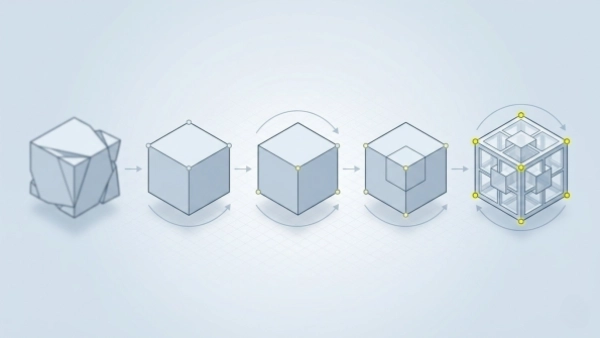
Three-dimensional spatial problems can feel intimidating—even for people who perform well in other types of reasoning. Cubes rotate, shapes fold, viewpoints shift, and suddenly the mental image collapses. Many mistakes come not from lack of intelligence, but from approaching spatial tasks without a clear method.
The good news is that 3D spatial reasoning follows consistent principles. When you apply a structured framework, these problems become predictable, manageable, and far less mentally exhausting. This article presents a step-by-step approach you can use across nearly all spatial problem types, from mental rotation to cross-sections and object assembly. Before diving in, it helps to understand how the brain processes 3D space — the neuroscience behind why this framework works the way it does.

Step 1: Identify the Exact Type of Spatial Task
Before attempting to visualize anything, stop and classify the problem. This pause is critical. Many spatial errors happen not because the visualization is poor, but because the brain is applying the wrong kind of transformation.
Different spatial tasks rely on different cognitive operations. When these operations are mixed up, the mental image quickly becomes unstable.
Ask yourself:
- Is the object itself rotating, or is only the viewpoint changing?
- Is the object being transformed (folded, cut, flipped), or does its structure remain unchanged?
- Am I comparing two static objects, or predicting what an object looks like after a sequence of actions?
Common categories include:
- Mental rotation, where the object changes orientation but not structure
- Perspective shifting, where the object stays fixed but your viewpoint moves
- Folding and unfolding, where flat surfaces form a 3D shape
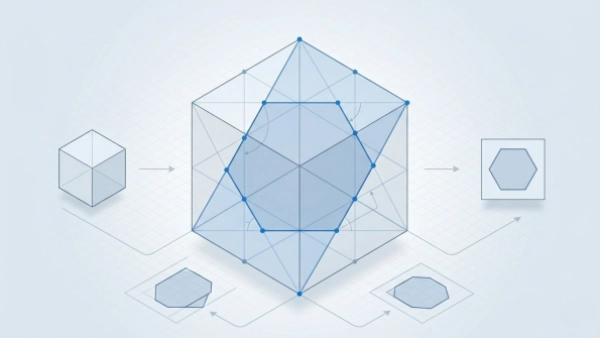
- Cross-sections, where a solid is sliced to reveal an internal shape
- Object assembly or disassembly, where parts combine or separate
Correct classification immediately narrows what kinds of changes are allowed and what must remain constant. This reduces ambiguity and prevents you from imagining impossible transformations. For a deeper look at mental rotation specifically, see our guide on mastering mental rotation from beginner to advanced.
Step 2: Establish a Stable Reference
Spatial problems often feel confusing because the mental image lacks a fixed reference point. Without an anchor, the object “floats” in the mind, making it easy to lose orientation or distort relationships.
Before performing any transformation, choose a clear and reliable anchor.
Effective anchors include:
- A uniquely marked face, color, or symbol
- A distinctive corner or edge
- A clearly defined “top,” “bottom,” “front,” or “back”
Once selected, the anchor must remain consistent throughout the problem. You do not rotate or reinterpret the anchor arbitrarily. Instead, you track how everything else moves relative to it.
Anchors serve as cognitive stabilizers. They dramatically reduce disorientation and help preserve structural accuracy during complex transformations.
Step 3: Constrain the Movement
Spatial problems become overwhelming when the brain attempts to manipulate the entire object at once. To avoid this, deliberately constrain the movement before visualizing anything.
Ask:
- How many axes are involved—one, two, or three?
- Is the movement a rotation, a flip, or a fold?
- Does the change occur in discrete steps or as a continuous motion?
Then apply transformations incrementally rather than globally. For example:
- Rotate an object 90° at a time instead of imagining a full 180° or 270° rotation
- Fold one edge or face before completing the entire shape
- Shift the viewpoint gradually rather than jumping to the final angle
The brain processes sequential changes far more reliably than large, simultaneous transformations. Constraining movement reduces cognitive load and preserves image clarity.
Step 4: Preserve Structural Invariants
One of the most important principles in spatial reasoning is recognizing what cannot change.
Even as objects rotate or move, certain properties remain invariant:
- Adjacency: which faces or edges touch
- Shape and proportions
- Relative positions of markings or features
- Number of faces, edges, or components
As you visualize, continuously check your mental image against these invariants. If two faces were adjacent before a rotation, they must remain adjacent afterward. If a problem involves only rotation, mirror images are automatically invalid.
Most incorrect answer choices violate at least one invariant. Once you learn to spot these violations, elimination becomes faster and more reliable than pure visualization. This principle is especially important when solving cross-section problems, where structural relationships are the primary source of constraint.
Step 5: Track One Feature at a Time
Attempting to follow every part of an object simultaneously overwhelms working memory. Instead, simplify the task by focusing on one critical feature and tracking it precisely.
Effective tracking targets include:
- A single marked face on a cube
- One distinctive corner across multiple rotations
- The path of a specific edge during folding
Once you know where that feature ends up, many answer choices can be eliminated immediately. You do not need a perfect image of the entire object—accurate tracking of one feature often provides enough information to determine the correct answer.
In spatial reasoning, precision is more valuable than completeness.
Step 6: Use Logical Elimination Before Full Visualization
Contrary to intuition, perfect visualization is rarely necessary. In many cases, logical elimination is more dependable than mental imagery alone.
Begin by removing options that:
- Show impossible face-to-face or edge-to-edge relationships
- Violate left–right or top–bottom consistency
- Ignore preserved structure or invariants
- Introduce reflections when only rotations or folds are allowed
This step transforms partial understanding into accurate problem-solving. It also protects against errors caused by fragile or unstable mental images. If you find elimination difficult, read why most people fail spatial logic questions — the root causes almost always trace back to skipping this step.
Step 7: Reconstruct Only If Necessary
If multiple options remain after elimination, reconstruct the final image carefully using all previous steps.
At this stage:
- Reconfirm your anchor
- Apply transformations sequentially and deliberately
- Continuously check invariants
- Avoid subconsciously “adjusting” the image to match an answer choice
If the image feels unstable or confusing, that is a signal to slow down—not to push through. Stability is a prerequisite for accuracy.
Step 8: Sanity-Check the Final Answer
Before committing, perform a quick consistency check:
- Does the result preserve all original relationships?
- Could the specified transformation realistically produce this outcome?
- Does the answer rely on a mirror flip when none was mentioned?
This final check often catches subtle errors caused by rushed or incomplete visualization.
Why This Framework Works
This framework aligns closely with how the brain naturally processes spatial information:
- Anchors prevent cognitive drift
- Sequential steps reduce working-memory overload
- Invariants provide logical constraints
- Elimination compensates for imperfect imagery
Rather than forcing the brain to “see everything at once,” the framework distributes the task across manageable, reliable operations.
Applying the Framework Across Problem Types
The same principles apply across all major spatial question formats:
- Mental rotation: Track a single face, rotate incrementally, verify adjacency
- Perspective shifting: Move the viewpoint rather than the object; remap left and right
- Folding problems: Identify hinge lines and preserve edge connections
- Cross-sections: Visualize the cutting plane and trace intersection paths
- Assembly tasks: Align components step by step and eliminate physically impossible fits
With repetition, this framework becomes automatic. Spatial problems feel less chaotic, require less effort, and produce more consistent results — transforming spatial reasoning from guesswork into a reliable skill. To build this automaticity through structured repetition, follow our 30-day spatial reasoning training plan.
Final Thoughts
3D spatial problems are not tests of raw talent—they are tests of method. When approached randomly, even strong thinkers struggle. When approached systematically, these problems become predictable and solvable.
By classifying the task, anchoring your perspective, constraining transformations, preserving invariants, and using logic strategically, you turn spatial reasoning from guesswork into a skill. Mastery does not come from trying harder to visualize — it comes from thinking more clearly about how space works. To understand the broader cognitive context, read about how spatial intelligence compares to logical and verbal intelligence.
Ready to test your spatial reasoning under real time pressure? Try our free 18-minute IQ exam — it includes spatial and abstract reasoning questions where this framework applies directly.