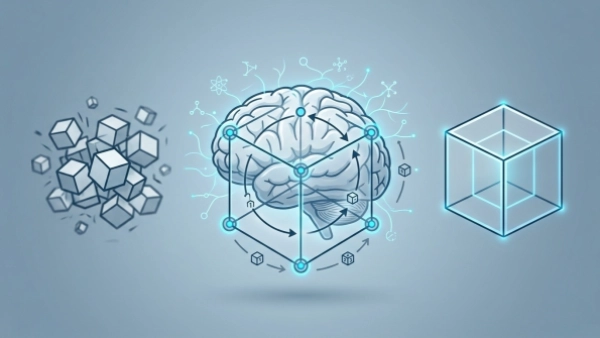
Intelligence is often discussed as a single trait, measured by scores, grades, or test performance. In reality, human intelligence is made up of multiple cognitive systems, each optimized for different kinds of problems. Among the most important—and most misunderstood—are spatial intelligence, logical intelligence, and verbal intelligence.
These forms of intelligence do not compete with one another. They operate differently, rely on different mental processes, and shine in different situations. Understanding how they compare helps explain why people with similar overall ability can excel in very different domains.
Three Ways the Mind Solves Problems
At a fundamental level, different forms of intelligence reflect how the brain represents information and operates on it. When people approach a problem, they are not only using different skills—they are often using entirely different internal formats for thinking.
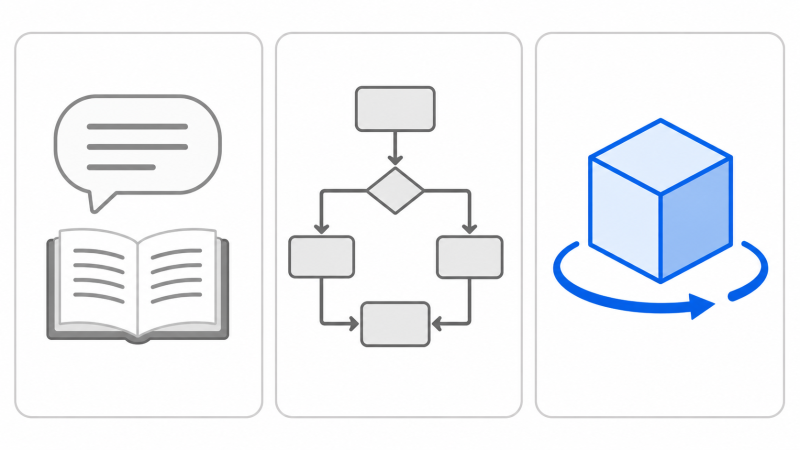
Broadly speaking, verbal, logical, and spatial intelligence correspond to three distinct ways the mind organizes and manipulates information:
- Verbal intelligence works primarily with language—words, grammar, meaning, and narrative structure.
- Logical intelligence works with abstract symbols, rules, patterns, and formal relationships.
- Spatial intelligence works with mental images, spatial layouts, transformations, and relative positions.
Each of these systems excels under certain conditions and struggles under others. No single system is universally superior. Instead, they represent different cognitive tools optimized for different types of problems.
Verbal Intelligence: Thinking in Words
Verbal intelligence is the ability to understand, interpret, and produce language. It supports reading comprehension, vocabulary acquisition, argument analysis, and the clear expression of complex ideas.
People with strong verbal intelligence tend to process information through inner speech. They think in sentences, reason through language, and often clarify their thoughts by putting them into words.
Common characteristics include:
- Learning most effectively through reading, lectures, and discussion
- Explaining reasoning step by step using language
- Noticing subtle differences in wording, tone, or meaning
- Remembering information in verbal or narrative form
Verbal reasoning excels in domains where ideas can be described, categorized, and debated through language. Fields such as law, literature, education, journalism, and philosophy rely heavily on verbal intelligence.
However, verbal intelligence has clear limitations. Some problems do not translate cleanly into words. When relationships are highly visual, dynamic, or spatially complex, verbal descriptions can become cumbersome or ambiguous. In these cases, language may obscure understanding rather than enhance it. Our verbal intelligence guide covers how to develop this skill systematically for IQ and aptitude tests.
Logical Intelligence: Thinking in Rules and Structures
Logical intelligence involves reasoning through formal systems. It focuses on identifying patterns, applying rules, and following structured sequences of thought. This form of intelligence is closely associated with mathematics, formal logic, computer science, and analytical problem-solving.
People strong in logical intelligence often:
- Detect patterns and regularities quickly
- Break complex problems into ordered steps
- Apply known rules or formulas to unfamiliar situations
- Identify contradictions, inconsistencies or faulty assumptions
Logical reasoning performs best when problems have clear constraints and explicit rules. Algebraic manipulation, mathematical proofs, coding, and structured logic puzzles all reward this style of thinking.
Its limitations become apparent when problems are ill-defined, visually complex, or require internal simulation rather than rule application. A person may understand every rule involved and still struggle if the task requires imagining how an object changes shape, orientation, or position in space.
Logical intelligence alone does not guarantee strong spatial performance, just as fluency in grammar does not guarantee visual insight. To explore how logical and abstract thinking differ in practice, read abstract reasoning vs logical reasoning — what's the difference.
Spatial Intelligence: Thinking in Images and Transformations
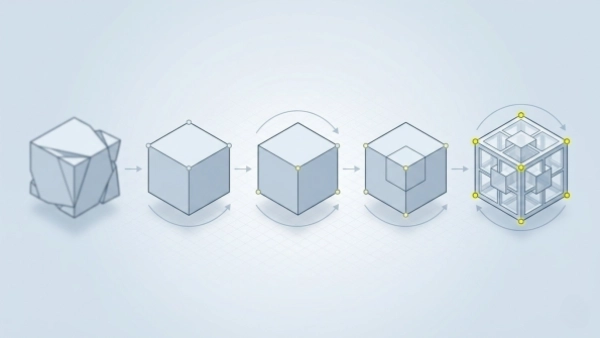
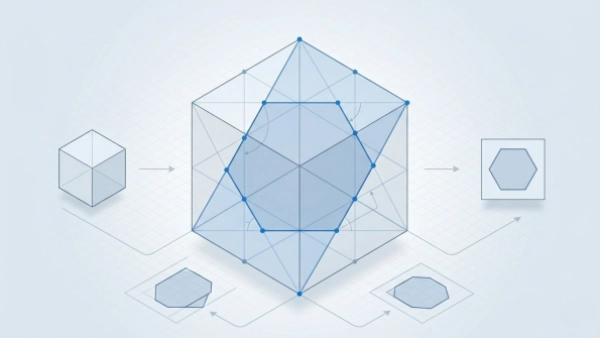
Spatial intelligence is the ability to mentally represent objects, relationships, and movements in space. It allows the mind to visualize structures, rotate objects, fold surfaces, rearrange components, and navigate environments without physical movement.
People with strong spatial intelligence often:
- Think in images rather than words
- Understand systems by visualizing how parts fit together
- Grasp geometry and physical relationships intuitively
- Predict how objects will look after transformation
Spatial reasoning is essential in fields such as engineering, architecture, physics, surgery, design, animation, and navigation. It also plays a central role in everyday problem-solving, from assembling furniture to understanding maps and diagrams.
Unlike verbal and logical reasoning, spatial intelligence often operates below conscious language. Spatial thinkers may arrive at correct solutions quickly, guided by internal imagery, but struggle to explain their reasoning step by step. The insight feels immediate rather than sequential.
This does not reflect a lack of rigor — it reflects a different cognitive pathway. To understand the neuroscience behind why this happens, read our article on how the brain processes 3D space.
Why These Intelligences Feel So Different
The key difference between these forms of intelligence lies in representation—the internal format the brain uses to think.
- Verbal intelligence represents ideas as words, meanings, and linguistic structures.
- Logical intelligence represents problems as symbols, rules, and formal relationships.
- Spatial intelligence represents information as mental images, layouts, and transformations.
Because these representations are fundamentally different, strength in one domain does not automatically transfer to another. A person may reason fluently in equations yet struggle to imagine a 3D object from a new angle. Another may visualize complex systems effortlessly but find symbolic proofs tedious and unintuitive.
This is not a contradiction or a deficiency. It is an example of cognitive specialization—the brain optimizing different systems for different tasks.
Performance in Testing and Assessment
Standardized tests tend to emphasize verbal and logical reasoning because these abilities are easier to measure, score, and explain. Spatial intelligence, however, plays a unique and important role in cognitive assessment.
Spatial tasks are particularly effective at measuring fluid intelligence—the ability to reason with novel, unfamiliar information. These tasks typically:
- Depend less on memorized knowledge
- Resist shortcut strategies and rote learning
- Require real-time mental construction and transformation
For a deeper explanation of fluid intelligence and how it relates to cognitive training, read our science-based article on whether abstract reasoning can be improved.
For this reason, spatial reasoning appears frequently in technical aptitude tests, engineering admissions, and certain IQ assessments. It captures aspects of intelligence that cannot be fully expressed through words or formulas. To see spatial reasoning in action in a real test format, explore our spatial logic guide for strategies and practice.
Why Spatial Intelligence Is Often Undervalued
Traditional education relies heavily on language. Concepts are explained verbally, assessed through writing, and reinforced through symbolic notation. As a result, students with strong verbal skills often appear more academically capable, even when spatial understanding is equally critical.
This imbalance can lead to common misconceptions:
- Spatial thinkers may be labeled as “intuitive” rather than analytical
- Difficulty with verbal explanation may be mistaken for shallow understanding
- Visual and spatial problem-solving may be underrecognized or underdeveloped
Yet in many professions, spatial intelligence is not optional — it is foundational. If you find spatial tasks difficult, it is very likely a training gap rather than a talent gap. Read why most people fail spatial logic questions and how to fix it for a direct, practical answer.
How the Intelligences Work Together
In real-world problem-solving, the most effective thinkers combine all three forms of intelligence.
For example:
- An engineer may visualize a system spatially, analyze it logically, and communicate it verbally.
- A surgeon may plan movements spatially, follow logical procedures, and interpret verbal data.
- A scientist may imagine structures visually, test hypotheses logically, and publish results verbally.
Rather than ranking intelligences, it is more accurate to view them as complementary cognitive tools, each contributing something essential.
Implications for Learning and Development
Understanding these differences has important practical implications.
- Struggling with verbal explanations does not indicate low intelligence.
- Difficulty with spatial tasks often reflects lack of training rather than lack of ability.
- Learning is most effective when information is presented in multiple formats—visual, verbal, and symbolic.
Spatial intelligence, in particular, is highly trainable. With consistent practice, mental images become more stable, transformations become faster, and visualization becomes more precise. Our guide to mastering mental rotation is a strong starting point for building this skill from scratch.
Recognizing and nurturing all three forms of intelligence leads to more accurate assessment, better education, and a deeper appreciation of how diverse minds solve problems. For the bigger picture of what IQ tests measure across all these domains, see our IQ basics 101 guide.
Final Thoughts
Spatial, logical, and verbal intelligence represent different ways the human mind engages with the world. Each excels under different conditions, and each reveals something unique about how people think.
Recognizing these differences allows for fairer assessment, better education, and deeper respect for diverse cognitive strengths. Intelligence is not one-dimensional — and understanding that fact is itself a form of intelligence. To measure where your own strengths lie, try our free IQ exam.