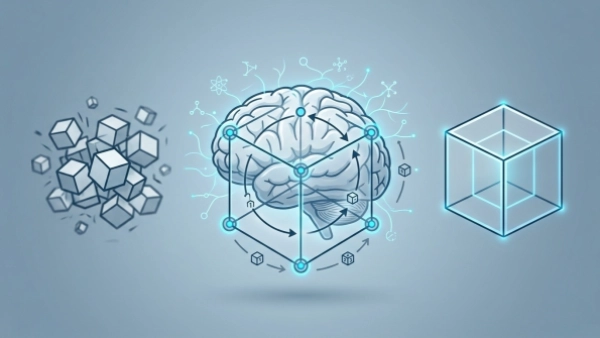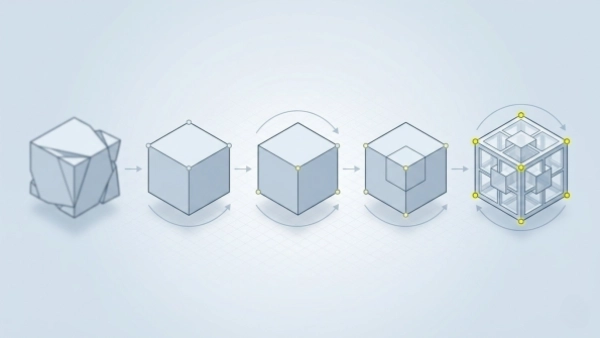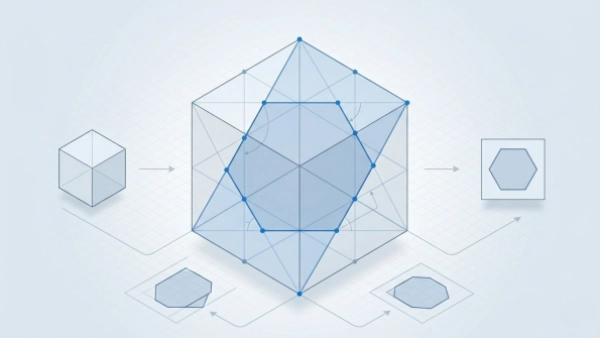
When you imagine rotating a cube in your mind, walking through an unfamiliar building, or visualizing how a flat sheet of paper folds into a box, your brain is performing an impressive feat. It is constructing, transforming, and maintaining a three-dimensional model of space—entirely without physical movement.
This ability, often referred to as spatial processing, is a core function of human cognition. It supports everything from navigation and tool use to engineering, art, and scientific reasoning. Understanding how the brain processes 3D space not only explains why certain tasks feel mentally demanding, but also reveals why spatial skills can be trained and improved with practice.
The Brain Does Not “See” 3D Space—It Builds It
Contrary to intuition, the brain does not receive a ready-made 3D picture of the world. The visual information entering the eyes is fundamentally two-dimensional. Depth, distance, and spatial relationships must be inferred.
To construct a 3D representation, the brain integrates multiple sources of information, including:
- Differences between the images seen by each eye
- Changes in object size and clarity with distance
- Motion cues as the head or body moves
- Learned assumptions about geometry and perspective
These signals are combined into a mental model that allows you to judge how objects relate to one another in space. This process happens so smoothly that it feels effortless—until the brain is pushed beyond familiar situations.
Key Brain Systems Involved in 3D Spatial Processing
Spatial reasoning is not localized to a single “spatial center.” Instead, it emerges from coordinated activity across several brain regions.
Visual Processing Pathways
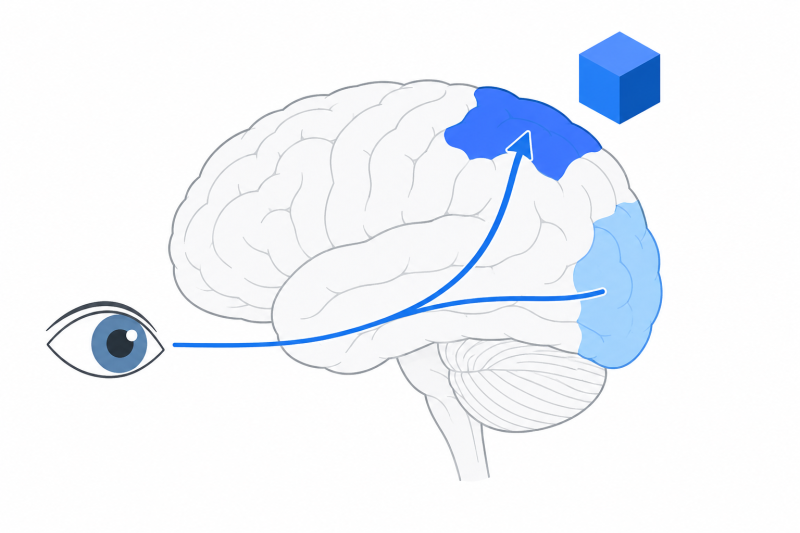
After basic visual features such as color and edges are detected, information flows through two major processing streams:
- A pathway focused on object identity (“what” an object is)
- A pathway focused on spatial location and movement (“where” an object is)
The second pathway plays a central role in 3D processing. It helps determine where objects are located relative to each other and how they move through space.
The Parietal Cortex: Spatial Integration Hub
The parietal region of the brain acts as a spatial integration center. It combines visual input with body position, movement, and orientation. This allows you to understand space not just visually, but in relation to yourself.
When you mentally rotate an object, imagine viewing it from another angle, or track how parts of an object relate to one another, this region is heavily engaged.
Working Memory and Spatial Manipulation
Holding a 3D object in mind requires working memory. The brain must temporarily store spatial information while actively transforming it—rotating, folding, or re-orienting it without losing internal consistency.
This is why complex spatial tasks feel mentally exhausting. They place sustained demands on attention, memory, and visualization at the same time.
Mental Rotation: A Window Into Spatial Thinking
One of the most studied spatial abilities is mental rotation—the ability to imagine how an object appears after being rotated in space.
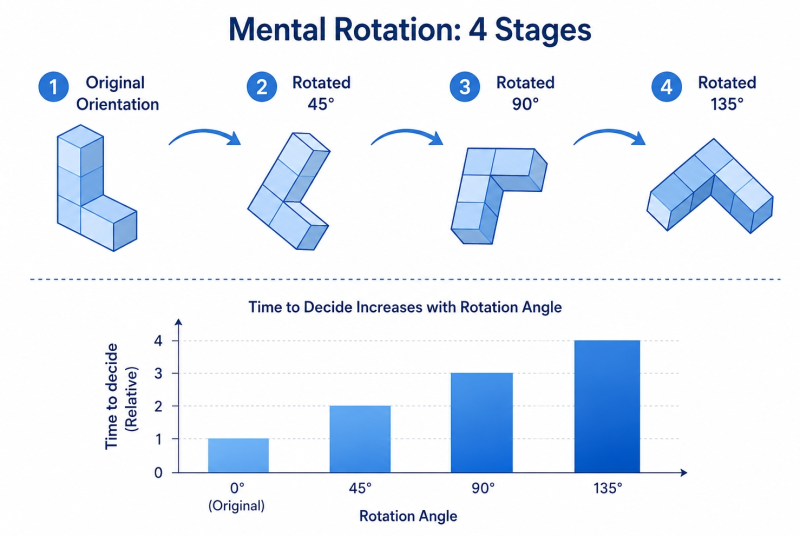
Research shows that mental rotation behaves in a surprisingly physical way. The more an object must be rotated, the longer it takes for people to decide whether two shapes are the same. This suggests that the brain performs a step-by-step transformation rather than an instant comparison.
Importantly, mental rotation does not involve reshaping the object. The brain preserves structural relationships while updating orientation. Errors occur when people unintentionally distort the object during this process. To build this skill practically, read our guide on mastering mental rotation from beginner to advanced.
Perspective Shifting: Moving the Mind, Not the Object
Another essential spatial skill is perspective shifting. In these tasks, the object remains fixed, but your viewpoint changes.
To do this successfully, the brain must suppress the original viewpoint and construct a new one. This requires:
- Keeping track of which surfaces would now be visible
- Understanding which parts are hidden
- Re-mapping left and right from the new position
Perspective shifting is especially challenging because it conflicts with the brain's tendency to anchor itself to a default orientation. This is why people often confuse left and right when imagining views from behind or below an object. Our guide on how to solve cross-section problems systematically applies this principle directly to test questions.
Why Spatial Tasks Feel Hard (Even for Smart People)
Spatial reasoning relies less on rules and formulas and more on internal simulation. Unlike verbal or numerical problems, there is often no clear sequence of steps to follow. Instead, success depends on the stability of the mental image.
Several factors increase difficulty:
- Multiple transformations performed without reset
- Loss of reference points during rotation
- High working-memory load
- Time pressure
When these demands exceed cognitive capacity, the mental image degrades. Parts may "drift," flip incorrectly, or lose alignment — leading to errors even when the underlying logic is sound. This is precisely why most people fail spatial logic questions — not from lack of ability, but from working-memory overload.
Training Changes How the Brain Handles Space
The encouraging reality is that spatial processing is highly plastic. Training does not merely improve performance—it changes how efficiently the brain allocates resources.
With practice:
- Mental images become more stable
- Transformations require less conscious effort
- The brain relies more on pattern recognition and less on brute-force simulation
- Processing speed increases without sacrificing accuracy
This is why experienced engineers, designers, and surgeons often report that complex spatial tasks feel intuitive. Their brains have learned to compress information and reuse efficient internal representations. For a structured training plan based on this principle, see our 30-day spatial reasoning training plan.
Visualization vs. Verbal Reasoning: Different Strengths, Different Systems
Spatial thinkers often struggle to explain how they reached an answer. This is because spatial reasoning operates largely outside verbal language.
Verbal reasoning relies on symbolic manipulation and explicit rules. Spatial reasoning relies on visual-motor simulation and internal imagery. Neither is inherently superior, but they excel in different domains.
Strong spatial ability is particularly valuable when:
- Problems involve unfamiliar structures
- Solutions require predicting transformations
- Information cannot be easily verbalized
Understanding this distinction helps explain why traditional education sometimes undervalues spatial intelligence, despite its importance in many technical and creative fields.
For comparison, see how spatial reasoning relates to abstract reasoning — another nonverbal cognitive skill that overlaps with but differs from spatial intelligence.
Implications for Learning and Performance
Understanding how the brain processes 3D space leads to practical insights for learning and improvement:
- Early practice should emphasize accuracy and image stability over speed
- Anchors and fixed reference points reduce working-memory load
- Breaking transformations into steps aligns with natural neural processing
- External tools—sketches, models, diagrams—can scaffold internal visualization
Most importantly, difficulty with spatial tasks does not indicate low ability. It usually reflects high demand on systems that improve rapidly with targeted, structured training. For a practical method that aligns with these neural principles, read our step-by-step framework for solving 3D spatial problems.
Spatial reasoning is not a fixed trait. It is a cognitive skill grounded in adaptable neural systems—systems that respond strongly to practice, feedback, and thoughtful engagement.
Final Thoughts
The human brain was not designed to solve abstract 3D puzzles on paper—yet it can learn to do so remarkably well. Spatial reasoning emerges from coordinated neural systems that build, manipulate, and maintain internal models of space.
By understanding how these systems work, we gain more than academic insight. We gain practical strategies for improving visualization, reducing errors, and developing a skill set that underlies some of the most powerful forms of human problem-solving.
Spatial ability is not a fixed trait. It is a trainable function of the brain — and one that rewards patience, structure, and thoughtful practice. To explore how spatial intelligence compares to other cognitive skills, read about spatial intelligence vs logical and verbal intelligence. And to see your own spatial reasoning in action, try our free IQ exam.