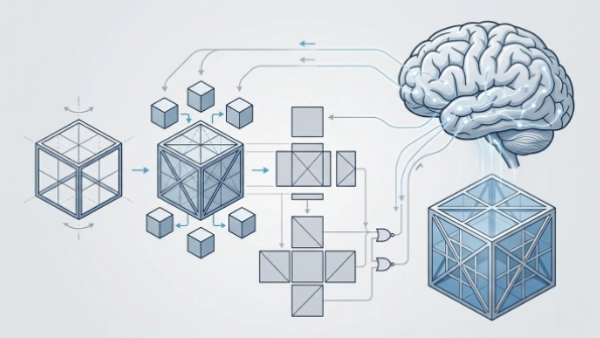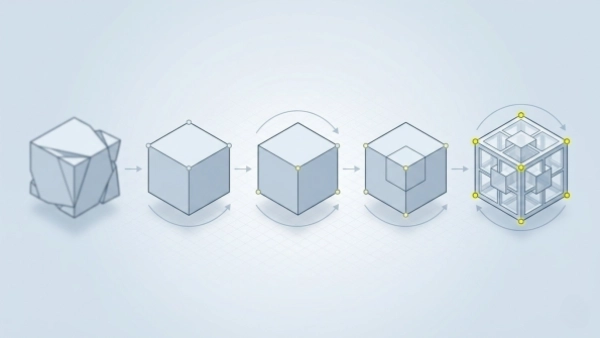
Spatial logic is not just an abstract skill tested in IQ exams or puzzle books. It is a practical cognitive ability that shapes how we design buildings, navigate cities, perform surgery, and even pack a suitcase efficiently.
At its core, spatial logic is the ability to understand relationships between objects in three-dimensional space and to reason about transformations, orientation, structure, and constraints. It allows you to mentally rotate, slice, assemble, and predict how physical systems behave.
In the real world, this skill is everywhere.
What Spatial Logic Really Means
Spatial logic combines several mental operations:
- Visualizing 3D objects internally
- Tracking transformations (rotation, reflection, scaling)
- Understanding structural constraints
- Predicting hidden relationships
- Reasoning about intersections and alignments
Unlike pure imagination, spatial logic is structured. It follows rules of geometry, physics, and proportion. You are not “picturing randomly.” You are mentally simulating based on constraints.
That distinction is what makes it powerful in professional fields.
Architecture: Designing What Does Not Yet Exist
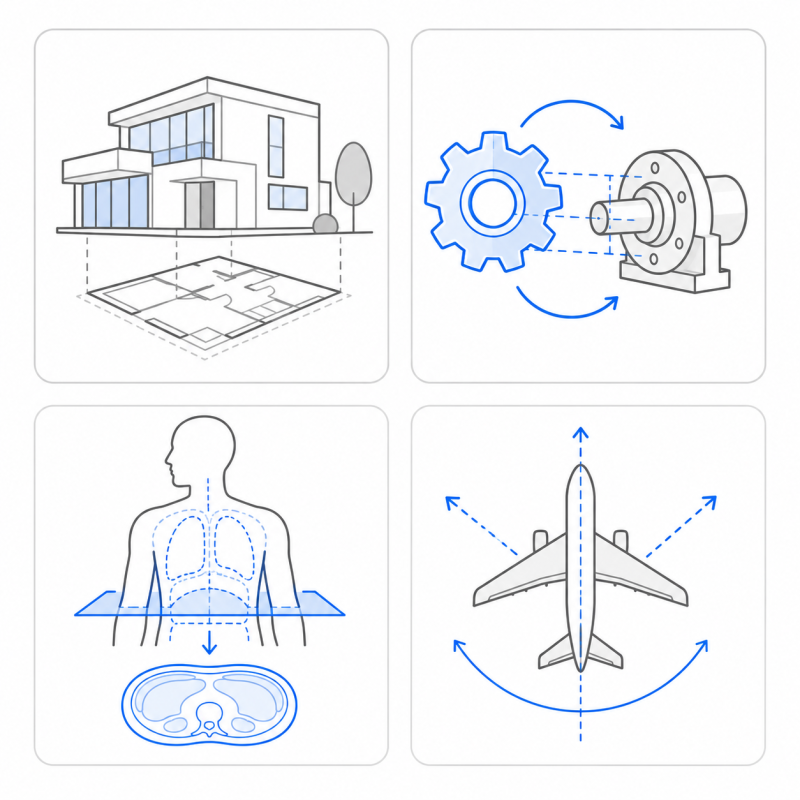
In architecture, spatial logic is not optional—it is foundational.
Architects are not simply illustrators producing attractive facades. They are spatial strategists who must mentally construct buildings long before the first brick is laid. Every design decision requires internal simulation across structure, light, circulation, and proportion.
An architect must continuously model:
- How structural loads travel from roof to foundation
- How beams, slabs, and columns interact
- How interior volumes connect and flow
- How vertical and horizontal circulation systems integrate
- How light enters, reflects, diffuses, and shifts throughout the day
- How humans experience compression, openness, direction, and scale
These are not aesthetic guesses. They are spatial predictions governed by geometry and physics.
Consider the Guggenheim Museum Bilbao, designed by Frank Gehry. Its flowing metallic surfaces appear sculptural and organic, but beneath that appearance lies extraordinary spatial reasoning. The design required understanding how curved surfaces intersect, how non-orthogonal planes meet, and how complex forms maintain structural integrity.
Even in modest residential projects, spatial logic is constantly at work:
- If a staircase rotates 90 degrees, how does that affect head clearance?
- If a ceiling drops 30 centimeters, how does it alter perceived volume?
- If a wall shifts 50 centimeters, how does that reshape furniture layout and movement patterns?
- If a window changes orientation, how does seasonal sunlight behave?
Every modification propagates consequences throughout the system.
Architects often describe "walking through" buildings mentally. This mental walkthrough is not imaginative storytelling — it is structured 3D simulation under constraints. To understand the cognitive mechanics behind this process, read how the brain processes 3D space.
Engineering: Managing Invisible Forces
If architecture shapes space, engineering ensures it survives reality.
Engineers rely on spatial logic to predict behavior under stress, motion, heat, and load. Much of their work involves forces that cannot be seen directly.
Mechanical engineers mentally track:
- Rotating shafts and torque distribution
- Gear engagement and clearance tolerances
- Thermal expansion within tight assemblies
- Interlocking moving components
They must predict how parts interact before prototypes exist.
Civil engineers visualize how bridges transfer weight from deck to cables to towers to foundations. They simulate bending moments and stress concentrations across three-dimensional structures.
Electrical engineers must imagine how wiring pathways snake through walls, panels, and enclosures without conflict. In high-density systems, millimeters matter.
Software engineers working in 3D modeling, robotics, augmented reality, or simulation environments manipulate virtual objects with the same precision. Whether designing collision detection in a physics engine or programming robotic arm articulation, spatial constraints must be calculated and respected.
Without strong spatial logic, small oversights compound quickly:
- A misaligned tolerance causes mechanical failure.
- An underestimated load results in structural fatigue.
- A routing conflict creates assembly delays.
Engineering is spatial reasoning made tangible.
Surgery: Navigating the Human Body
Few professions demand more precise spatial judgment than surgery.
Surgeons operate within a dynamic, living 3D environment where visibility is often limited and structures are densely packed. They must convert 2D imaging—CT scans, MRIs, ultrasound slices—into coherent 3D anatomical maps.
They must understand:
- Relative positioning of arteries, veins, and nerves
- Layered tissue structures
- Depth relationships hidden from direct view
- How tissue displacement affects surrounding organs
In minimally invasive procedures, surgeons rely on camera feeds displayed on screens while manipulating long instruments through small incisions. Hand movement direction may not match visual orientation. Depth perception is mediated by imaging systems.
This requires continuous spatial recalibration.
A slight misjudgment in orientation or depth can damage critical structures. Spatial reasoning here is not theoretical—it is life-critical.
Surgeons often describe building “mental maps” of the operative field. That map is constantly updated as tissue shifts or visibility changes.
Spatial logic becomes embodied precision.
Aviation and Navigation: Thinking in Motion
Spatial reasoning becomes even more demanding when motion is involved.
Pilots must constantly track:
- Aircraft orientation relative to the horizon
- Pitch, roll, and yaw simultaneously
- Wind vectors and drift angles
- Descent trajectories and glide slopes
- Relative positions of other aircraft
In poor visibility, visual cues disappear. Pilots rely entirely on instrument data to reconstruct their orientation mentally. This process, known as instrument flight, demands disciplined spatial updating.
Ship captains interpret currents, wind, and navigational charts. Drone operators coordinate camera perspective, altitude, and movement simultaneously.
Unlike static spatial problems, these environments change continuously. The mental model must update in real time.
Spatial logic under motion is dynamic prediction.
Everyday Life: Small Decisions, Constantly
You do not need professional training to engage spatial logic. You use it every day, often unconsciously.
You use it when you:
- Parallel park in a tight space
- Rearrange furniture in a room
- Assemble flat-pack furniture
- Load a dishwasher efficiently
- Organize shelves or storage units
- Estimate whether an object fits through a doorway
Even cooking involves spatial reasoning—judging how ingredients fit in a pan or how slicing alters structure.
These micro-decisions rely on the same cognitive systems architects and surgeons use—just at different levels of complexity.
The brain does not distinguish between “simple” and “advanced” spatial logic. It scales the same processes.
Why Spatial Logic Is Often Undervalued
Traditional education systems emphasize verbal fluency and symbolic mathematics. Spatial reasoning is often treated as secondary or artistic rather than analytical.
Yet cognitive science research repeatedly shows that spatial ability strongly predicts performance in STEM disciplines. Many scientific breakthroughs depend on the ability to visualize transformations and structural relationships.
Theoretical physicists frequently describe “seeing” equations geometrically. Engineers sketch force diagrams to understand abstract relationships. Surgeons construct mental anatomical maps. Architects mentally inhabit buildings that do not yet exist.
Spatial logic is not aesthetic intuition. It is structured predictive reasoning under constraint.
The Cognitive Mechanics Behind Spatial Logic
Spatial reasoning draws heavily on:
- Mental rotation (transforming objects internally)
- Working memory (holding multiple spatial elements simultaneously)
- Attention control (filtering irrelevant details)
- Pattern recognition (identifying symmetry and structure)
- Constraint tracking (maintaining geometric rules)
Experts reduce cognitive strain by applying strategies:
- Anchoring reference points before rotating objects
- Counting intersections before imagining full shapes
- Breaking complex systems into manageable subsystems
- Tracking boundaries and constraints explicitly
Rather than relying on vague visualization, they rely on structured reasoning. This is what separates novices from professionals. The most common reason people struggle with spatial tasks is not lack of ability but lack of strategy — see why most people fail spatial logic questions for a direct analysis of the most common mistakes.
How Spatial Logic Transfers Across Fields
One of the most powerful features of spatial ability is transferability.
A student practicing 3D geometry strengthens mental operations that later support:
- Architectural design studios
- Mechanical engineering modeling
- Surgical training simulations
- Robotics programming
- Animation and game development
- Industrial design
Improving spatial logic builds cognitive infrastructure that supports multiple domains.
It is not niche training. It is foundational mental architecture.
Can Spatial Logic Be Improved?
Yes—and significantly.
Research shows that structured practice enhances spatial ability across age groups. Effective training methods include:
- Mental rotation exercises
- Cross-section problem solving
- 3D model building (physical or digital)
- Technical drawing and drafting
- Computer-aided design (CAD)
- Robotics kits and assembly tasks
- Spatially demanding puzzle or construction games
The key is constraint-based practice. Improvement does not come from vague visualization but from repeated exposure to structured transformation problems. To start building this skill systematically, our guides on mastering mental rotation, solving cross-section problems, and the step-by-step framework for 3D spatial problems are excellent starting points.
Over time:
- Working memory load decreases
- Transformation speed increases
- Errors decrease
- Internal models become more stable
Spatial thinking becomes automatic and precise.
From Abstract Skill to Real-World Power
Spatial logic bridges imagination and reality.
It allows humans to:
- Design buildings that stand safely
- Engineer machines that function reliably
- Perform surgeries with precision
- Navigate airspace securely
- Construct infrastructure that endures
It transforms invisible structure into predictable outcomes.
When you mentally rotate a cube, slice a 3D shape, or reorganize a room, you are exercising a cognitive system that underpins architecture, engineering, medicine, aviation, and countless other fields.
Spatial logic is not merely about "seeing in 3D." It is about thinking structurally in three dimensions — and applying that thinking where consequences matter. And in the real world, they almost always do.
To understand how spatial intelligence compares to other cognitive strengths, read about spatial intelligence vs logical and verbal intelligence. And to see where your own spatial reasoning stands today, take our free IQ exam.