Most people associate spatial logic with IQ tests, timed puzzles, or abstract shape-rotation questions. While those tools measure spatial ability, they are not the only—or even the best—way to develop it.
Spatial logic is a practical cognitive skill. It improves when you regularly manipulate, predict, and reason about three-dimensional relationships in meaningful contexts.
You don’t need test sheets.
You need structured exposure to space.
Below is a practical, test-free framework for building spatial intelligence in everyday life.
First: Understand What You’re Actually Training
Before you try to improve spatial logic, you need to understand what it really is.
Spatial logic is not vague imagination or “being good at visualizing.” It is a collection of specific, trainable mental operations that work together to help you reason about three-dimensional relationships.
These operations include:
- Mental rotation – turning objects in your mind without physically moving them
- Perspective shifting – imagining the same object from a different viewpoint
- Tracking intersections – understanding where planes, edges, or surfaces meet
- Predicting structural constraints – knowing what shapes are possible or impossible
- Mapping 2D to 3D – converting flat drawings into volumetric objects
- Dynamic updating – continuously adjusting position as objects move
Each of these is a distinct cognitive function. If you want to improve spatial ability, you must deliberately challenge these components—not just “picture things harder.”
Passive visualization does not create growth.
Active manipulation does.
The difference is crucial:
- Passive: “I can kind of see it.”
- Active: “I can rotate it, slice it, predict it, and verify it.”
Improvement begins when you move from vague imagery to controlled transformation. To understand exactly what the brain is doing during these operations at a neurological level, read how the brain processes 3D space.
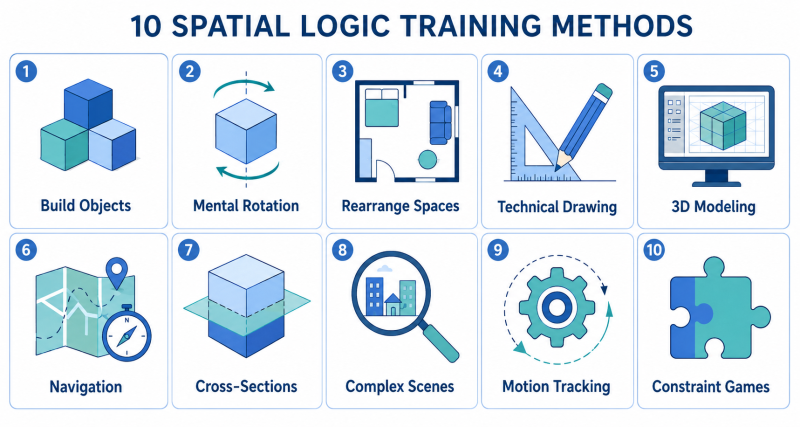
1. Build and Manipulate Physical Objects
Physical construction remains one of the most powerful forms of spatial training because it forces real constraint-based reasoning.
Try working with:
- Building block structures
- Mechanical model kits
- Modular construction systems
- Wooden interlocking puzzles
- Geometric solids that must align precisely
But don’t assemble passively.
Before placing each piece, pause and ask:
- How must this rotate to fit?
- Which hidden surfaces will align?
- Where will edges meet?
- What will become invisible once connected?
Make a prediction first.
Then test it.
If your prediction fails, analyze why. Did you misjudge orientation? Overlook a hidden face? Miscalculate symmetry?
That moment—where your expectation meets reality—is where spatial calibration improves. The brain adjusts its internal model to reduce future error.
Over time, predictions become faster and more accurate.
2. Practice Mental Rotation in Daily Life
You don’t need worksheets to train rotation. Everyday objects are sufficient.
Look around you and deliberately practice:
- Mentally flipping your laptop upside down
- Rotating your phone 90°, 180°, 270°
- Turning a coffee mug so the handle shifts position
- Imagining your room viewed from the ceiling
At first, the image may feel unstable, blurry, or incomplete. That instability is not failure—it is your current working memory limit being exposed.
The goal is stabilization.
Hold the image longer. Rotate it slowly. Track one anchor point (like a corner or edge) throughout the transformation.
Advanced variation:
- Rotate an object 90° left.
- Then flip it vertically.
- Then rotate it again.
Track the final orientation precisely without physically moving the object.
Sequential transformations dramatically increase cognitive load — and therefore training intensity. For a structured progression from basic to advanced mental rotation, see our dedicated guide on mastering mental rotation from beginner to advanced.
3. Rearrange Real Spaces Intentionally
Rearranging furniture is applied spatial reasoning in its purest form.
Before moving anything:
- Sketch a rough layout of the room.
- Mark fixed constraints (doors, windows, outlets).
- Predict walking paths.
- Estimate clearance distances.
- Visualize visual balance and scale.
Then execute the move.
Afterward, reflect:
- Did proportions feel different than expected?
- Did traffic flow improve or worsen?
- Did lighting change more than predicted?
These mismatches between expectation and reality sharpen spatial accuracy.
Over time, you’ll notice improved ability to judge distance, fit, and proportion without measurement.
4. Learn Basic Technical Drawing
You do not need architectural training to benefit from drafting.
Drawing forces precision in spatial thinking.
Practice:
- Sketching cubes in perspective
- Drawing cylinders with correct ellipses
- Representing objects from front, side, and top views
- Converting floor plans into volumetric forms
- Drawing cross-sections of boxes
The critical skill is translation between representations.
When you convert 2D into 3D, you strengthen your internal structural model. When you convert 3D into 2D, you strengthen projection reasoning.
Even rough sketches build neural pathways that passive viewing cannot.
5. Use Digital 3D Tools
Digital environments accelerate spatial training because feedback is immediate.
Try:
- Beginner-friendly 3D modeling tools
- Entry-level CAD software
- Construction sandbox games
- Virtual level-building systems
But avoid blind trial-and-error.
Before placing or rotating an object:
- Predict its orientation.
- Anticipate intersections.
- Estimate whether parts will collide.
Then test.
The rapid feedback loop strengthens calibration quickly. You see instantly whether your prediction matched reality.
Digital environments also allow perspective switching—zooming, orbiting, slicing—which strengthens flexibility in viewpoint transformation.
6. Train Through Navigation Awareness
Navigation is dynamic spatial updating.
Instead of passively following GPS:
- Predict turns before they occur.
- Mentally track cardinal direction.
- Estimate distance traveled.
- Reconstruct your path after arrival.
- Sketch the route from memory.
Occasionally navigate without assistance.
This strengthens allocentric spatial reasoning—the ability to understand the environment independently of your current viewpoint.
You move from “I follow directions” to “I understand the map.”
7. Practice Cross-Section Thinking
Cross-sections are powerful because they force you to think about hidden structure.
Practice mentally slicing:
- A loaf of bread at different angles
- A cylinder diagonally
- A cone horizontally
- A multi-story building vertically
Ask:
- How many intersection edges appear?
- Are edges straight or curved?
- Does symmetry remain?
- What shape results?
Instead of guessing the final shape, count intersections and apply geometric constraints. This builds structural reasoning over intuition. For a full systematic method, read how to solve cross-section problems systematically.
8. Slow Down Complex Visual Scenes
When viewing complex machinery, architecture, or dense environments, slow down and decompose.
Identify:
- Primary load-bearing elements
- Symmetry axes
- Repeating modules
- Moving vs fixed components
- Hidden supports
This analytical decomposition transforms visual overwhelm into structured understanding.
With repetition, pattern recognition improves. Your brain starts detecting structural logic automatically.
9. Add Motion to Static Objects
Advanced spatial logic includes motion tracking.
Practice imagining:
- A door swinging open and closing
- A gear rotating and engaging another
- A drawer sliding out
- A drone pitching, rolling, and yawing
Track all relevant components simultaneously.
If overwhelmed, simplify:
- Focus on one axis of rotation.
- Add complexity gradually.
Motion multiplies cognitive demand. Mastering it significantly upgrades spatial skill.
10. Use Constraint-Based Games (Not Just IQ Tests)
Certain games naturally build spatial reasoning:
- Construction-based sandbox systems
- Strategy games involving terrain planning
- Puzzle games requiring perspective shifts
- Physical board games involving spatial planning
The key factor is constraint.
Unstructured creativity alone is less effective than problem-solving within rules. Constraints force you to reason, not just imagine.
Why Tests Alone Don’t Build Deep Skill
IQ-style spatial tests often measure speed under time pressure. They can improve recognition patterns but may not develop deep structural understanding.
Real-world spatial logic requires:
- Multi-step transformations
- Error detection
- Structural constraint tracking
- Stable internal models
- Accuracy under complexity
Training in varied, real contexts builds transferable skill rather than test-specific shortcuts. If you want to understand what the most common strategy failures look like in actual test conditions, read why most people fail spatial logic questions and how to fix it.
A Weekly Training Structure (No Tests Required)
A balanced schedule might look like:
- Day 1: Physical building or model assembly
- Day 2: Mental rotation exercises (10–15 minutes)
- Day 3: Perspective and cross-section drawing
- Day 4: Digital 3D modeling practice
- Day 5: Navigation awareness training
- Day 6: Cross-section visualization challenges
- Day 7: Light review or observational decomposition
Consistency matters more than intensity. Small daily exposure beats occasional long sessions. For a fully structured 30-day programme built on the same principles, see our 30-day spatial reasoning training plan.
Signs Your Spatial Logic Is Improving
You may begin to notice:
- Faster mental rotation
- Clearer, more stable internal images
- Improved directional awareness
- Better fit and scale estimation
- Reduced confusion with technical diagrams
- Increased comfort using 3D software
Progress is gradual but cumulative. Improvements often appear subtle at first.
The Core Principle: Predict Before Acting
All effective spatial training shares one principle:
Predict first.
Then verify.
Whether rotating an object, rearranging furniture, placing a digital model, or navigating a route—form a clear mental prediction before execution.
The discrepancy between expectation and outcome refines your internal model.
Without prediction, there is no calibration.
From Test Skill to Life Skill
Spatial logic is not reserved for architects, engineers, or surgeons. It supports:
- Design
- Construction
- Navigation
- Sports performance
- Mechanical repair
- Everyday organization
You do not need IQ tests to develop spatial logic. You need consistent, structured engagement with three-dimensional space. The more deliberately you manipulate, rotate, slice, predict, and update spatial relationships, the stronger your internal modeling system becomes.
And unlike a test score, that improvement directly enhances how you interact with the real world. To see how these skills translate into test performance, explore our step-by-step framework for solving 3D spatial problems. And to understand where spatial intelligence fits alongside other cognitive skills, read about spatial intelligence vs logical and verbal intelligence.
When you're ready to benchmark your spatial reasoning against real test conditions, try our free 18-minute IQ exam — the results will show you exactly which spatial skills to prioritize next.