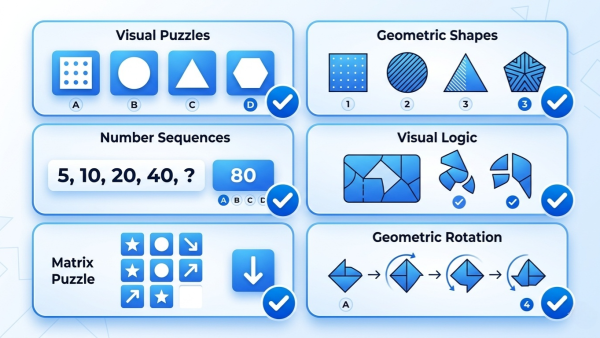
Spatial reasoning is a key cognitive skill that allows you to visualize, manipulate, and understand objects in space. It plays an essential role in IQ-style tests, technical problem-solving, and real-world tasks such as navigation, design, and engineering.
The good news is that spatial reasoning is highly trainable. With the right exercises and consistent practice, you can improve quickly.
This guide provides 15 practical spatial reasoning exercises designed to strengthen your visualization skills, improve accuracy, and increase problem-solving speed.
What Is Spatial Reasoning?
Spatial reasoning is the ability to:
- Mentally rotate objects
- Visualize shapes in different orientations
- Understand how parts fit together
- Analyze 2D and 3D structures
These skills are commonly tested in IQ questions involving shapes, patterns, and object transformations.
Why Spatial Practice Matters
Improving spatial reasoning helps you:
- Solve visual puzzles faster
- Reduce errors in shape-based questions
- Improve logical thinking
- Perform better in IQ and aptitude tests
- Enhance real-world skills like design and navigation
15 Spatial Reasoning Exercises
1. Mental Rotation Practice
Visualize a shape rotating 90° or 180°.
Goal: Improve your ability to track orientation changes.
2. Shape Matching
Identify which option matches a rotated version of a given shape.
Goal: Recognize shapes despite transformations.
3. Mirror Reflection
Determine how a shape looks when reflected across a vertical or horizontal axis.
Goal: Strengthen symmetry recognition.
4. Cube Counting
Count the number of cubes in a 3D stacked structure.
Goal: Improve depth perception and hidden object detection.
5. Net to 3D Shape
Visualize how a flat net folds into a 3D object.
Goal: Understand spatial construction.
6. 3D Rotation Sequences
Track how a 3D object changes across multiple rotations.
Goal: Improve multi-step visualization.
7. Pattern Completion (Spatial)
Complete a visual pattern based on spatial transformations.
Goal: Combine logic with visualization.
8. Cross-Section Analysis
Determine the shape formed when an object is cut.
Goal: Understand internal structures.
9. Block Assembly
Identify how smaller blocks combine to form a larger shape.
Goal: Improve structural reasoning.
10. Perspective Changes
Recognize how an object looks from different viewpoints.
Goal: Build flexible visualization skills.
11. Hidden Shape Detection
Find a simple shape within a complex image.
Goal: Improve visual filtering ability.
12. Path Tracing
Follow a path through a 3D or layered structure.
Goal: Strengthen spatial tracking.
13. Folding and Hole Punching
Predict the result of folding paper and punching holes.
Goal: Develop transformation prediction skills.
14. Symmetry Identification
Determine whether a shape has symmetry.
Goal: Improve pattern recognition.
15. Object Transformation Sequences
Track multiple changes such as rotation, reflection, and resizing.
Goal: Combine multiple spatial rules efficiently.
How to Practice Effectively
1. Start With Simple Shapes
Begin with basic 2D objects before moving to complex 3D structures.
2. Focus on One Skill at a Time
Practice rotation, reflection, or visualization separately before combining them.
3. Use Step-by-Step Thinking
Break each problem into small steps:
- Identify the transformation
- Apply it mentally
- Verify the result
4. Practice Daily
Even 10–15 minutes per day can lead to noticeable improvement.
5. Add Time Constraints Later
Once comfortable, introduce time limits to improve speed and test readiness.
Sample Practice Question
Question:
A cube is rotated 90° clockwise. Which option shows the correct new position?
Approach:
- Track visible faces
- Follow rotation direction
- Eliminate incorrect options
Common Mistakes to Avoid
Avoid these common errors:
- Guessing without visualization
- Ignoring rotation direction
- Overcomplicating simple transformations
- Not practicing consistently
- Skipping review of mistakes
How Fast Can You Improve?
With consistent practice:
- Week 1: Better understanding of spatial transformations
- Week 2–3: Improved accuracy
- Week 4+: Faster visualization and confidence
Spatial reasoning improves quickly with repetition.
Real-World Benefits of Spatial Skills
Spatial reasoning is valuable in:
- Engineering and architecture
- Graphic design and art
- Gaming and navigation
- Problem-solving and analysis
These skills go far beyond IQ tests.
Build Your Spatial Skills Step by Step
To improve efficiently:
- Practice regularly
- Focus on key transformations
- Learn from mistakes
- Gradually increase difficulty
Over time, your brain will process spatial information faster and more accurately.
Start Training Today
Use these 15 exercises as a structured training plan. With consistency and focus, you can significantly improve your spatial reasoning skills and perform better on IQ-style questions.