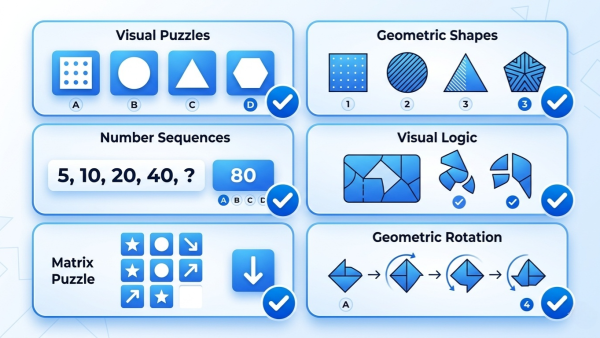
If you want to improve your performance on IQ-style tests, the first step is understanding the different types of questions you’ll encounter. Most IQ questions are not random—they follow specific patterns and are designed to evaluate distinct cognitive skills.
By learning how each question type works, you can approach problems more efficiently and avoid unnecessary confusion. This guide breaks down the 10 most common IQ question types, along with simple examples and explanations to help you practice effectively.
1. Abstract Reasoning (Matrix Questions)
Abstract reasoning questions are among the most common in IQ tests. They usually present a grid of shapes or symbols with one missing element.
What it tests:
- Pattern recognition
- Logical consistency
- Visual reasoning
Example:
A 3×3 grid shows shapes changing across rows and columns. The final square is missing.
How to solve:
Look for patterns in:
- Shape transformation
- Rotation
- Number of elements
2. Number Series (Numerical Patterns)
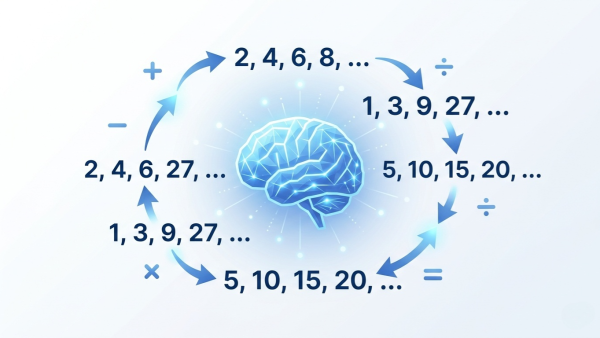
These questions ask you to find the next number in a sequence.
What it tests:
- Numerical reasoning
- Pattern detection
- Logical progression
Example:
2, 4, 8, 16, ?
Explanation:
Each number doubles → next is 32
3. Verbal Analogies
Verbal analogies test relationships between words.
What it tests:
- Vocabulary
- Logical relationships
- Language reasoning
Example:
Bird is to Fly as Fish is to ______?
Answer: Swim
4. Classification (Odd One Out)
You are given a group of items and must identify which one does not belong.
What it tests:
- Logical grouping
- Concept recognition
- Pattern breaking
Example:
Apple, Banana, Carrot, Mango
Answer: Carrot (vegetable, others are fruits)
5. Logical Deduction
These questions involve statements or conditions, and you must draw a correct conclusion.
What it tests:
- Critical thinking
- Deductive reasoning
- Logical consistency
Example:
- All cats are animals.
- All animals have cells.
Conclusion: All cats have cells
6. Spatial Reasoning (3D Visualization)
These questions involve shapes, rotations, or folding patterns.
What it tests:
- Visualization
- Mental rotation
- Spatial awareness
Example:
Which 3D object results from folding a cube net?
How to solve:
Mentally fold the shape and track how faces connect.
7. Coding and Decoding
You are given a rule that transforms letters or numbers, and you must apply it.
What it tests:
- Pattern application
- Logical transformation
- Attention to detail
Example:
If CAT → DBU, then DOG → ?
Explanation:
Each letter shifts +1 → EPH
8. Direction Sense Questions
These questions test your ability to track movement and orientation.
What it tests:
- Spatial awareness
- Logical tracking
- Attention to direction
Example:
A person walks 10 meters north, then 5 meters east. Where are they now?
Answer: Northeast of the starting point
9. Series Completion (Shapes or Symbols)
Similar to number series, but uses visual elements.
What it tests:
- Visual sequencing
- Pattern recognition
- Rule identification
Example:
A sequence of shapes rotates 90° each step.
Answer: The next shape continues the rotation pattern
10. Problem Solving (Mixed Logic Questions)
These are more complex questions that combine multiple reasoning skills.
What it tests:
- Multi-step thinking
- Analytical reasoning
- Flexibility
Example:
If 3 machines make 3 items in 3 minutes, how long do 6 machines take to make 6 items?
Answer: 3 minutes (same rate)
How to Approach Different IQ Question Types
Understanding the type of question is often half the solution. Once you recognize the pattern, you can apply the right strategy.
Key Tips
- Identify the question type first
- Look for patterns before calculating
- Eliminate incorrect options quickly
- Stay consistent in your logic
Why Learning Question Types Improves Performance
When you practice IQ questions without understanding their structure, progress can be slow. But when you recognize patterns across question types, your brain starts to process information more efficiently.
This leads to:
- Faster response times
- Higher accuracy
- Better confidence during tests
Build Your Skills With Structured Practice
The best way to master these question types is through consistent practice. Focus on one type at a time, then gradually mix them to simulate real test conditions.
If you want to improve further, explore more practice IQ questions with detailed explanations and train your brain step by step.
Final Thoughts
IQ questions are not about memorization—they are about recognizing patterns, applying logic, and thinking clearly under pressure. By understanding the most common question types, you give yourself a strong foundation for continuous improvement.
Start practicing regularly, stay curious, and focus on learning from each question you solve.